
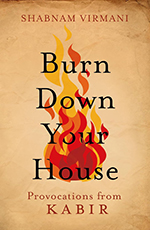
A book of rare worth, Burn Down Your House: Provocations from Kabir is a gem in the truest sense of the word. Deceptively simple, the writing glows with a depth of distilled profundity and ineluctable wisdom. It is a book that cuts through the available scholarly discourse on Kabir and shines pin-pointed light on the essential ideas that animate this radical poet’s verse. Virmani’s inwardness with Kabir, her intuitive hold on the poet’s genius for simultaneously inhabiting multiple dimensions of meaning, and the resulting power that this confers on his verse lends this book the immediacy and clarity of an epiphany.
As Virmani confesses in the Author’s Note, to say less is perhaps the most difficult task. The brief to write a pithy introduction to the poetic ideas of Kabir for the English reader which she accepted proved to be ‘an arduous churning’. Journeying with Kabir as she has for over two decades, it must have been immensely challenging to fine tune a distilled selection of ideas from her intimate understanding of the vast reservoir of his poems, songs and insights, the various Kabirpanthis she has known and all the different practices surrounding Kabir: performative and scholarly, with which she has closely interacted. Besides performing Kabir songs herself, Virmani has not only travelled all over the country and worked with the different panthis but has also made four documentary films on Kabir that journey across geographic, linguistic, cultural and psychological borders and barriers.
Virmani discusses the implicit association of ideas in Kabir’s dohas fused by powerful metaphors, and the organic interconnectedness of themes such as love, longing, social critique and spiritual seeking. Often Kabir’s scathing social critique is embedded in the yearning for spiritual oneness. His penetrating understanding of the fickle mind with its endless continuum of illusory desires and a never-fulfilled lack in the innermost being figures with references to death: metaphorical and physical. Virmani guides the reader through the process of visualizing the connection between these ideas by mapping selections of poems grouped into different thematic chapters, each titled with a line from a well-known doha. With verve and uncluttered lucidity, she allows the reader to discover for herself a sampling of Kabir’s poems under a dedicated theme. Thus, for instance, the first chapter titled, ‘Take the Bitter Pill’ (Katuk Vachan Kabir ke), shows through a selection of poems how Kabir ‘pierces self-satisfied spirituality, pious homilies, the posturing and regurgitated second-hand truths heard from here and there’. In cryptic flamboyance, Kabir presents an urgent vision of devastation:
The market is plundered
The city is littered with the dead.
A fire rages in the sky.
The sun and moon have burnt away and so have nine million stars.
Wake up now, traveller, there’s no time to lose.
Terming his poems ‘provocations’ (this word also serves as the title of the book), Virmani draws attention to how, if read with vulnerability and openness, they have the ability to shear off the thick hide of our complacency:
Just half a poem
Could slice off your head
If you ponder and grapple with it
No wisdom will arise
By chanting hundreds
Day and night.
Each of these chapters, a well-knit nugget of verse and commentary on a specific theme, is an exercise in cognitive understanding and mindful awareness of the self’s frailties and delusions. The dohas hold a mirror to the limited awareness in human beings of what constitutes the fundamentally real and significant. Take for instance the chapter titled ‘Play the Game of Death’, in which Virmani narrates the apocryphal story of Kabir’s answer to a King’s query on how he liked the magnificent palace to which everyone had been invited. ‘It’s quite nice, except for two flaws,’ Kabir is remembered to have said: ‘one, that it is going to crumble and fall. And two, that the owner will have to leave it.’
Why so cocky, asks Kabir
Sure, your mansion is world class
Soon it will be flat on its face
And overrun with grass.
And, again in another doha, Kabir makes short work of human illusions and pretensions:
What to say of this world, Kabir
Now bitter, now sweet
Yesterday, your wedding banquet
Today, your funeral feast.
A word now on sources and translations. As clearly perceptible from the quoted excerpts of the poems, Virmani’s translations are focused on capturing the spontaneous wit and crackling immediacy of Kabir’s vani. Towards this end, she dispenses with debates on literary translation; her endeavour is to get as close as possible to the lived, current idiom in the English translation so as to bring Kabir to non-Hindi audiences. However, the original poem of every translated doha is included in the appendix titled ‘Original Hindi Poems’ at the end of the volume. This inclusion is a boon to the lay reader who is then able to read the translation together with the original, a wonderfully enabling exercise always. In her introductory note to the book, Virmani states that Kabir’s original poems too have been tweaked occasionally: where a more contemporary word in Hindi affords the same meaning, the older inaccessible word has been replaced by the simpler and more easily understood Hindi word. The intention is to make Kabir’s poems, originals and translations, lucid and easily available to the reader.
Virmani lists seven collections of Kabir poems edited by different scholars or performing groups. These texts are not her only sources, however. Making no claim that her selection is representative of a historically defined Kabir, or that the poems under consideration are from manuscripts closer to the ‘real’ Kabir and therefore more ‘authentic’, she draws from diverse sources heard and practiced in the vast oral traditions that focalize on this poet.
Virmani cautions us, therefore, on trying to pin down the definitive original poem and offer a definitive meaning of a doha and its metaphors. Even as a set of Kabir’s poems are consecrated as ‘shabd’, ‘the word of the guru’ in the Guru Granth Sahib and preserved there is unchanging and immutable, millions of people across India keep the poems alive in a living continuous tradition, a ‘vast Kabirian commons’ in which they have become co-creators and participants. This, she claims, is a shape-shifting body of oral literature which reflects a social ethos that includes diversity of sources and expressions in the tradition of Kabir.
The terse acuity and wisdom of the poems, matched by Virmani’s incisive, hard-hitting and unfailingly insightful commentary is impossible to condense in a short review such as the present. A reviewer can only urge the reader to pick up this absolutely important book to begin the slow process of comprehending not only the layered deceptions of her own self, but also the never-assuaged yearning for communion with an unalloyed source of nurturing love.
Rohini Mokashi-Punekar teaches at the Department of Humanities and Social Sciences, Indian Institute of Technology, Guwahati. She is the author of On the Threshold: Songs of Chokhamela (The Book Review Literary Trust 2002, and Altamira Press 2005), Untouchable Saints: An Indian Phenomenon (Manohar, 2005) which she co-edited with Eleanor Zelliot, Vikram Seth: An Introduction (Cambridge University Press, 2008) and The Third Eye and Other Works: Mahatma Phule’s Writings on Education (Orient BlackSwan, 2023).