
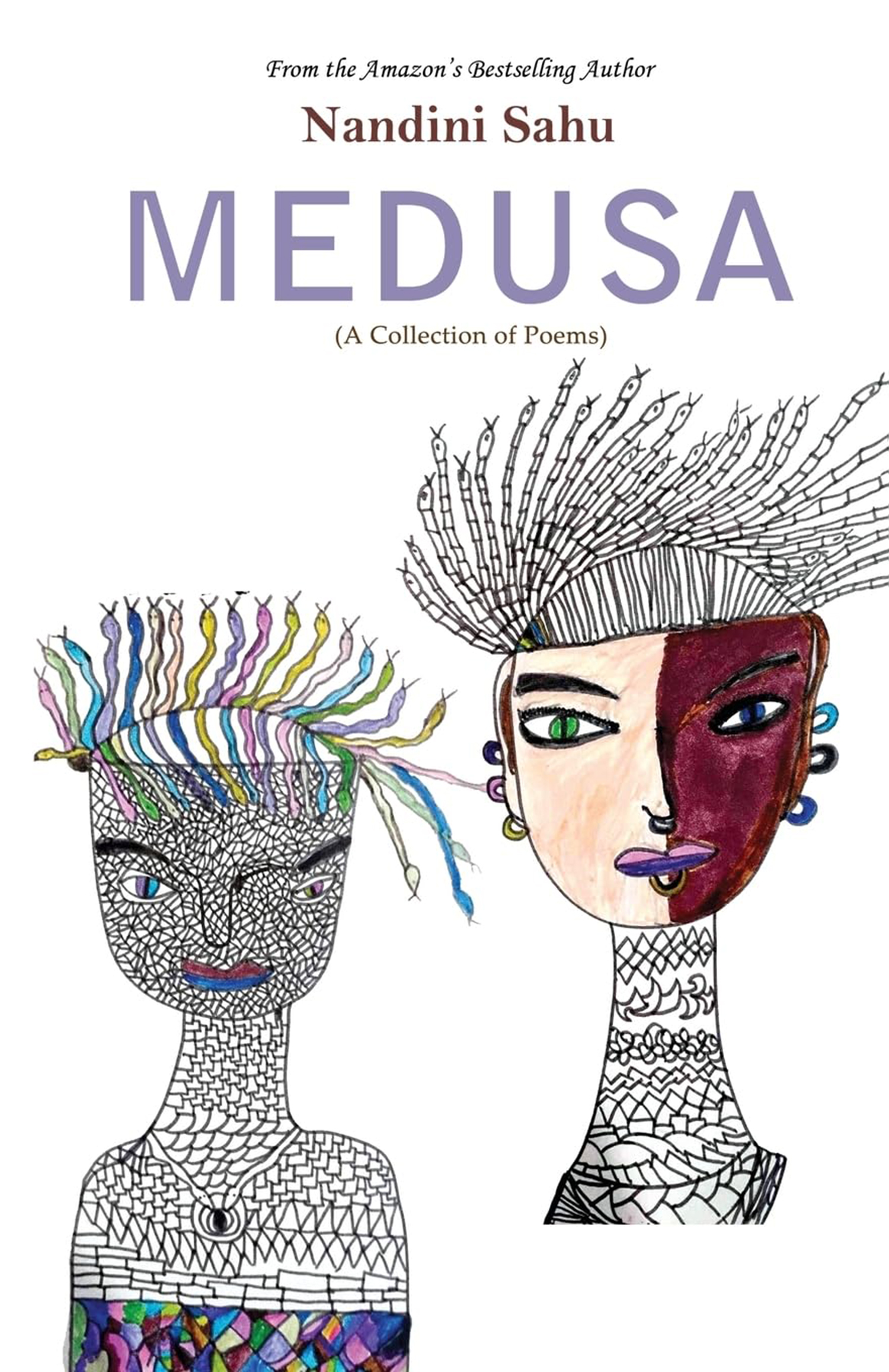
The story of Medusa, one of the better-known Greek myths, is about one of the three Gorgons and the only mortal one. Hesiod’s ‘Theogony’ tells the story of Medusa who was violated by the Greek God Poseidon in the Temple of Athena. Angered by this sacrilegious act, Athena, powerless to act against Poseidon, turns her wrath to Medusa and curses that whoever looks at her would turn into stone. Medusa meets her death when Perseus, the sun of Zeus, beheads her with the help of Athena and Hermes, and then continues to carry around her decapitated head to win over enemies by turning them into stone. Often evoked in contradictory terms, Medusa is imagined at times as beautiful, unlike the other Gorgons, but popularly, also with a head full of snakes, a scary and fearful image. In fact, contemporary retellings of the myth show a significant shift from envisioning Medusa as a monstrous figure to one which sees her as reclaiming both agency and the narrative, positing her as figure of female empowerment and strength. In fact, this shift in perception is recorded even in other forms of art such as sculptures. For instance, the Argentinian sculptor of Italian descent, Luciano Garbati titled his sculpture ‘Medusa with the Head of Perseus’, inverting Benvenuto Cellini’s ‘Perseus with the Head of Medusa’, thereby becoming a focal point of discourse during the #MeToo movement.
It is this continued interest in Medusa, the myth’s relevance and ability to reinvent itself, that serves as an inspiration for this collection of poems, titled ‘Medusa’ by the well-known Indian poet, Nandini Sahu. The poet—celebrated for Sita: A Long Narrative Poem, a memoir of sorts of Sita told in the first person—draws on the contradictions inherent in the figure of Medusa for this contemplative, self-reflexive and celebratory collection of deeply felt poems. The collection is intriguingly dedicated to ‘you’, a dedication that could be interpreted as one to the reader, all women, men, or perhaps even the poet herself. The last one being a possibility can be arrived at from the fact that the poems in the collection can be read as suggestive of the poet as one ridden by self-doubt, doubts compounded by both the expectations as well as censure of society, but her ultimately triumphing over them. Thus, many of the poems are reflective of the poet’s struggles to assimilate and accept varying, contradictory aspects of herself, increasingly becoming more comfortable in her own skin, and slowly but firmly not only arriving at an acceptance of that flawed self, but even a quiet affirmation and celebration of the same.
The collection opens with the titular poem ‘Medusa’ and immediately the poet wrests the narrative back with the announcement, ‘I will never reduce the illumination of my sparkling eyes./ Because you claim, my eyes have been your solitary gain’, followed by the declaration that ‘My “ecriture feminine” takes encounters/ with conformist patriarchal schemes.’ While making these assertions and refusing to be reduced to just a body part, the poet also embraces her own dichotomies, that she, ‘the venomous/ pit viper Bothrops is Medusa and the nonvenomous sea serpent/ Atractus is also Medusa.’ This preoccupation with contradictions spills over to other poems such as ‘God’s Elect’, in which while the poet accepts the ‘fractured yet complete/ a paradox of past and present’, she is also beset by anxieties like, ‘she is God’s chosen. But chosen for what? A crown of grace or a burden of spikes?’ But the poet’s journey, while it may not be an easy one, is one paved with love, and an acceptance of love, that of others, and especially of one’s own self, devoid of any bitterness. This openness to love though comes across as hinged more on a desire to heal oneself as ‘Hurt People Hurt People’, and the realization that if hurt is allowed to fester, ‘without knowing,/ they turn into the very thing they fear.’ The poet also conveys a sense birthed by wisdom that love is not always enough, a sentiment that is evoked in the poignant retelling of the story of ‘Dushyant and Shakuntala’, a story of love found, lost, and found again, but a love that Shakuntala having traversed a thorny path realizes means to ‘live as a myth, anonymous … For history calls it a tale of love/while she is the song in a muted tongue.’ So while the poems do betray a sense of vulnerability, ‘the only cloud/ drifting, empty,/ always on the verge of breaking …’, yet there is a growing realization that while one might understand ‘the distinction/ between fairness and vengeance/ Life may not fix it, but life must concede it,’ echoing the poet’s growing equanimity and willingness to accept life for what it is rather than what she desires it to be.
In this journey of self-discovery, self-realization and self-actualization, the poet seeks the enabling comfort of ‘Sisterhood’. Yet, this sisterhood is spelled out in the poet’s own terms and one which gives due importance to the need for solidarity but also articulates her need to be ‘accessible yet peripheral’: a desire not born out of selfishness but an almost newfound confidence to ‘live alone in the company of others living alone’; in a house newly constructed ‘where no one lived in the past/ no one made love, no one died/ or none got exhausted.’ But this confidence, the poet demonstrates, is also a measure of acceptance of her own frailties, follies and idiosyncrasies, and therein lies the poet’s ability to be finally at peace with herself.
The collection is also peppered with a few deeply personal poems; poems that speak of abuse, trauma and loss, and yet, it is a collection of poems defined by strength: where ‘As the Going Gets Tough’, a poem reminiscent of Maya Angelou’s ‘Still I Rise’, the poet and other women remain unfatigued, resilient and march on ‘Into a Brave New World of Possibilities’.
This slim volume of poetry, like the poet herself, contains multitudes and speaks at times in contrary minds, and at times betrays vulnerability. A need to love and be loved, and yet ultimately standing fiercely independent, resolute and uncompromising in refusing to be anything but herself. Some of the poems proclaim their intentions loudly, while some are more muted, though neither ever lose their voice or point of view. Some of the poems deploy startling metaphors, the process of acquisition of culture compared to that of pickling wherein we add a pinch of this and a dash of that, and we arrive at a ‘preserved delight’. Then there are metaphors such as that of ‘manthan’ which elevate the ordinary to the extraordinary.
However, what is most commendable about Medusa is how this collection marries the West with the East, with Sahu, who is a well-established folklorist, drawing upon myths and practices rooted in Indian culture to evoke the very same contradictions that Medusa ignites. It is this connectedness of the world that the poet celebrates in her final offering of the collection, ‘The Akshayapatra in Jagannath Puri’, a ‘journey back through time … From Pacific Ocean and islands to the desert’s heat’, a tribute to the poet’s Oriya roots and the twelve hundred years’ old shrine of Lord Jagannath, where food, like Medusa becomes the signifier of all that connects us in spite of myriad differences. It’s a collection of poems that will make its demands on its readers but therein lies its beauty.
Shibani Phukan is Associate Professor, Department of English, ARSD College, University of Delhi, Delhi.