
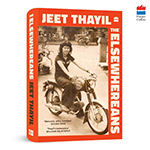
Where do we go when no place feels like it was ever ours? Who are we, when memory won’t hold still long enough to shape a coherent self? Is belonging a matter of place, of the body, of language—or simply a high that fades? Can we return to somewhere that never truly allowed us in? What does it mean to live perpetually in transit—not between places, but between versions of oneself? These questions sit at the edge of The Elsewhereans, Jeet Thayil’s documentary novel which refuses the consolations of narrative coherence or interiority; it does not offer character arcs, resolution, or the illusion of psychological wholeness. Instead, it fragments time and self into shards—of memory, hallucination, voice, and disconnected dialogue—delivered through abrupt transitions that disorient and estrange.
The novel charts a dual journey: on one hand, it reconstructs the lives of Thayil’s parents—George, a peripatetic journalist, and Ammu, a quietly resilient artist shaped by silence and suffering; on the other, it becomes a deeply personal exploration of grief, addiction, and emotional distance. We follow the family from the young bride’s family home, Anniethottam in Kerala, to a cramped apartment in Mahim, Bombay; then to 1960s Patna amid student unrest, onward to the cultural tensions and racism of Hong Kong, through the war-scarred aftermath of Vietnam, and finally—via Bombay and New York—to Bangalore, where the journey halts in the enforced stillness of the 2020 pandemic lockdown. Everything unfolds through a collage of memory—letters, photographs, postcards, marginalia, and half-remembered conversations. Yet Thayil deliberately thwarts any attempt to read the narrative as purely autobiographical; rather, he inserts a quiet caveat: ‘The real names and photographs in these pages are fictions. The fictional names and events are documentary. The truth, as we know, lies in between.’ It is within this liminal space that Thayil explores the idea that ‘Everyone is from elsewhere,’—a phrase that offers a conceptual hinge to understand The Elsewhereans, wherein each character encounters and interprets it differently, shaped by their histories and dislocations (p. 87).
While Ammu experiences ‘Elsewhere’ as a kind of ‘spiritual calling’—an inward choice rather than an external imposition—for others, it represents not merely a physical location, it is also a condition of unbelonging (p. 88). To be elsewhere is to be outside: of nations, of relationships, of language, of continuity. The primary narratorial voice belongs to Jeet, the son of Ammu and George. Like his parents, he is an Elsewherean, equally shaped by displacement and dislocation. Jeet retraces paths already taken: working for the Hong Kong magazine his father once led, following his footsteps in Vietnam in search of a mysterious woman in an old photograph, and visiting Baudelaire’s grave in Paris, echoing his Uncle Markose’s lifelong devotion. He sees himself not as someone seeking to settle, but as someone for whom ‘movement is the message’—carrying his home within, never needing to arrive (p. 87). He is not alone in living this way. His aunt Uma sees ‘movement’ as ‘God’s message’, while his father George traces its origins to the Indian epics, where displacement is not disruption but narrative design, essential to how stories—and selves—unfold (p. 186).
In The Elsewhereans, personal histories are inseparable from the geographies and contexts that shape them: each character’s story unfolds as a reflection of the place it inhabits. From church-led anti-communist rallies in Kerala against the Namboodiripad government, Da Nang’s tourist circuits that map the war’s violence and resistance, to the aftershocks of China’s Cultural Revolution as told through Lijia—the daughter of a poet nearly executed for his verse—the novel moves through scenes where personal and political histories collide. Thayil recounts these moments with unflinching detail, exposing how language, memory, and state power intersect, whether through racism, censorship, or the quiet violence of nationalist control.
Alongside the Elsewhereans—unmoored from place or singular self—what anchors the novel is the emotional range carried within their relationships: grief, frustration, tenderness, and disillusionment. Here, women endure, often without protest—until they don’t. Similarly, the strained silences between fathers and sons, and relationships suspended between affection and alienation unfold without sentimentality, capturing the slow erosion of intimacy without resorting to spectacle. Grief, in Thayil’s hands, becomes a lens through which the fractures of society are refracted. Rather than offering resolution, the novel allows grief to remain suspended, cyclical, returning in altered forms—as memory, addiction, silence, or estrangement. It is not something to overcome, but inhabited.
At times, the novel’s scope strains its cohesion. Its non-linear form, while echoing the workings of memory, can dissolve into fragmentation—characters vanish without resolution, timelines blur, and emotional arcs stall. The COVID-19 section reframes the ‘Elsewhereans’ through the lens of collective displacement, but feels grafted on, with earlier figures like Ammu and George receding too abruptly. Yet, this disorientation may be deliberate; Thayil seems less intent on narrative closure than on capturing memory’s looping, discontinuous rhythm.
Ultimately, The Elsewhereans resists closure in both form and feeling. It leaves us adrift in questions—about exile, memory, fractured identities, and the limits of narrative itself. Few lines capture the spirit of the novel as clearly as Jawed Sheikh’s couplet: ‘Apne samaan ko baandhe hue, iss soch mein hoon / Jo kahin ke nahin rehte, woh kahaan jaate hain?’ (With all I own wrapped tight, I sit and wonder—where do those who belong nowhere ever go?). It is in a similar sense of suspension, of being in transit with no fixed destination, that the novel finds its deepest resonance.
Amandeep Kaur is Assistant Professor, English, Guru Nanak Dev University, Amritsar, Punjab.