
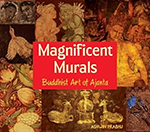
I don’t know when I first learnt the words stupa, chaitya, and vihara, but I certainly knew them midway into my first year as a history undergraduate. Knew the words, let me clarify. It is embarrassing to admit today that it took me another decade or maybe even more to figure out what these terms meant. It appears commonsensical to me today that a stupa is the hemispherical commemorative structure which often houses relics of the Buddha/his associates/venerated teachers, that a chaitya is a prayer hall and a vihara the residence of monks, but in the last century, there was nowhere for me to learn this basic stuff. All the texts and monographs I read then proceeded on the assumption that their readers came pre-fitted with this knowledge.
So, even though we now live in a world with inexhaustible information supply, it is fabulous indeed that a book on the Buddhist Art of Ajanta begins with explaining each of these terms. Though it is aimed at schoolchildren and therefore explains the expressions it uses, including such things as the difference between frescoes and murals (which, again, in all honesty, I had believed were synonyms till I read this), Magnificent Murals would be useful for any layperson with an interest in early Indian art, or even a tourist looking to travel to Ajanta.
The slim volume begins with the physical geography of Ajanta—a marvel in itself and proceeds to narrate the tale of the serendipitous discovery of the site in 1819 by a British army officer on a hunt. We learn then about when and why the caves were built, for and by whom, and how. The earliest of these caves were carved out between the first and second centuries before the common era, and work was resumed in the fifth century after a few centuries of ‘all quiet on the western Deccan front’.
The murals at Ajanta narrate episodes from the life of the Buddha and tales from the Jataka, but also include a variety of decorative motifs—geometrical, floral, and faunal. Why were these paintings made? While Dieter Schlingloff, among the greatest scholars of Ajanta, believes that they were ‘pictorial sermons’, the sheer abundance of such art south of the Vindhyas, in ‘Hindu’ contexts as much as in Buddhist ones, makes one inclined to agree with Ingrid Aall’s musing that these ‘songs of history’ might be the painters of yore ‘praying with brush on the walls’.
Many of us have nodded with dawning comprehension when a competent tour guide gestures to a part of some story sculpted or painted in any temple/chaitya/vihara/stupa and proceeds to narrate the entire story. Magnificent Murals actually explicates the process of deciphering the tales. The paintings do not always flow in a linear fashion. Pillars, trees, and gateways may be used to separate one frame from another but, in many cases, different scenes or narrative episodes may just feature side by side. Having this spelled out is actually a huge revelation for all but specialist art historians. The ‘story’ being told is to be pieced together through a juxtaposition of several panels, some of which may flow from left to right (or right to left), be placed in adjoining frames like the Amar Chitra Katha comics of old, or many episodes may even coexist in a single frame. So, if you see three elephants in a single frame, that isn’t a tale about three elephants, but the Chhaddanta Jataka featuring the same Bodhisattva-elephant in different episodes.
Even with all of this, figuring out significantly damaged murals as in Ajanta can be extremely challenging. Magnificent Murals adds detailed reconstructed line drawings alongside photographs of the murals from Ajanta, with boxed highlights showing exactly how to decipher the pictorial text. This is illustrated through episodes from the life of the Buddha represented in both sculptural and painted forms, and the Chhaddanta, the Mahakapi, and the Matriposhaka Jatakas.
The last section details the attempts to preserve and protect the paintings, including modern attempts at digital restoration. We learn that Nandalal Bose was inspired by Ajanta when he worked on the borders and front and back covers of the Constitution of India—so these ancient murals live on in the founding document of our nation state.
This book shoul