
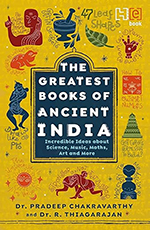
History, as most children meet it in the classroom, is a discipline of settled answers. Textbooks present the past as a chain of dates, dynasties and events to be memorized, and examinations reward the recall of one correct version. What this approach seldom teaches is how the past comes to be known at all: how a manuscript is read, what it can and cannot tell us, and why two careful readers may draw different conclusions from the same text. It is this neglected question that The Greatest Books of Ancient India: Incredible Ideas about Science, Music, Maths, Art and More, Pradeep Chakravarthy and R Thiagarajan, takes up. A children’s book, it introduces fourteen major works from ancient India, composed primarily in Sanskrit, and, in doing so, invites young readers to approach the written records of the past as texts to be interpreted rather than answers to be memorized.
The texts the book chooses make that invitation all the more compelling. It offers a clear and vivid introduction to works whose subjects range from astronomy and architecture to governance, surgery, music, mathematics and even wrestling. The book presents these not as religious or philosophical writings but as works of non-fiction, notable for their range and precision and composed by some of the finest minds of the ancient world. That choice matters. Ancient India is often approached by young readers, if at all, through epic and scripture, and the everyday, technical and practical intellectual life of the period rarely surfaces. Most of these works, moreover, remain little known beyond specialist circles, so the book introduces its young readers to material that even many adults will be meeting for the first time.
The selection begins with the sciences of number and the sky. The Aryabhatiya and the Lilavati represent astronomy and mathematics, the first a compact treatise on planetary motion and calculation, the second a work of arithmetic and geometry known for posing its problems in a playful, conversational manner. The Mayamata turns to architecture, dealing with the planning and construction of buildings and settlements. Medicine and the study of nature follow: the Sushruta Samhita is associated with surgery and the Charaka Samhita with internal medicine, while the Rasaratna Samuccaya enters the world of alchemy and the Vriksha Ayurveda the study of plants and their care. The Krishi Parashara extends this attention to the land itself through agriculture, and the Arthashastra widens it further to the workings of the state, from administration to economic policy.
The remaining works turn from the management of society to its pleasures and its arts. The Manasollasa, a royal compendium, ranges across the interests of a cultivated court, while the Sangita Ratnakara on music, the Natya Shastra on drama and dance, and the Chitra Sutra on painting show how systematically these arts were theorized. The list closes, unexpectedly, with the Malla Purana, a treatise on wrestling. That a single volume can hold surgery and song, crop cultivation and combat, is precisely what gives the book its breadth, and it sets up the question: how well does it help a young reader move from knowing that these texts exist to understanding how they might be read?
The book does not begin, as one might expect, with the works themselves. Instead of moving directly to its fourteen texts, it pauses over the language in which all of them were composed. Sanskrit is introduced first, through a brief history of how the language developed, and the account soon takes a linguistic turn. Panini, the grammarian, occupies a central place in it, credited with a decisive part in shaping and standardizing the language as it evolved. The decision is a sound one. Since every text discussed later is in Sanskrit, a young reader who has some sense of how the language took its form is better placed to appreciate what follows, and the opening chapter becomes a bridge to the main material rather than a detour from it.
Having established the language, the authors turn to the difficulties of working with manuscripts, and it is here that the book is at its most candid. Many ancient manuscripts, they point out, carry no author’s name, so a work may reach us without anyone to whom it can be securely attributed. The materials on which such works were written were also fragile, and survival over centuries was never guaranteed. Nor were copies ever identical. Each was made by hand, and in the course of copying, mistakes crept in, often unnoticed, and were carried forward by the next copyist. A manuscript, on this account, is not a transparent window onto the original composition but the end point of a long and imperfect chain of transmission.
These are familiar problems to anyone who studies old texts, yet they are rarely put before children. School history tends to present a source as a finished object, with an author, a date and a settled meaning attached, and the uncertainty behind it is quietly removed before the material reaches the classroom. By naming these difficulties openly, the book gives its young readers something the conventional syllabus withholds: an understanding that the past is known through documents which are incomplete, disputed and sometimes wrong. This is the point at which the concern raised at the start of this review, the neglected question of how the past comes to be known, finds its most concrete expression in the book.
The book’s clearest virtue is its lucidity. Writing for young readers, the authors hold back on detail and give each chapter a brief account of what a text is about, how it is arranged, why it mattered and what made it new in its day. Difficult ideas are pared down to plain explanations, often with a familiar analogy to help. This holds whether the subject is Āryabhaṭṭa’s astronomical predictions, the arrival of zero and negative numbers, or the surgery described in the Suśruta Saṁhita. Each time, the emphasis falls on what was forward-looking in the work and why it still matters.
Closely tied to this is the choice of offering the larger picture before the detail. Every chapter sets out how a text is organized and what it contains before turning to its ideas, so a first-time reader grasps its scope and purpose in advance and sees a coherent body of knowledge rather than a set of stray facts. Children learn that ancient scholars worked in mathematics, medicine and astronomy, and they also learn what those scholars contributed. The chapter on the Māyamata shows these qualities at work. Architecture here is more than construction. The authors bring out a worldview in which the land is sacred, and the builder is told to assess a site’s soil by its slope, colour, smell and even taste before laying a foundation. Such attention to the environment is surprising in a text of this age. Concrete details, like the recipe for Aṣṭabandhanam, a binding compound used in temple building centuries before modern cement, make the technical material easier to remember.
A recurring theme is the interconnectedness of ancient Indian thought. The authors stress that the writers of these texts saw everything as linked, so that art, music, mathematics, nature, ethics, governance and well-being formed one whole rather than separate fields. In an age of specialization, this offers young readers a useful corrective. The book is equally alert to the culture that produced these works. Sanskrit served as a shared language among scholars in different regions, and authors composed concise, tightly structured texts meant to be memorized and passed on. The section on the librarians, collectors and translators who preserved them is especially welcome. By describing the labour of saving fragile palm-leaf manuscripts from loss, it returns to the problems of transmission raised at the outset and shows that the survival of knowledge is an achievement in itself.
The book is also well designed for use. References at the end of sections direct curious readers onward, which makes the book a gateway rather than a final word. It does not aim at exhaustive coverage. Its purpose is to spark curiosity, and here it largely succeeds; alongside, it also leaves space for shared discussion and independent questions.
If a reservation must be voiced, it is a modest one. Fourteen works in a single volume leave little space to linger over any one of them, and a reader taken with a particular chapter may wish the book had stayed with it a little longer. This is largely the price of its design, however. The book sets out to introduce rather than to exhaust, and the references at the end of each section already point the way onward. Taken as a whole, the book answers the concern with which this review began.
Children usually meet history as a sequence of settled answers and are seldom shown how those answers are reached. Here the order is reversed. The book opens with Sanskrit and Pāṇini, speaks candidly about the uncertainties that attend old manuscripts, and only then turns to its fourteen works, which the reader is by now ready to see as documents that have survived through the effort of many hands. The picture that emerges, of a culture that treated art, science, statecraft and the care of the body as parts of a single inquiry, is not one most young readers are given. With its lucid prose, its classroom activities and its memorable anecdotes, the book is easy to put into children’s hands and just as easy for teachers and parents to share. It deserves a place in every school library. Its lasting contribution is to show young readers that history is something one learns to read, question and care for, and not merely a body of facts to be memorized.