
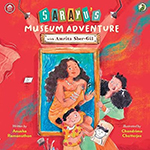
This colourful and charming little book resonates at several levels. Amrita Sher-Gil and her painting ‘The Ancient Story Teller’ were part of my parents’ homes and my life. Amrita was a dear friend of my father, and then my mother after my parents’ marriage, so I grew up with stories of her vibrant personality and extraordinary talent. It is wonderful to have both come alive for another generation.
‘The Ancient Story Teller’ was bought by my father after Amrita’s first solo exhibition in Lucknow. The only painting that was sold. Its deep, glowing colours and serene imagery, counterpoised by the luminous whites of the village wall backdrop, were a magical world into which I disappeared as a child.
Today, Amrita’s fame is such that it’s a shock that in her lifetime she was ignored, even mocked. People felt that painting was a nice hobby for a young girl, but one shouldn’t be so intense about it. Moderation was not Amrita’s style! Into the decorous 1930s world of pearls, puffed sleeves and pale pastel chiffons, her flaming red, parrot green and gold brocades, chunky Tibetan jewellery and sleeveless blouses signalled a new kind of woman, and a new way of life.
It’s a shock too that she was only 28 when she died but still left such a body of trailblazing, uniquely individual, confident work, 171 paintings in a space of just 10 years. That confidence about her life, work and directions is something today’s youth should aspire to. Too often young people are led by society’s expectations.
All in all, an Amrita Sher-Gil exhibition is a wonderful place for Sarayu’s Museum adventure! The paintings, and Amrita’s way of looking at herself and the world, tell one, as this little book does, that art itself can be an adventure. The adventure of discovering the power of colour, line and paint of course, but also of discovering that each person’s way of looking is uniquely their own. Just as their life is.
There is a lot more in this book than just reading Anusha Ramanathan’s text and admiring Chandrima Chatterjee’s vivid illustrations. It encourages you to go beyond the last pages and think, draw and observe, looking at yourself as well as the world. Something Amrita always did, turning her life, India and even poverty and sadness into something triumphant and enduring.
You too, should be an Amrita, irrepressible, a life force, expressing yourself, bursting off the walls, not the potbellied museum security guard, snoozing in his chair….
(Chandrima, I thought that was a delicious touch!).