
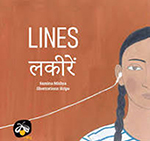
The unusual title of the book and the image on the cover immediately invite exploration even from the most casual browser! Inside the book, the minimal text (in Hindi and English) and uncluttered images are disarmingly simple and direct. They channel the viewers’ vision and thoughts on the painful themes of loss, alienation and displacement, but also give the space to imagine a different kind of pathway.
Samina Mishra says that the book began with a conversation about borders with children from Afghani families when she was engaged in a project at the Simurgh Centre in Delhi—a cultural centre that fosters exchange between Afghani and Indian artists. The discussion about borders between countries, the experience of borders in daily life, and borders within us, inspired her poem. It captures the experiences of children through the voice of a young adolescent girl, whose family was forced to leave home, the country, relationships and means of livelihood to struggle for stability again.
The metaphor of ‘lines’ is creatively traced both through text and visual image. The vivid images in the poem are given context and feeling through Kripa’s striking illustrations where washing lines are blown by the wind, a file of refugees walk through the cotton fields to find safety, and closed doors and gates represent the insensitivity and indifference of officialdom. The fragile and inadequate lines of communication between the young girl and her grandmother are powerfully evoked by the edge of the page, both on the cover and in the picture of outstretched arms which struggle to touch and console the young girl. The narrator’s identity is not only defined as a refugee, but she is also typical of any young girl who can feel the limits of her confidence or is trapped in a mesh of seemingly arbitrary authority. But lines are open-ended and have a potential for movement, and the book closes with the possibility of a different kind of future where straight lines can bend and flow.
The clear-cut lines between the colours—mainly the earth colours of ochre, the rich blue of the precious stone lapis lazuli, and cyan, which is the light bluish-green associated with water and the sky—harmonize to create a landscape in the mind that goes beyond division and separation.
At a time when migrants are often met worldwide with hostility, resentment and misunderstanding, this book reminds us of our shared humanity and each one’s need for a home that gives safety and peace. According to UNHCR, approximately 49 million children across the world are presently suffering from forcible displacement. Lines as a poetry and picture book would work well as a prompt for discussion and creative expression with older children. The book, by its nature, elicits a sensitive and thoughtful response to share our own and to imagine others’ experience of longing for freedom and acceptance beyond the bars of fear and exclusion.
Jane Sahi has been working in the field of education for 38 years. She is the author of Education and Peace, and the Founder of Sita School, an alternative school.