
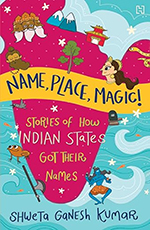
In her sixth book for children, Shweta Ganesh Kumar turns to the myths, legends and histories behind the names of Indian States and Union Territories. While the book is aimed at young readers, it will appeal to anyone curious about the subject. Across its thirty chapters, the stories range from the creation of the universe to tales of early humans communicating with the flora and fauna, fierce battles between gods and asuras, and humans meditating for thousands of years. These seemingly fantastical accounts eventually lead back to the names of 28 States and 8 Union Territories of India. The book does not always reduce the origins of place names to a single definitive explanation. By presenting different theories and identifying whether an account comes from mythology or recorded history, Kumar also opens up the idea that the origins of names can be uncertain, debated and shaped by multiple traditions. Kashmir, for instance, is explained through both the story of Rishi Kashyap and an alternative involving two jinns, Kashf and Mir.
The stories often blur the line between landscape and mythology: mountains, rivers and forests are not just geographical features but are an integral part of stories about gods, sages, demons and avatars. By introducing young minds to the characters and narratives of Indian mythology, the book can become a gateway to a much wider world of stories, turning one book into the beginning of a longer reading journey. In the case of Himachal Pradesh, the story draws on tales of Lord Shiva, Sati and Parvati before connecting the mythology of the mountains to the State’s name through King Himaraja. Each story is followed by a ‘Know Your State’ section, which provides facts about the State, its capital, official language, dance forms, festivals, martial arts and other distinguishing features. This helps connect the stories of the past with the contemporary identity of each State, showing that a State is defined not only by its name or history but also by what it represents today.
Is a State the ‘sugar bowl of India’, the ‘falcon capital of the world’, or a region known for its rich sporting culture?
Beyond the stories behind place names, the book also offers glimpses into the cultural diversity of India and the ways in which different communities have made sense of the world around them. Stories from different States feature mountain or sun deities whose roles appear strikingly similar despite differences in names and tradition. In this sense, we learn about the human impulse and the need to reason about things beyond our understanding. Across cultures, fundamental questions such as the origin of humanity are often answered through stories of divine creation or descent from gods. One of the book’s quiet strengths is the way it reveals the diversity within the Northeast, a region that is often perceived from elsewhere in India as a single cultural entity. The ‘Seven Sisters’ thus emerge as distinct places, each with its own stories and identity. Elsewhere, the repeated presence of figures such as Lord Shiva and the recurring idea of their lands as gateways to heaven reveal unexpected connections across thousands of kilometres.
Kumar’s descriptive language also invites young readers to visualize the characters and scenes in their minds. Sage Vishwamitra, for instance, is introduced as a ‘serious man with bushy eyebrows, a long grey beard, and hair flecked with black-and-white, tied up in a bun on the top of his head.’ Such details give the characters a vivid physical appearance and allow readers to construct the world of the story in their imagination. Each chapter is accompanied by at least one black-and-white illustration by Vibha Surya. While these images connect well with the stories, they feel somewhat restrained in comparison with the imaginative richness of the text. The mythology, with its celestial worlds and extraordinary landscapes, offers considerable scope for more visually adventurous sketches. The stories turn geographical names into cultural memory, giving readers a sense of the histories and traditions attached to different places. However, the absence of maps is a significant omission, as visualizing where these States and Union Territories are located could have further strengthened the connection between story and geography.
Yet Name, Place, Magic! succeeds in making geographical history less abstract and more engaging by making the map of India feel like a collection of stories. Its pages bring together gods and humans, rivers and mountains, history and myths, revealing how people have remembered and imagined the places they inhabit. Kumar’s book ultimately lives up to its title: it starts with names, takes readers through places and discovers magic along the way.