
The Aravalli Range is one of the world’s oldest fold-mountain ranges. Expectedly, it has undergone considerable erosion. However, recent illegal mining, aggressive urban expansion, real estate development, encroachment and deforestation have brought us to a juncture where this ecological asset is under threat due to human interference. The mountain range is also reeling under a controversy regarding its legal definition, which not only impacts its environmental protection but also decides the extent to which it continues to serve as an industrial and livestock husbandry resource. In this context, activists and concerned citizens have organized protests, too. More recently, protests were also held in another context, where environmental activists concerned about the ecological impact of an artificially curated urban forest and (alleged but unproven) unscientific planting drives opposed the Haryana Government’s Matri Van afforestation project. At the same time, inspired by Africa’s Great Green Wall, the Aravalli Green Wall Project is underway, too. It is in this socio-political climate that Katie Bagli’s Story of the Aravallis for Young Readers was published earlier this year. Not to mention the hair-raising dust storm that affected parts of Rajasthan in the final week of May 2026.
The book provides children a concise yet comprehensive view of the Aravallis—one that likely presents the mountain range more holistically than their school textbooks. It explains its ecological, environmental, cultural and historical significance to India. The central question it attempts to tackle pertains to the man-made reasons that pose a threat to the Aravallis, and why this ancient mountain range should matter to us, beyond its short-term economic resourcefulness. Fortunately, the book is far from a sorry tale! Roughly divided into three sections, the first part provides a geological and ecological overview, and introduces the main problem at hand. An important question raised in one of the initial chapters is, ‘What matters more—development and economic growth, or the preservation of the gifts that nature has provided?’ The second part speaks of its wondrous beauty and recounts institutional efforts and stories that serve as reminders of successful ways in which various stakeholders have helped protect the mountain range in the past and continue to do so. It’s a wide range, from successful translocation of tigers to extending support to poachers and their families to find alternative sources of income. Finally, the third section emphasizes the risk of loss of this natural asset, if we don’t act soon and in its favour. In conclusion, the author reminds children of their agency in spreading awareness and voicing their concerns. Though the book is aimed at all children above 8 years of age, middle-schoolers seem to be the most well-suited audience for it.
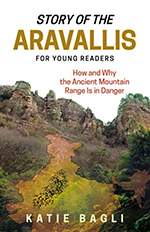
The text, a combination of descriptive and narrative writing, and the use of photographs instead of illustrations, are an ideal fit for the subject. The cover is thoughtfully designed to include both a partial shot revealing the rugged topography of the Aravallis and an outline illustration of the grand landscape set against the Indian map. Even though we encounter phrases like ‘gifts of nature’, the book steers clear of romanticizing the Aravallis. The author’s attempt to spotlight its multidimensional significance to India comes through, and her stance in favour of protection and restoration of the mountain range against all odds is quite resolute. However, I’m left wondering whether the book falls short of fully committing itself to problematizing the Aravallis. Though it introduces readers to rampant mining in the area and the development of a disturbing marble slurry dumping site near Kishangarh, several political developments don’t find mention. A few amongst these are the ban on mining in the first decade of the 21st century and the definitional controversy mentioned earlier in this review. Similarly, nothing is mentioned about the recent restoration projects announced by the Government, and consequently the debates and uncertainty regarding ecological benefits in this regard.
Nevertheless, the book remains topical, accessible to children and is highly recommended. Its pragmatic approach is suitable to educate and involve children to critically consider and debate environmental and political developments in the context of a geological phenomenon they most certainly encounter in their school textbooks and will inevitably be impacted by.