
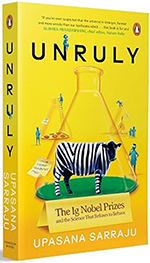
‘The Chapter You Can Skip’ is the title of the introductory chapter of Upasana Sarraju’s book Unruly: The Ig Nobel Prizes and the Science That Refuses to Behave. The chapter title makes you go, ‘huh, why?’ and you end up reading it. An apt way, I thought, to start a book about the Ig Nobels that have two main criteria (largely unchanged since 1991): they make you laugh, and they make you think.
The Ig Nobels have been awarded for a multitude of weird topics.
How many souls from the State of Alabama are likely to end up in hell? This calculation earned the Southern Baptist Church of Alabama the 1994 Ig Nobel Prize for Mathematics. Cows that have names produce more milk than nameless cows—this was the 2009 Veterinary Medicine Ig Nobel awardee. Can a cat be both a solid and a liquid? Yes, apparently under certain conditions—this is an Ig Nobel classic. Some others: Why don’t woodpeckers get headaches? Just how slippery is a banana peel underfoot?
Self-nominations (roughly 20% of the applications each year) for an Ig Nobel rarely win. There is a discreet Ig Nobel Board of Governors who debate and decide who the awardees will be.
Are the Ig Nobels just a glorified comedy sketch night for academia? Surprisingly, the answer is no. And Sarraju’s book smartly pivots away from treating these studies as mere novelty trivia. Sarraju takes readers on a delightfully eccentric tour through the world of ‘weird science’, crafting an ode to the beautifully messy, unpredictable nature of human curiosity.
Unruly explores the genuine rigour, stubborn hope, and occasional accidental brilliance hiding behind unorthodox experiments. Sarraju investigates the inner workings of the ‘Ig universe’—the chaotic nominating letters, lively committee debates, and the thin, porous boundary between what society labels ‘serious science’ and what it writes off as absurd.
In addition to being treated to Western anecdotes, the reader gets to peek behind the scenes of Indian spaces such as NIMHANS, ISRO, the Tata Institute of Fundamental Research, and other labs. Information flows in from fields as disparate as Antarctic ecology, psychiatry, fluid dynamics, and quantum quirks.
The book delves into questions such as ‘Who decides what counts as real science? Who polices the boundaries of academic prestige, and why do grant committees so often favor predictability over wonder?’ Sarraju argues persuasively that curiosity should not be hierarchized.
Sarraju treats science as a deeply emotional, trial-and-error human enterprise driven by people willing to risk looking foolish in pursuit of a truth.
Unruly leaves you with appreciation for the weird minds mapping our universe, proving that sometimes, the best way to understand the world is to laugh first and think later.