
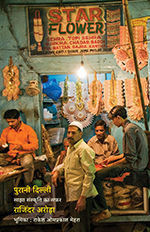
‘Sheher dikhaoge mujhe?’ (Will you show me the city?) Arora asks a battery-rickshaw driver idling outside Jama Masjid’s Gate No. 1, in the opening line of ‘Hunar aur Peshe’, the chapter on the city’s crafts and professions. It’s two hours before the midday prayer, on what looks like a government holiday. The driver, Rafat Ali, is in his forties, with a Sufi’s bearing and hair dyed orange with henna. Visibly surprised by the request, he unties the cloth from his head, wipes down the seat, and says: ‘sit’. Then, instead of the usual monuments, he delivers Arora to tradespeople. What follows is a patient and specific taxonomy of a city understood through what its hands still do: the bhishti, the sehriwaale, the qawwal, the hakim, the naai, the rafoogar, the rangrez, the bunkar and the ‘ear specialist’, among several others. Wandering through Shahjahanabad’s lanes with Rafat, Arora writes that listening to centuries of history given voice in those same streets felt like speaking with time itself.
Rajinder Arora’s book is neither the guide that the opening question implies, nor a history of Shahjahanabad in the disciplined sense. The twelve chapters move in two distinct registers. The first few trace Old Delhi’s seventeenth-century founding under Shah Jahan, the religious politics of his court, and Jahanara Begum’s Chandni Chowk through its Mughal high point and its colonial and postcolonial unmaking. Once that historical spine is laid down, the register shifts to a wide synchronic survey of what a sajha sanskriti, a shared culture, is actually made of: devotional architecture across faiths, Urdu’s literary and calligraphic world, food, courtesans, the rooftop pleasures of kite-flying and pigeon-keeping, and a final chapter carrying the city from 1857 to 1947, ending as the new capital rises beside the old.
The book does not settle for an uncomplicated version of its own thesis. The chapter on Shah Jahan’s religious politics asks directly whether temples were built or destroyed under his reign, and answers with real ambivalence: some were repaired and endowed, others destroyed after the Jujhar Singh revolt of 1631. Arora’s own summary is unsentimental. The Jahanara chapter is equally direct about colonial hypocrisy, noting plainly that the same British administration which shut down Chandni Chowk’s kothas as ‘anaitik’ or ‘immoral’ was staffed by officers who spent their evenings inside them; the same chapter turns, without much softening, to what heritage has become today: old shops surviving as mere ‘selfie spots’. The chapter on the city’s syncretic worship pauses to say, in its own voice, that at a moment when religion elsewhere is being turned into a weapon and used to build walls, Shahjahanabad’s crowded skyline of a temple and a mosque and a gurdwara stands as an answer to that. Even the Eid chapter turns a mild, self-directed question on itself, wondering aloud whether the warmth it describes is real and constant or something that only wakes once a year. And the courtesan chapter, which could easily have settled for uncomplicated celebration or uncomplicated pity, does neither: it documents Azizun Bai’s and Dharmman Bibi’s real, dangerous roles in the 1857 revolt and the punitive confiscation and displacement that followed for tawaifs generally, while also reporting, without flinching, that popular memory blames the same women for ruined households and broken marriages. Arora is willing to hold a contradiction rather than resolve it for the reader’s comfort.
Any chapter could serve as a fair sample of this method. In ‘Urdu Bazaar: Kitabat ka Jadoo’, on the city’s calligraphers and bookbinders, Arora first sets the market in its own history: a stretch of Old Delhi where noblemen from Bhopal, Hyderabad, Lucknow, Rampur, and further afield, once kept havelis so their poets and scribes could have manuscripts copied, illuminated, and bound close to where the finest hands worked. Each calligraphic style carries its own discipline: the flowing nastaliq suited to poetry, the plainer naskh reserved for scripture, and the bold sulus meant to be read off a wall or a gate from a distance. Having built that world with evident care, Arora then simply walks into what remains of it, and steps back. Four named khattats carry the chapter from there: Mohammed Ghalib, who still writes out the Quran and volumes of verse by hand outside a shop numbered 4181, and speaks of the work as inheritance rather than income; Shiraz Hussain of Khwab Tanha Collective, whose studio still finds buyers for his poster-calligraphy at exhibitions and fairs; Mohammed Zubair, who learned the craft from an older brother as a boy, was once turned away from formal training for being too young, and is not teaching it to his own daughter; and Mushtaq Ahmed, who has taught the discipline to some two thousand students across fifty years and says, plainly, that none of it has ever been enough to live on. The chapter is proof, in miniature, of how the whole book works: patient attention, a named source behind every claim of significance, and testimony given room to speak for itself.
Purani Dilli earns its place on the same shelf as the city’s more monumental histories without pretending to be one of them. Reading it feels less like consulting history than walking beside the author as he takes it down—four centuries and one particular afternoon treated as though they were only a few streets apart.
Kanupriya Dhingra researches the history of the book and print cultures with an ethnographic focus on Delhi, India. Her first monograph, Old Delhi’s Parallel Book Bazaar (Cambridge University Press, 2024), draws on her doctoral research at SOAS, University of London. She teaches literature and cultural studies at the School of Liberal Studies, BML Munjal University, and serves on the international Board of Directors of the Society for the History of Authorship, Reading, and Publishing (SHARP).