
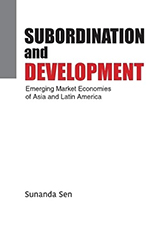
The central question the book seeks to answer is why (and how) the developing economies of the Global South remain in subordination even after gaining formal independence. Why do these otherwise politically independent countries accept policies which work to their detriment? That’s because there is an inbuilt mechanism in these policies which arm-twists these nations into perpetual subordination. In other words, these policies create a vicious cycle. Once a country chooses to enter this policy vortex, much like how Abhimanyu of the Mahabharata got stuck in the chakravyuha, it seems to find no way out of it.
This book is both about showing in intricate detail what this chakravyuha is and how to avoid entering it in the first place.
To understand what this grand design of subordination is, one needs to first identify its chief architect—global finance capital—and the machinations to enforce its will on the subjects. Sunanda Sen uses extensive macro data of three Latin American countries—Mexico, Brazil and Argentina—and two from Asia—India and China—to show how global finance has subjugated these regions over the years. Incidentally, what she says may be applicable even to some countries of the North, particularly those which have chosen to align their interests with those of the US and have lost policy sovereignty.
The vortex of global finance is built in the following manner. To attract finance capital, countries need to maintain high returns on their financial assets. Let’s say the return on financial assets in India is 7 per cent in rupee terms.
International finance will not be interested in rupee returns as it would like to make money in terms of dollars, so what matters is this 7 per cent converted into dollar returns. Suppose the rupee loses value (with respect to dollar) by 7 per cent in that same year, finance takes back the same amount of dollars it brought at the beginning of the period. The net return in dollar terms is zero! And if the rupee depreciates by more than 7 per cent, let alone making money, finance loses value in absolute terms. To top it, there is something called a ‘country risk’, which all countries in the Global South have to pay for on account of an unstable political climate in these recipient countries. So, the financial returns in the Global South have to be significantly higher than what finance receives in the US.
This global asymmetry of returns has serious implications for the recipient countries in the Global South. One, higher financial returns are detrimental to real investment in these countries since only those projects would be undertaken which have a higher return than these financial returns. This could potentially lead to deindustrialization, as she shows with the exception of China. Two, countries have to keep their exchange rates inflated (artificially appreciated), which has a negative impact on their trade numbers. An expensive rupee means expensive Indian goods for the international markets and cheaper imports for India. This widens the trade deficit. Of the four sources of aggregate demand—consumption, investment, government expenditure and net exports—countries effectively lose control over two. Consumption demand is anyway an endogenous function of income, so it does not have an independent influence on GDP. That leaves us with only one exogenous source of demand—government expenditure—which can steer the economy.
Three, even that source of demand is made a victim of this policy. Finance capital does not like large governments. Countries are, therefore, forced to set a limit to government expenditure (like India has the FRBM according to which it cannot spend more than a certain per cent of GDP). Instead of being a driver of the economy, government expenditure becomes a pillion rider. Countries effectively give up the driver’s seat and enter autopilot mode.
Four, the most important lever of the vicious cycle is the international pressure to manage ‘political risk’. Even if a country decides to break away from this vortex, it will be declared an errant nation and downgraded by rating agencies, which forces capital flight. This Damocles sword of capital flight is what keeps these countries on a leash and perpetuates this subordination.
Professor Sen uses extensive data for these five countries to establish this one-size-fits-all policy and how it has wreaked havoc across the board over the years. In all of this, China, she argues, is an exception, at least till some time back. After all, while all the other countries were either stagnating or deindustrializing, China was growing and industrializing at an unprecedented scale. And that itself is a lesson for all countries in the Global South.
China could do so precisely because it chose not to enter the vortex of finance, at least not go the whole hog. It kept its currency under control and used it for export-led growth. So, while it opened its current account, China kept its capital account under a tight leash despite international pressure. What this did was relieve China of the pressure to either keep the interest rates high or appreciate the exchange rate to attract international finance. The threat of capital flight, as a result of restrictions on portfolio finance, did not arise in the first place. To be sure, it is not just these policies which delivered industrialization to the country. While these were necessary conditions, industrial policy along with availability of cheap labour made China the industrial base of the world.
Let me end with what I would have liked to be discussed further in the book. What China showed to the world was if a country chooses not to enter the chakravyuha laid down by finance, it can have a trajectory of its own even as it is dependent on the global economy in other ways. But what about the countries which have already entered the arena; how do they get out of it? That roadmap is as important, if not more, as ways of avoiding it altogether.
In many ways this work is a snapshot of a significant part of a large body of work Professor Sunanda Sen has built over the years.
Rohit Azad teaches at Centre for Economic Studies and Planning, Jawaharlal Nehru University, New Delhi.