
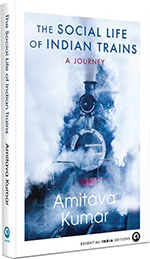
In this slender hardback, Amitava Kumar offers a set of engaging railway narratives that vary in form and tone yet converge on a shared experience of train travel in India. The longest piece, ‘Kashmir to Kanyakumari’, recounts a three-day journey across twelve States, covering 2,335 miles (3,758 km). The shortest piece, aptly titled ‘Discovery of India’, opens the volume by foregrounding the railways as an experiential unifier of the nation, generating a sense of belonging through the lived proximity of strangers as they arrive and depart. The remaining three essays reflect on key moments in the history of Indian railways and stations, their representation in creative archives, and the enduring thrill of travelling on the toy train from New Jalpaiguri to Darjeeling.
Kumar observes that, despite the considerable expansion of domestic air traffic, trains remain critically essential for urban commuting in India’s massive cities and continue to suit the means of the majority for cross-country journeys. More than any Indian language, national law, or other, statutory instrument, the railways have forged affective bonds among people daily, extending their reach into even the most remote regions. In this sense, nationhood in India has been produced through the interplay of infrastructure and institution—one felt, the other formalized.
In his account of the Himsagar Express journey, Kumar recounts a telling encounter with Ganesh Rajwar, who boards the train at Nagpur en route to Vijayawada for a promised job at a construction site. Rajwar’s story—representative of the large-scale outmigration from States such as Bihar, Odisha, and Jharkhand—lays bare the structural compulsions that drive migrant labour within India. Confronted with this quiet desperation, Kumar finds himself unable to pose the searching questions drawn from the 1967 documentary I Am 20, directed by SNS Sastry for the Films Division of India, which famously opens on a moving train. Yet the encounter also renews his impulse to engage fellow passengers in the compressed, moving microcosm of the railway compartment, revisiting those still-relevant questions in the light of contemporary social transformations.
The documentary’s continued relevance lies in its central insight: that India’s youthful optimism remains tethered to an uncertain present. The contrast it evokes—between expanded mobile connectivity and persistent deficits in literacy and opportunity—has only sharpened over time. What the film could not have anticipated, however, are the anxieties generated by more recent majoritarian currents, which further complicate the promise of an inclusive future. Kumar’s railway reflections, drawn from conversations aboard the Himsagar Express, thus offer a vivid cross-section of Indian society in motion, revealing the enduring gap between the constitutional promise of justice, liberty, and equality and their uneven realization in everyday life.
From this perspective, one may also read Mahatma Gandhi’s appeal to the colonial authorities for the provision of basic amenities for ‘third-class passengers’, articulated in his letter of 25 September 1917 (as cited by Amitava Kumar, pp. 65-66). Gandhi’s intervention exposed the ethical deficit of a system that moved millions while neglecting their dignity, insisting that infrastructure must be accountable to the conditions of its most vulnerable users. The continuing inadequacies of railway travel for large sections of passengers suggest that the force of Gandhi’s message appears attenuated, if not altogether forgotten, even in the postcolonial moment.
The railways arrived in India on 16 April 1853—about twenty-eight years after their inauguration in England on 27 September 1825, when the Stockton and Darlington Railways’ opening marked the beginning of regular commercial rail transport using steam locomotion for both freight and passengers. Traffic on the twenty-one-mile Bori Bunder–Thane line grew rapidly: within the very year of its opening, the service carried over 61,000 passengers, dispelling initial conservative doubts and fears. The anticipated positive externalities of the railway soon outweighed scepticism. Although the system was designed to serve colonial interests, facilitating troop movement and promoting commercial crops, often at the expense of local needs, it nonetheless contributed to a profound shift in social perception, introducing a velocity of movement far beyond the pace of bullock carts and reconfiguring notions of space and time. In time, the railway became deeply entwined with the nation’s most traumatic historical experience—Partition of 1947—especially along border regions where displaced populations moved across the subcontinent. The railway embodies thus a paradox at the heart of modern India: it is at once an instrument of connection and a stage on which the nation’s deepest fractures have been enacted. Indeed, travelling by train across India offers a miniature encounter with the nation’s capacious heterogeneity and compassionate humanity.
Alongside the demographic changes the author observes in Darjeeling since his first visit in 1968, he continues to find the meandering two-foot-gauge train magical and compelling. Slow and often inconvenient, it nonetheless exposes the flaneur of the rails to the actual texture of the landscape and its people. Its value lies in restoring contact with the real. By contrast, what Kumar calls ‘club-level travel’—smooth and efficient—tends to flatten differences and produce what he aptly terms ‘a uniform culture of homogeneity’.
Finally, Kumar is a stickler for measured elegance in textual production. Yet, in the opening paragraph of the first essay, one encounters a dangling infinitive (‘to travel … take the train’), inconsistent parallelism, and punctuation that blurs rather than clarifies the movement of thought. This lapse in copy-editing should be addressed in the next reprint.
Murari Prasad is former Professor of English at Purnea University, Bihar.