
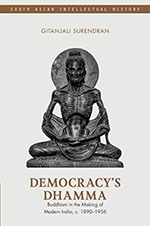
The story of the making of Indian democracy has mostly been told through the binary of the colonized and the colonizer. Even socio-cultural developments within the colonized have primarily been studied in contingency with various aspects of colonialism. Gitanjali Surendran’s new book, Democracy’s Dhamma: Buddhism in the Making of Modern India, c. 1890–1956 offers a fresh perspective on how a rediscovery and reimagination of universal Buddhism contributed significantly to the foundations of Indian democracy. Surendran’s book explores the largely untold story of how a melange of characters from modern South and Southeast Asia were directly influenced by the ethical principles of Buddhism.
The central premise of the book is that much before British and European orientalists ‘discovered’ Buddhism and Buddhist heritage in modern India, a motley group of South and South East Asian activists, pilgrims, politicians, and bhikkus had contributed to the re-emergence of Buddhism. The reason this modern discovery of Buddhism is significant because this is the period when the life stories of the Buddha and multiple Buddhist sites were confirmed as ‘fact’, backed up by various historical, literary and archaeological evidence. Buddhism, along with re-emerging as a socially engaged religion, was also being spoken about in material terms through a prodigious circulation of Buddhist relics, artefacts, and models of temples. Surendran’s story begins in the 1890s with Anagarika Dharmapala from Ceylon, whom she identifies as the most important Buddhist modernizer and the architect of the idea of an international community of Buddhists.
Surendran’s book is divided into eight chapters. The first five chapters deal broadly with how Buddhism was rediscovered and reimagined as a universal religion by the Bengali educated middle class. The narrative then flows to how Buddhism was primarily invoked as a political and ethical tool by ‘lower-caste’ intellectuals in their battle against upper-caste hegemony in everyday life. Surendran ingeniously ties up her narrative by devoting a chapter each to how central Buddhist principles were to the socio-political thought of Ambedkar and Nehru.
Dharmapala was the glue that brought national and international Buddhist believers and sympathizers together. These include Buddhist figures from Ceylon, Burma, Thailand, Japan and China. Dharmapala’s ethical mission, as well as his political project, was to seek control of the Mahabodhi temple at Bodh Gaya. Being the sacred site where the Buddha attained enlightenment, Dharmapala’s goal was to ensure the safety of this site, along with other Buddhist sites in India. Dharmapala’s most immediate challenge was to rescue the site from the Hindus, as since the eighteenth century, the temple site was maintained by a Saivite Giri monastery under the leadership of their Hindu mahant. Surendran underscores the importance of Dharmapala to this project of universalizing Buddhism by decoupling him from the nation-state frame. Dharmapala is even today popularly remembered as a Sinhala nationalist. However, Surendran argues that we ought to understand his role in making Buddhism the first non-semitic religion to be named and placed in the category of a ‘world religion’. The book explores Dharmapala’s transnational influence by gauging the influence of the Theosophical Society on his religious outlook, and the impact of key writings like Henry Olcott’s A Buddhist Catechism and Edwin Arnold’s The Light of Asia. As much as Dharmapala was engaged in an intellectual engagement with Buddhism, he was also directly contributing to reclaiming the Mahabodhi temple for the Buddhists by organizing national and international conventions. During his time, ‘pilgrimage’ became an important part of Buddhist worship. Dharmapala made a name for himself at the World Parliament of Religions in Chicago in 1893. This was also where Vivekananda prophesied his strong conviction in the universal dimensions of Vedanta philosophy.
Surendran juxtaposes both Dharmapala and Vivekananda as she argues that both these figures were products of this key universal moment for non-semitic religions. Vivekananda had considerable differences with Dharmapala and his zealous championing of Buddhism. Along with believing in the superiority of Vedanta, Vivekananda criticized Buddhism for godlessness. On the other hand, Dharmapala encouraged believers to move beyond the question of the existence of god. Instead of operating in this binary throughout, Surendran complicates the story by exploring the frictions within Dharmapala’s Buddhism. One of these ideas was Dharmapala’s envisioning of Hindus and Buddhists to be from the same racial stock. Dharmapala, being the self-appointed spokesperson of the entire Buddhist world, identified Buddhism as Arya Dharma and called it ‘the perfect manifestation of an Indo-Aryans civilization and spirit’. Surendran highlights another point of departure from the conventional understanding of Buddhism. She observes that for Dharmapala, Buddhism’s ethic of productivity was a result of virile activity, making it a paradoxical concoction of gentility and masculinity.
This comparative arc of Dharmapala and Vivekananda gets contextualized and connected with exploring what Surendran calls the ‘Buddhist traffic’ around regions of the Bay of Bengal. This traffic is ingeniously termed as the ‘Buddhist Bay’. Surendran explains the reasons for this traffic, by underscoring the importance of translations of Buddhist books, press reports on archaeological finds and the growing grid of transport networks. In the chapters dealing with Bengal, the city of Calcutta is reconstructed as a vibrant Buddhist destination which was visited by Japanese priests, Tibetan lamas and Burmese reformers. At times the detailing overpowers the intellectual narrative. Too many characters further amplify a dizzying grid of Buddhist contributors. However, one could say that this bourgeoning of regional and international scholars itself is testament to this Buddhist ‘moment’.
Surendran profiles emerging influential Buddhist societies like the Buddhist Text Society and the Buddhist Shrine Restoration Society. These chapters also excavate the buried histories of some key writers who sought to restore the glory of Buddhism. These include Sarat Chandra Das, who was a state intelligence agent and scholar of Tibet; Beni Madhab Barua, the first Professor of Pali in Calcutta; SC Mookherjee, the founder of the Indian Rationalistic Society; and Rabindranath Tagore, who prophesied a spiritualized modernity. Paraphrasing Barua, Buddhism for these intellectuals was a culture, a civilization, and a being whose tentacles touched every aspect of the society.
Closer to Indian Independence, Surendran carefully examines what she terms Nehru’s ‘relic diplomacy’. This was the period when Buddhist relics were being taken on tours of Buddhist countries as well as domestically. Even though Nehru was known to register strong critiques against organized religions, he understood the pulsating power of what Surendran calls ‘public emotional culture’. Nehru sought to channelize this culture through identifying Buddhism as a ‘civic religion’, which embodied cosmopolitanism instead of nationalist particularism. In this sense, Nehru’s idea of Buddhism as an inclusive civic religion shared parallels with Buddhist anti-caste leaders and writers covered in this book like Iyothee Thass, Dharmananda Kosambi and Rahul Sankrityayan. As Surendran observes, their attempt was to return the moral content of religion as a public good through Buddhism. This dimension gets explored in detail in the final chapter on Ambedkar. For Surendran, Ambedkar believed in how societies must always be in an experimental state. Reimagining Buddhism was in the spirit of that experimentalism. As the Buddha never claimed to be more than a man, Ambedkar’s Dhamma was a Dhamma of a social idea. Surendran provides a meticulous documentation of Ambedkar’s engagement with Buddhism, especially since the 1940s. These include Ambedkar’s study of Buddhism and Pali, his drafting of a Pali-English dictionary, establishing of the ‘People’s Education Society’ in 1945 to being an admirer of Buddhist ceremonials, congregational worships and appointment of lay preachers, among others.
This book will be a treasure-trove for anyone who is interested in archives related to modern Buddhism. It will also inspire emerging scholars to take a plunge in the hitherto unchartered terrains of the making of modern India.
Suraj Thube is Visiting Faculty, Department of Political Science, Ashoka University, Sonipat.