
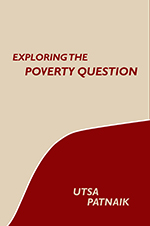
Exploring the Poverty Question by Utsa Patnaik presents a narrative on the incidence of economic poverty and its measurement, locating the same in the context of various economic phenomena that generate poverty. The author has been engaged with these questions for more than three decades now and this book weaves her various arguments regarding economic poverty in ex-colonial developing countries in a wholesome understanding of the issue. For the reader, this volume also serves as an insider-outsider view of the Indian poverty debate while also engaging with the World Bank poverty estimation methods, as well as those in China.
Through several chapters in the book which delve deep into consumption expenditure and nutritional data, Patnaik presents a robust argument about where the poverty estimation processes in countries like India have gone wrong and why it warrants an urgent rectification. The author’s theoretical-empirical investigations reveal that a fundamental error in poverty estimation methods followed in India, and often globally, is to anchor the poverty line around an unchanging consumption basket. In the Indian case, the ‘normative’ consumption basket used for poverty estimation was originally drawn up in the 1970s and was costed for arriving at the poverty line. Thereafter, the practice has been to estimate the subsequent poverty line by simply re-estimating the cost of the same consumption basket through price indices for various rounds of poverty estimation.
Patnaik argues that this method of only accounting for inflation in estimating poverty lines misses out on structural changes within the economy that alter the consumption basket. Over a longish period, the gamut of structural changes expands and consequently the changes in the ‘normative’ consumption basket are large. Ignoring this makes the poverty estimates drift away from the original norm and real poverty incidence. By 2004-05, the official poverty line in India allows the attainment of only around 1800 Kcal per person, which was almost 400 Kcal lower than the original calorie ‘norm’.
This point of a changing consumption basket which cannot be captured by prices can be lucidly comprehended through the following example. Say, an agricultural labourer receives a part of her wages in kind, in terms of rice valued at farm gate prices. The remaining rice that she requires for her household is procured at a higher retail market price. Thus, the average price at which she consumes rice is a weighted average of the farm gate and retail prices. When the same person starts receiving her wages entirely in cash at some later point in time, it means that she has to buy her entire requirement of rice from the market at the retail price, which would definitely be higher than the earlier weighted average price that she was paying. The same amount of money that she earlier spent on rice consumption would allow her to procure lesser physical quantity of rice with lesser embodiment of calories. Given that she still wants to consume the same amount of rice, she has to ceteris paribus increase the share for rice in her total consumption budget. One should note that all this can happen even when the price of rice in the economy remains invariant.
Introduction of the targeted Public Distribution System, privatization of educational and health services or the increasing integration of internet in people’s lives are some of the structural changes that have altered the consumption basket to something very different from what it originally was. Not accounting for that, the Indian poverty estimates in 2004-05 for rural areas was around 40% less than what it would have been if the poverty line allowed the consumption of the calories embodied in the original poverty line basket. The meticulous calculation by the author reveals such stark underestimation of poverty. When subsequent re-examination of the poverty estimation methodology was undertaken, like by the Tendulkar Committee in 2009 and the Rangarajan Committee in 2014, there was an increase in past and current poverty incidence due to corrections in the ‘normative’ consumption basket. Although even these committees continued to recommend the use of only price indices to estimate poverty in subsequent years, implying that the ‘original sin’ was not done away with.
In her works, Patnaik has made a strong case for the linkage between the satisfaction of food and nutritional needs with the incidence of poverty. Theoretically, she has criticized the argument that people lower their food intakes with increased incomes using the food-feed framework that has emerged with modern industrial food systems. Richer industrial countries which have undergone dietary transitions end up consuming higher levels of grains, taking ‘direct’ food and ‘indirect’ feed together.
One criticism that Patnaik’s method of estimating poverty with nutrition-invariant poverty lines is that energy requirements of people themselves may vary across space and change over time. ‘Servicification’ of the economy with less arduous work or better transport systems are often cited as reasons why energy requirements may have been reduced. However, while these are valid points, the new ‘norm’ of calorie intake cannot be arbitrarily arrived at without a systematic assessment of the population structure, work patterns and bio-medical status of the population. An exercise like that, involving professional nutritionists, statisticians and economists will be more than welcome periodically to see how the norms of poverty are changing. An accurate estimation of poverty is very important from the developmental and welfare perspectives.
In this regard, the nutritional norm for understanding poverty should also be revisited to include micro-nutrients. Surveys like the National Health and Family Surveys have revealed the increasing deficiency of micro-nutrients in India. This is deeply linked to the alterations of diets of the Indian population caused by decades of industry-style ‘rice-wheat-vegetable oil’ monocultures, which has transformed Indian diets to become calorie- and fat-intense, displacing important micro-nutrients. Taking this into account will show that nutritional poverty is deeper than what Patnaik measures and addressing it will require more than expanding existing food welfare measures. It will require a transformation of agriculture into a sustainable one that reduces the use of harmful chemicals and allows the restoration of life back into soil.
Poverty is a many-faceted phenomenon that also gets continually produced by socioeconomic systems. Addressing poverty consequently also requires not just welfare measures but analysing the existing policies and processes of production and consumption. To start the process though, as Patnaik suggests, one needs to measure poverty incidence correctly!
Arindam Banerjee is Professor and Dean, School of Liberal Studies, BML Munjal University, Haryana.