
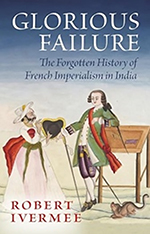
Robert Ivermee’s Glorious Failure is an intellectually ambitious and historiographically disruptive work that compels a reconfiguration of the place of French imperialism within the larger narrative of South Asian and global colonial history. At once archival in depth and analytical in scope, the book retrieves from relative obscurity a prolonged and complex episode of imperial ambition that has too often been overshadowed by the more familiar arc of British dominance. What emerges is not peripheral or abortive curiosity, but a deeply consequential imperial project whose very failure becomes the key to understanding the unstable architecture of early modern empire.
The book’s central thesis is framed through a paradox of considerable analytical sophistication: French imperialism in India emerges as at once territorially ambitious and structurally precarious, historically consequential in its moment of operation, but curiously effaced in subsequent historiographical memory. Spanning approximately a century and a half, from the late seventeenth century during the reign of Louis XIV to the post-Napoleonic conjuncture, France sustained a concerted and evolving project of political consolidation and territorial intervention in the subcontinent, propelled by an interlocking matrix of commercial ambition, dynastic prestige, and competitive geopolitical calculation.
However, despite moments of remarkable ascendancy, this imperial formation ultimately collapsed under the weight of strategic miscalculation, military defeat, and systemic fragility. The ‘failure’ invoked in the title is, thus, neither incidental nor merely descriptive. Instead, it is constitutive of the book’s interpretive framework, enabling Ivermee to probe the limits of imperial power, rather than merely recount its achievements.
Among the book’s most consequential contributions is its rigorous dismantling of the long-entrenched doctrine of French colonial exceptionalism. A persistent strand within the historiography has, for decades, portrayed French imperial expansion, particularly in the Indian context, as comparatively temperate in character: ostensibly commercial rather than territorial in orientation, and assimilative rather than coercive in its governing ethos. The author subjects this interpretive tradition to sustained critical scrutiny and ultimately dislodges it with compelling force. Drawing upon expansive and carefully curated archival corpus, he demonstrates that French imperial expansion was neither anomalous nor benign, but instead grounded in modalities of power and domination structurally analogous to those deployed by other European empires. Military aggression, calculated political intervention, opportunistic alliance-building, and the instrumental use of enslavement constituted not peripheral aberrations but the very grammar of French imperial practice. The effect of this argument is not merely corrective but transformative, in that it situates France firmly within the shared moral and structural economy of European imperialism.
The work’s narrative unfolds through a carefully calibrated progression that is both chronological and thematic. In its early chapters, the book reconstructs the tentative beginnings of French engagement in India, emphasizing the precariousness of European enterprise in a landscape still dominated by powerful and resilient indigenous polities. The French East India Company emerges, not as a monolithic agent of empire, but as a fragile institution, dependent upon local intermediaries and susceptible to financial instability. This emphasis on vulnerability is crucial, for it disrupts any retrospective projection of imperial inevitability.
As the narrative advances into the mid-eighteenth century, it acquires heightened dynamism, tracing the rapid expansion of French influence during a period of profound political flux. The fragmentation of Mughal authority created opportunities that French agents exploited with considerable ingenuity. Through strategic interventions in succession disputes, the cultivation of alliances with regional powers, and the deployment of military force, they succeeded in constructing a formidable, if precarious, imperial presence. However, what distinguishes the scholar’s account is his refusal to render this process as a purely European imposition. Indian actors occupy a central position within the narrative, not as passive recipients of colonial power, but as active participants in its constitution. The French empire in India thus appears as an entangled formation, co-produced through negotiation, collaboration, and conflict.
The book’s examination of imperial collapse stands among its most analytically compelling and narratively incisive sections. Ivermee concentrates on the critical decade between 1751 and 1761, a period marked by cascading reversals that collectively precipitated the disintegration of French power in India. Military campaigns in the Carnatic faltered with increasing frequency, fragile alliances dissolved under pressure, and the recall of pivotal figures, such as Joseph François Dupleix, eroded whatever strategic coherence remained within the French imperial apparatus. These internal fragilities were further intensified by the expansive geopolitical currents of the Seven Years’ War, whose globalized theatres of conflict stretched French resources to their limits. The cumulative effect was the loss of key territorial enclaves and the decisive curtailment of French ambitions for sustained territorial dominion in the Indian subcontinent.
What is particularly striking, however, is the historian’s resistance to deterministic explanation. Rather than presenting French defeat as the inevitable outcome of structural inferiority, the study foregrounds contingency. At multiple junctures, alternative trajectories were conceivable; the balance of power remained fluid, and the eventual ascendancy of the British was far from assured. This emphasis on contingency not only enriches the narrative, but also serves as a broader historiographical intervention, challenging linear and teleological models of imperial history.
The later chapters turn to the longue durée afterlife of French imperial ambition in India, illuminating a mode of engagement which, though attenuated, proved remarkably resilient in altered form. In the wake of the Treaty of Paris (1783), France retained a constellation of enclaves and continued to imagine renewed modalities of influence within the subcontinent. During this phase, the justificatory language of empire underwent a discernible recalibration—the idioms of the Enlightenment, most notably the valorization of liberty and the articulation of the ‘rights of man’, were strategically appropriated to confer moral legitimacy upon reconfigured projects of imperial expansion, even as the underlying structures of domination persisted with little substantive alteration. The writer exposes the profound contradictions inherent in this ideological shift: universalist rhetoric coexisted with the continued subordination of indigenous populations, revealing the limits of metropolitan reformism within colonial contexts.
Of equal significance is the work’s deliberate extension of its temporal horizon into the nineteenth and twentieth centuries. By charting the persistence of French enclaves and their eventual transition through decolonization, the study foregrounds the longue durée of imperial presence and the intricate, often contested processes through which colonial inheritances are reconfigured, mediated, and remembered. In this expanded frame, the history of French India emerges, not as a closed episode, but as an enduring and evolving legacy. However, as Ivermee persuasively contends, this past has been systematically relegated to the margins—consigned to a condition of historical obscurity, alternately forgotten, effaced, or selectively sanitized within both national narratives and the broader architecture of global historiography. This act of recovery is, therefore, not merely additive but critical, exposing the epistemological structures that govern historical visibility.
In terms of methodology, Glorious Failure is exemplary. Robert Ivermee demonstrates an impressive command of multilingual sources and integrates them with a high degree of interpretive sophistication. His approach is marked by a sensitivity to both macro-historical processes and micro-historical detail, allowing him to illuminate the lived experiences that underpinned broader structural transformations. The narrative is enriched by the inclusion of diverse voices, European officials, Indian intermediaries, and other actors, whose interactions reveal the complexity of imperial governance.
Stylistically, the book is distinguished by its clarity and rhetorical poise. The present study’s prose is at once precise and evocative, capable of sustaining dense analytical arguments while maintaining narrative momentum. The writing avoids both the dryness of purely technical scholarship and the excesses of ornamental verbosity, achieving instead a balance that is both intellectually rigorous and aesthetically engaging.
If one were to identify a limitation, it might be the relative emphasis on political and military dimensions at the expense of deeper exploration of social and cultural histories. While the book gestures towards issues such as slavery, urban life, and cultural exchange, these themes are not always developed with the same analytical intensity as the geopolitical narrative. A more sustained engagement with subaltern perspectives and everyday colonial practices might have further enriched the study, particularly in light of recent historiographical trends that foreground the textures of lived experience. Nevertheless, such reservations do not in any way diminish the book’s substantial achievements. Glorious Failure stands as a major contribution to the historiography of empire, not only for its recovery of a neglected subject, but for its reorientation of analytical perspective. By foregrounding contingency, entanglement, and structural violence, Ivermee challenges entrenched narratives and opens new avenues for comparative and trans-imperial inquiry.
More broadly, the book resonates with contemporary debates about the legacies of colonialism and the politics of historical memory. Its insistence on confronting the disjunction between imperial rhetoric and practice, and its exposure of the processes through which certain histories are effaced, lend it critical relevance that extends beyond the confines of academic discourse.
Robert Ivermee has produced a work of exceptional scholarly merit, one that is at once empirically rich, analytically incisive, and stylistically compelling. Glorious Failure does more than recover a forgotten past. It compels a fundamental reconsideration of how empires are made, unmade, and remembered. It will undoubtedly become an indispensable reference for historians of South Asia, colonialism, and global history, and a touchstone for future scholarship seeking to grapple with the complexities of imperial power.
Amol Saghar is an independent historian.