
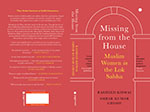
This book explores one of the most neglected aspects of the debate on Muslim political representation—the presence of Muslim women in the Lok Sabha. Written in a narrative style, it traces the sociological background, family association, and political trajectories of 18 Muslim women MPs. These life stories are not merely presented as biographical sketches covering the personal experiences of these women, and the moments that shaped and defined their political contribution; the authors also use these descriptive accounts as a point of reference to disrupt the established male-centric understanding of Muslim political representation. They argue:
…. Doubly marginalized as part of the minority and conservative Muslim community and as women, Muslim women have remained extremely under represented, with a total of barely eighteen representatives in the Lok Sabha in the last seven decades. It reveals the telling yet largely glossed over fact that out of nearly 7500 MPs voted to power since 1951, only 0.6% have been Muslim women. Out of the eighteen Lok Sabhas constituted till June 2024 in last four Lok Sabhas, there was not a single Muslim woman! Equally shocking is the fact that out of the 543 seats in the lower house, more than four Muslim women have never been voted to power at one time. (p. xxxv)
Analysing the under-representation of Muslim women in the Lok Sabha, the authors underline four important factors that affect women’s mobility in politics. First, the patriarchal nature of mainstream electoral politics limits women’s substantive political participation, and for that matter, their representation. It is claimed that ‘the low representation of Muslim women in politics is a part of a larger issue—an inconducive environment for women in general to participate more actively in politics’ (p. 202). They highlight the apathetic attitude of political parties which do not provide adequate representation to women in not only parliamentary politics but also in party positions. That is the reason very few women have been able to become Chief Ministers or party Presidents.
Second, Muslim women’s representation is also examined in relation to regional diversity.
Muslim women do not find favourable environment for upward mobility in politics in relatively less-developed States like UP, MP, Bihar and Jharkhand. Interestingly, many States with better social-economic indicators have also failed to produce a greater number of Muslim women MPs. Recognizing this complex regional picture, the authors ask: ‘Can better social economic indicators ensure a greater scope for women to enter and participate in electoral politics?… Even with social economic empowerment, what are the factors that deter women to thrive in electoral politics?’ (p. 203).
Third, Muslim women’s presence in the Parliament is inextricably linked to what is often described as ‘dynastic politics’. The eighteen biographical sketches presented in the book clearly show that a sizeable majority of Muslim women MPs came from economically well-off and influential political families. They were introduced to electoral politics to protect the legacy and influence of the family in a particular constituency. The author notes: ‘Muslim women leaders …were propelled into political limelight to support male family members, but were pushed into oblivion after serving one or two tenures in Parliament. The fact that very few could serve as long term MPs (like several male politicians in India) or become ministers, reveals the difficulty that even these ‘politically successful’ women confronted to sustain their political journeys and rise in the field’ (pp. xiv-xv).
Finally, the authors discover a unique feature associated with Muslim women MPs. They note: …not one out of the eighteen had any major allegations of corruption, criminal charges or using hate speech… there were no Enforcement Directorate (ED), Central Bureau of Investigation (CBI), Income Tax or Police cases against them. Those who are familiar with the intricacies of the actual working of our political system would notice this with a sense of admiration. Many of them, in fact, went back to their daily lives with ease and dignity. Perhaps it is for all major political parties, including the Bhartiya Janata party (BJP) to look at Muslim women’s role in legislative politics with a greater degree of interest and as having potential, particularly when the Women’s Reservation Act of 2023 is set to become a reality in a few years from now (pp. xxvi-xxvii). This observation is very crucial. It underlines the significance of women’s agency.
The authors do not make any sweeping generalizations. The debate on Muslim political representation revolves around a strong belief: The Muslims of India constitute a homogeneous political community, which has collective, identifiable and eventually fixed political interests; and for this reason, adequate number of Muslim legislatures in proportion to actual Muslim population is desirable. This simple, straightforward, and ahistorical assumption is often invoked to measure Muslim representation in quantifiable terms. This book, no doubt, tries to destabilize the given explanatory template of Muslim representation by highlighting the question of gender disparity. However, the main argument of the book relies heavily on a simple logic: that Muslim women’s representation (or under-representation) can only be determined by a population-to-MP ratio.
This line of reasoning leads us to an interesting paradox: Muslim women MPs, as the authors themselves show, do not claim to represent only the Muslim population residing in their respective Lok Sabha constituencies. By this logic, it would be inappropriate to underestimate their secular political identity as an elected representative. At the same time, it is undeniable that the presence of Muslim women MPs in the Lok Sabha is essential for fostering a more inclusive and gender-just legislative ecosystem.
To understand the dynamics of this contradiction, we must pay attention to India’s political-institutional architecture. The Lok Sabha is designed not as a demographic mirror of India’s religious diversity. Instead of seeking proportional representation based on identity, the Constitution seems to expect that elected MPs must act as ethical advocates for all citizens. This shifts the focus from who the representatives are to how they act, turning the protection of marginalized minorities into a collective moral obligation rather than mere numbers game. Representation, in this sense, is envisaged as an entirely secular act. The Constitution, nevertheless, is conscious of group rights. It makes a set of legal arrangements to address group-specific socio-economic marginalization. The reservation given to SCs, STs, OBCs (and now the EWS) is a revealing example in this regard. In this case, representation is defined as institutional inclusion. This is also true about the presence of religious minorities. The Constitution recognizes the unity in diversity thesis as one of the directive principles for public policy. Articles 25-30, which are more broadly called the ‘minority rights’, aim to protect the cultural and religious uniqueness of minority groups. These provisions define representation as the religious-cultural presence of minorities in public life.
We thus find three distinct forms in which representation as an idea is defined by the Indian Constitution: formal secular representation, institutional inclusion, and cultural presence. These three forms of representation are inextricably linked to each other to provide an interesting balance of power. For instance, formal secular representation becomes operative in the true sense of the term, if the inclusive character of state-institutions is achieved and the state follows a cultural policy that remains sensitive towards minority cultures. Any possible disturbance in this equilibrium might lead to secular majoritarianism.
The under-representation of Muslim women in the Lok Sabha must be examined in relation to this multifaced conception of political representation. Muslim women MPs are elected to represent a political community of citizens constituted on secular basis at the constituency level. The religious identity of Muslim MPs, on the other hand, has a symbolic value of its own. Their presence in the Lok Sabha reflects the gradual unfolding of the process of democratic participation. Missing from the House offers us an opportunity to explore this process in its entirety.
Hilal Ahmed is Professor, Centre for the Study of Developing Societies (CSDS), Delhi.