
The Indian hills have always held a unique fascination for the millions who struggle through their lives in the heat and dust of the subcontinental plain. They were customarily looked at as sacred dwelling places of divinities who needed to be propitiated with arduous pilgrimages, as destinations of spiritual seekers and redoubts of mystics. Though there is copious cultural lore on these hilly abodes and fanciful accounts in traditional literature, there is virtually no record of habitations and life in these regions.
When the British colonizers discovered the wonder and grandeur of the high Himalaya and, particularly, the gentle charms of its salubrious lower reaches as of hilly ranges scattered across the subcontinent, they saw an opportunity to reproduce an idealized image of ‘home’ in this distant land. The ‘hill stations’ they created present an imagined English countryside complete with its cottages and gardens, lanes and hedgerows, chapels and churches. Even the tree cover was supplanted with varieties from afar.
The need for a ‘home away from home’ was reinforced by a belief that Europeans would deteriorate genetically if they were not isolated from the inhospitable tropical climate and the polluting company of natives. Unsurprisingly, this meant Indians would be excluded from these enclaves, except for those like the maharajas who were westernized enough to pass muster, or those who provided the labour to sustain the Western way of life.
The colonizers left a large volume of literature about the hills, with innumerable accounts of exploration and adventure, escapades and gossip. As Indian writing became more prolific in the later years, perceptive accounts of sojourns in the hills were penned by well-known storytellers and essayists. Sadly, modern Indian travellers who rush up for a quick detox in pleasant climes are not much inclined to put finger to keyboard—except perhaps for Facebook posts and personalized blogs.
Ruskin Bond had earlier co-edited a wonderful anthology on the Himalaya, with stirring articles by well-known adventurers, spiritual seekers, naturalists and thespians, as well as local inhabitants. That is a volume to be treasured, not just for the marvellous writing but for capturing the most magnificent mountain range on earth in its myriad aspects.
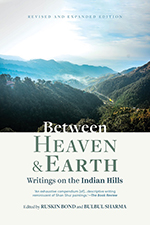
In the present volume, editors Bond and Bulbul Sharma, have brought together a new collection of pieces on the Indian hills, extending beyond the Himalaya to less exalted Ooty, Matheran, Hazaribagh, Shillong and others. Apart from accounts from the days of the Raj about life in the hills, clubs and party games, this volume touches on local people, folklore, cuisine, flora and fauna; even ghosts and spirits.
Writings on mountains cannot but contain evocative descriptions of glorious vistas and magical nature, sublime sunsets and dazzling moonrises, moments of epiphany and more-than-human encounters. Between Heaven and Earth is replete with these. Isabel Savory portrays a sunset as having ‘passed through every stage of beauty, through every glory of colour, through riot and triumph, through pathos and tenderness, into a long still rest.’ Rumer Godden depicts the tranquillity and stillness of the hills as an emptiness of the Buddhist kind, ‘an emptiness of space and not of blankness’. Francis Younghusband describes Nanga Parbat as ‘the very emblem of purity, dignity and repose…too light and too ethereal for earth but seemingly part of heaven; a vision which was a religion in itself, which diffused its beauty through one’s being and evoked from it all that was pure and lovely.’
Abanindranath Tagore was known to ‘write in pictures’. After a rain shower, he says, ‘the trees and plants have worn washed and fresh green clothes and have come out for celebrations’; ‘a tuft of sunburnt grass on the top of the mountain looks down from the blue sky and sees the cloud of water gradually approaching from below’; ‘the black hill on the other side…is sitting seriously and looking at the padam tree.’
During the heyday of the British hill station, some ten Indians were required to service the needs of each Brit. Writing about Simla in the 1830s, Emily Eden recalls that until quite recently, no European had ever been there, but now they led lives closely resembling life back home. Recognizing that this was possible only because of the vast number of impoverished locals in attendance, she wonders that ‘they do not cut all our heads off, and say nothing more of it.’
The first forays of upper class Indians to the hill stations are described by Swarnakumari Devi and Rabindranath Tagore. Stephen Alter writes of the transformation of the Landour of his youth, and Raja Bhasin about the evolution of Simla to the Shimla of today.
As far back as the first decade of the twentieth century, Younghusband noted that Gulmarg was ‘spoilt’ as compared to the ‘old days’. Several contributors comment on the environmental havoc and cultural upheaval that years of ‘development’, demographic change and mass tourism have wrought. Bijoya Sawian writes of her beloved Shillong: ‘We’ve lost the open spaces, we’re losing the greenery, and we hunt for unexpected beauty in clutter and dirt.’ Parimal Bhattacharya sees ‘signs of decrepitude’ all over Darjeeling. Even the snow-caps on the magnificent Himalayan peaks are becoming more difficult to sight.
Yet, as Bulbul Sharma discovers in a little village in Himachal Pradesh: ‘Nowhere else have I seen, smelt and touched the changing seasons as dramatically as in Shaya. Each year it seems as if spring has arrived for the first time on earth.’ As fruit trees burst into blossom and meadows sprout carpets of flowers, the red-billed blue magpie returns to his mischief and the whistling thrush trills sweeter than ever. Khushwant Singh revels in the solitude and all-pervading silence of his hideaway in Kasauli with a small puppy, a family of spiders and a thrumming barbet for company. In Binsar, Bill Aitken is ruled by nature’s clock rather than the one on his wrist. He exults in ‘the pulsating blueness of sky and wildly intoxicating tang of fresh grass, the benison of flowering cosmos… Never has my soul experienced such an orgy of abandoned delight.’
Other charms of the hills are narrated in Pushpesh Pant’s descriptions of Kumaoni meals, Minoo Avari’s recollection of memorable Christmases at scattered hill stations, and Ganesh Saili’s perplexity at why ghosts and spirits seem partial to the hills. In a fascinating piece, Shashwati Talukdar analyses colonial postcards of hill stations to decode ‘the project of empire with all its attendant anxieties and discursive gymnastic feats.’
Between Heaven and Earth is a delight. The Indian hills are a source of wonder and joy provided one knows where—and how—to look. The vignettes in this book bestow balm on harried urban souls and offer pointers on learning from our peerless hills.
Govindan Nair is former IAS officer based in Chennai.