
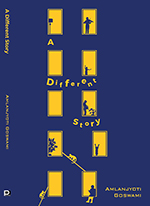
Amalanjyoti’s third collection of poems is divided into nine sections, each titled after a rasa as outlined in the Rasa Theory of Sanskrit: Wonder, Sorrow, Courage, Laughter, Anger, Fear, Compassion, Love and Peace. Among the poems in the eighth section titled ‘Love’ is a poem called ‘A Different Story’. Love stories that exist without a reason have an element of mystery that cannot be told: ‘They believe in themselves, breakfasts & long evenings/ These too exist without a reason.’ What poetry shares with love is this ability to turn the mundane into the magical. The world which exists as ‘any place in the world’ suddenly becomes ‘here and now’. Wandering minstrels and birds know as much about love as the abhisarika (the beloved one) who waits for the one who never comes. Looking for the sea and rain in Bombay is very much like looking for love: ‘go where no Google map can take you/ & lose your way/ somewhere along the road to nowhere/ that is when the sea will find you/ and the rain will embrace you/ like a feeling never born.’
Amalanjyoti’s poems probe the space of penumbra beyond the clear light of day, filled with echoes and presences. The expectant mood created by a master singer is woven into the gradual arrival of rain in a parched landscape: ‘You gestured patience, the future of water was still to come/ As drop by drop the drizzle came to your door-step, / One by one we collected raindrops/ In this parched land where no bird sings so well.’ The musician dazzles and drizzles, as his notes pick up tempo after a long alaap, ‘together with stirring with leaves, wet breeze’. This fine poem, ‘The Future of Water’ is dedicated to Ustaad Rashid Khan. Art in its various manifestations such as songs, films, myths and stories figure in several of these poems invoking intertextual resonances. ‘Gandhi Bhavan, Chandigarh’ is as much about the relation between art and artist, as about the Gandhi who eludes representation: ‘I realise my poem has no beginning or ending. It is not even beautiful. It has no song. No hands or feet. It is like Kolatkar’s Yeshwant Rao, one bobbly mass of words deepening into a sentence. It will make a theorist happy. But it will disappoint readers of poetry. But a Gandhi Bhawan? For that you need much more.’
The poem, ‘Things I learnt This Year at Rekhta’ draws attention to the gulf between Indian poetry and Indian English poetry. Urdu poetry has its admirers in thousands who throng the venues of a mushaira, particularly in winters, in cities like Delhi. The verses of Ghalib and Mir, Zauq and Momin still evoke passion and devotion. A poet who comes all the way from Amritsar recites his poems to the applause of ‘a crowd packed to the brim, standing room only’. The next line reads: ‘This would never happen for English poetry.’ Indian poetry still retains its oral roots in its strong bonds with rhythms and music. The audience waiting for a Qawwali knows that it will transport them into the world of youth and romance. Compared to this charged world of verbal magic, Indian English poetry appears cerebral and abstract. It cannot be denied there have been conscious efforts to bridge the gulf, in contemporary Indian English poetry.
‘Translating Banalata Sen’ is a journey to the dreamy interiors of the legendary poem. The poet is to present a translation of the poem before an audience, ‘in the empty season between two seasons/ in the break between life and death’, when he discovers that the best translation he has done is at home. His frantic journey home through the maddening crowds becomes a way of negotiating the act of translation: ‘I am just a turn away/ From that perfect poem/ Once I navigate this ocean of words/ This toss and turn of meaning.’ Words pour out of his pockets, and there is blood on the streets, cat whispers that Banalata is coming. His perfect translation is waiting there, ‘among the tattered yellow’. Banalata Sen is present, but there is no sign of Jibanananda ‘who is still waiting at the street, for the traffic to clear.’ What prompts the translators to return to ‘Banalata Sen’ repeatedly is the poem’s aura of mystique that communicates romantic yearnings filled with a pervasive sense of loss and metaphysical anguish. Vinodkumar Shukla’s meditative lines or Shrikant Verma’s Magad, attain the same haunting mystery in their best poems, as Amalanjyoti suggests in poems dedicated to them.
The section on ‘Fear’ begins with a poem that details the unjust treatment of the victims of the Bhopal tragedy. The Union Carbide got away by paying one lakh for those who were killed by the poisonous Methyl Isocyanate and ₹ 25000 to those who were reduced to living corpses. The poem ends with the wish: ‘If the accounts balance, for everyone in the same manner/ If ethics is the same as procedure.’ ‘Another Karna’ invokes the riddles of injustice the story of Karna brings out: ‘The loom of time casts its long shadow/ Would destiny have unravelled beyond argument?’ Not much has changed from the ancient times to modern, as far as questions of justice are concerned.
Is poetry becoming irrelevant in our times? Amalanjyoti seems to think so. When the passion for poetry dies, compassion or empathy for the other also seems to vanish from society. Some of the poems cited here are from the section ‘Compassion’. The Hindi teacher who was kind and surprisingly polite asked him to read masters such as Nirala and Muktibodh. He promised the kind-hearted teacher that he would read more with attention and feeling, and then left for the city, ‘where no one listens to a word of poetry.’ Salim bhai, who asks the poet to translate Rumi into Hindi feels that ignorance of Hindi or Persian is not a problem: ‘New words blaze in the new year/ “Keep this in your zehn”, he says/ When one day Rumi comes calling.’ ‘Man in the Crowd’ speaks of Ghalib wearing a mournful look, queueing for food on the street. When the perfect guest comes, he will become the Ghalib of old once again: ‘And share some secrets only he knows—Where poetry lives these days, what she likes and why/ She doesn’t enter our hearts as often.’
A Different Story is rich with many moments of epiphany that light up everyday scenes and sights. There are memories of lives lived in many places, works of art encountered in galleries, on screen, on pages and stages and the desire for a life of slowness and reflection amidst the gathering gloom of urban cacophony. Not all poems in the volume succeed to the same degree. Several of the longer poems would have benefitted from the work of a ruthless editor. In retrospect, the division of the poems based on their affective orientations has not enhanced the volume’s range or diversity.
EV Ramakrishnan is a literary critic who writes in Malayalam and English, an Indian English poet and a translator. He is a recipient of the Sahitya Akademi Award (2023) for his critical work in Malayalam.