
While reading Shehnab Sahin’s meticulously crafted short stories, I was reminded of what Mitra Phukan says in her introduction to The Greatest Assamese Stories Ever Told (2021): ‘The defining characteristics of a short story differ from place to place, and from era to era. Yet, there are also common characteristics which bind them together into a genre. As has been said by William Trevor in The Art of Fiction, it should be an “explosion of truth”.’ Yes, that’s how I felt while reading Sahin’s collection. An explosion of truth, in every story. It hits one not only through what is said, but also through what is left out—which is often considered a mark of brilliant storytelling in this format.
Sahin adopts an interesting titling strategy, providing a temporal reference by placing dates in brackets alongside each story’s title. This helps contextualize the everyday experiences of the protagonists as historically meaningful. And into these everyday experiences, she weaves in little acts of resistance as colonizers and the colonized, as invaders and the invaded, as people from pre-Independent India continued to interact amongst themselves in post-Independent India—and how that transformed or did not transform into an imagined community of India as a nation. She locates her stories across quite a range—British colonialism to Chinese Aggression to Assam Agitation to ULFA militancy to debates over citizenship. But in all these stories, the focus is on human lives and emotions.
The whole collection is a treasure, but I would like to mention here a few stories. ‘Two Leaves and a Bud’, which is set in 1858, is infused with magic-realism. Sahin mentions in her note that it is ‘set against the tumultuous backdrop of the “top-down” introduction of the plantation economy in Assam,’ which has been mostly narrated from the perspective of a British colonial agent whose duties are affected by the rituals that govern the plantation workers’ lives and their communication in the local dialects or a broken mix of Assamese, Bengali and English. This is a story that blends the real and that which cannot be rationalized, and how in that moment of confusion the truth begins to crumble—or reshape.
The same magic-realism and little acts of resistance can be found in the ‘Bellows of a Wilted Poppy’, set in 1860, which is the story of a bez (a traditional medical practitioner) who uses opium as an analgesic. The story takes a sharp turn when talks about the British banning poppy cultivation emerge.
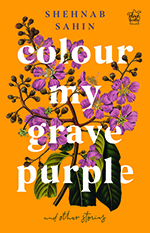
‘Colour My Grave Purple’, set in 1980-2000s, is a tender tale about a daughter’s love for her father and how she processes his death. One can sense her struggle in the following lines: ‘It was Abba’s first death anniversary… Her mother had organised a reading of the Quran by the Ulema to be followed by a dua, a prayer for the departed. Sara loathed the sounds that floated into her room… She hated the sounds of a faith that kept her away from her Abba. She was not allowed to visit his grave earlier that morning when an all-male group including her brother, who was much more functional and “normal” now, had gone to pay their respects and pray beside his grave at a cemetery in the heart of Guwahati.’
How does Sara cope with this? She goes through her Abba’s journals, where he talks about his postings across Assam and navigating incidents from Army-ULFA encounters and the agitation to drive illegal Bangladeshis out of Assam. In one of the journals, he writes, ‘On another note, I managed to get a few Ezar saplings. I have put myself on a mission. I will plant Ezar trees in all my accommodations, wherever I am posted. It takes around a decade for the tree to mature and knowing I won’t witness flowers of my own doing will pinch a little. But! Imagine in whose tenures they will. And how they will sing praises for the man who thought up this sensitive scheme. The world needs to be flooded with such beauty.’ The symbolism in this story, revealed tenderly, brought me goosebumps. But it reminded me of Rahat Indori’s hard-hitting words:
Sabhi ka khoon hai shamil yahan ki mitti mein,
Kisi ke baap ka Hindustan thodi hai
Everyone’s blood is a part of this earth
India is not anyone’s personal property
Through this story, in today’s socio-political climate that is marked by severe political polarization along religious lines, Sahin seems to interrogate what it means to be Muslim in India. Are they viewed in isolation? Or as part of a more cosmopolitan and secular inheritance? She also reminds us how Muslims like her Abba imagine India to be.
One can reflect upon these questions by paying attention to what Ali Khan Mahmudabad wrote in the context of Urdu poetry in his Poetry of Belonging: Muslim Imaginings of India 1850-1950 (2020): ‘In 2018, at a meeting in Meerut in the northern State of Uttar Pradesh, the chief of Rashtriya Swayamsevak Sangh (RSS), Mohan Bhagwat addressed one of the largest conclaves of RSS workers on a crisp February morning. In his long address to more than a thousand people, he said, “In India, one may follow a different eating habit, way of worshipping gods, philosophy, language and culture. But all are Hindus. There are many Hindus who are not aware of it. Only those who consider Bharat Mata (their) own mother are true Hindus.” This debate about who is a Hindu and what constitutes being a Hindu is of course intimately and inextricably linked to questions about Muslims and their relationship to India.’
Related to this broader rumination, Sahin also examines a distinct experience of Muslims that is unique to Assam. ‘Love is a Flimsy Kite’, set in 2019, is the story of a young Muslim couple who go through life’s journey as any other upper class Indian couple would. But when it comes to getting married, the boy steps back because he would not be able to convince his parents to accept a Miyani as a daughter-in-law, even though Miyani happens to be ‘Oxford returned’. Thus, Sahin captures the divisive politics in the anubhav–to borrow Gopal Guru and Sundar Sarukkai’s term—of what it means to be a so-called indigenous Muslim from Upper Assam and a Bengali-speaking Muslim with ancestry from Sylhet, which became a part of Pakistan with the Partition of India in 1947.
Stories like these bring to mind what dastango Shah Nadeem told his audience after a recent performance. Somebody asked him why he used Persian words and Persian sentences in his storytelling. While explaining himself, Nadeem reminded the audience that India as a modern nation state is about 78 years old, but India as a civilization is thousands of years old. The form of storytelling that he practices had travelled all the way from Persia to India, where it flourished under the Mughals. This is why, perhaps, the wise tell us that storytellers, artists and poets are the conscience keepers of society. Shehnab Sahin does just that through this collection.
Juanita Kakoty is a writer and researcher interested in epistemological and ontological queries related to gender, violence and social constructionism.