
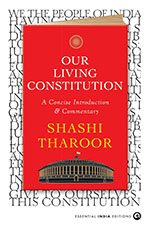
‘The Constitution will prevail as long as its spirit survives in the ordinary citizens of India’ (p. 106). Tharoor’s latest work concludes on this promising note at a time when the churning associated with democratic upsurge is being threatened by despotism, raising questions not just on popular sovereignty but also on many values cherished by Indians of diverse ideological positions. To whom or to what do we look to at such a time of deep reflection and contemplation? The Constitution, of course, and this is precisely what this cogent title by Shashi Tharoor undertakes.
For someone known for his sophisticated use of the English language, Our Living Constitution is a simple yet erudite ensemble of how the Indian Constitution came into being, how it continued relentlessly amidst different governments, how it stood the test of many a judicial precedent, and how it stands tall, figuratively so, as the sole ground of India’s sovereign legitimacy at present. With a total of nine brisk chapters, a Prologue and Conclusion, the book makes for an engaging read. The work contains interesting nuggets of information, for the uninitiated; that it was handwritten in English and Hindi (so much for the conflict over official language!) by Prem Behari Narain Raizada, with inputs from Nandalal Bose—the Constitution was a legal document and a work of art. Also, the date of adoption of the Constitution i.e., 26th January, was selected in keeping with the celebration of Independence by the Indian National Congress in the previous years on this date. The Indian Constitution was not just a celebration of India but also hailed as a model for other countries to emulate and adopt. Dr Rajendra Prasad described it as a ‘…Magna Carta of the emancipation of the human spirit’ (p. xiv).
While the Constitution was and is a lengthy one, embracing the philosophy of those drafting it, it is no less pragmatic, especially when one makes note of BR Ambedkar’s critical intervention in 1949 when he stated, ‘However good a Constitution may be, it is sure to turn out bad because those who are called to work it, happen to be a bad lot. However bad a Constitution may be, it may turn out to be good if those who are called to work it, happens to be a good lot…’ (p. x). The admission of the fallibility of human nature opened up the Indian Constitution as a realm of freedom and as the subsequent chapters would note, the Indian Constitution has been subjected to over a hundred amendments. Besides this, the statement is also a cautionary reminder to be wary of ‘wrong minded’ people in power (p. x) who are likely to distort the Constitution.
The chapters follow the trajectory, understandably, of Constitution making from colonial times. The landmarks are fairly similar to those mentioned in notable existing literature on the Indian Constitution. This review will attempt to draw attention to interesting information across the chapters that feed into the meta-narrative of how the Indian Constitution came into being.
The first chapter traces the fledgling efforts of the Indian nationalists and the British Crown to introduce piecemeal legislations of governance in colonial India, starting with the Government of India Act, 1858. Needless to say, this and subsequent legislations were unfolded with vastly different intentions. For the Indians, it was a gradual move towards Independence and for the British, a means of continued imperialism. This is evident in the gradual and frugal involvement of the Indians in Constitutional government, in particular the establishment of the Indian National Congress with the help of AO Hume. This was served as a legitimate platform for seeking purna swaraj, with all the tensions and contestations that accompanied Independence. Tharoor, in particular, labours on Granville Austin’s idea that the Indian Constitution is ‘first and foremost a social document’ (p. 6) and proceeds to dwell at length on the Directive Principles of State Policy (DPSP) and legislations like MGNREGA as an outcome of these directives. For Tharoor, the DPSP ‘continue to serve as a moral compass for policymakers’ (p. 9).
The idea of India is covered in chapter two with Nehru’s vision, that India is a ‘country held together, by strong but invisible threads…a myth and an idea, a dream and a vision, and yet very real and present and pervasive’ (p. 16) countering the critical views of Winston Churchill and Benjamin Disraeli who believed India barely possessed qualities that would befit a nation. While the concept itself may be European, Tharoor argues that India has been as much a nation, drawing from its mention i.e., Bharatvarsha in the Rig Veda, the civilization idea, quite akin to the notions of Adi Shankaracharya’s conception of Hinduism’s sacred geography or the notion of the Muslim ummah, both encompassing the idea of belonging to communities larger than themselves (p. 17).
The emphasis on nation and its coexistence with plurality is the bedrock of this chapter. While identity was primarily cultural, Constitution makers had to anchor identity with robust concepts of citizenship, human rights, fraternity and equality before law. Tharoor deftly positions the values of rule of law, secular democracy, state intervention and planning as one of the many ideas contributed by Ambedkar, Nehru and Patel, coming from vastly different socio-economic backgrounds, i.e., ‘born an untouchable’, ‘the patrician’ and ‘a doughty lawyer from farming stock’ respectively (p. 18).
Of significance in this chapter is the introduction of the term ‘civic nationalism’, the common thread and the philosophy that runs through the entire text. This nationalism had its support in liberal constitutionalism that captured the insight, i.e., ‘the singular thing about India is that you can only speak of it in the plural’ (p. 22).
Chapter three has on its very first page an interesting note that our current political leaders could very well emulate, i.e., under the rule of law, you do not have to agree all the time—except on the ground rules of how you will disagree (p. 25). The consensus on how to function in its absence was what has held India in good stead for the past 75 years. Tharoor elaborates on the idea of civic nationalism—how it derives political legitimacy from consent and active participation of citizens (and not from ascriptive identities). This idea is best captured by BR Ambedkar who stated, ‘I do not want that our loyalty as Indians should be in the slightest way affected by any competitive loyalty, whether that loyalty arises out of our religion, out of our culture or out of our language. I want all people to be Indians first, Indians last and nothing else but Indians’ (p. 27). Nevertheless, the Indian Constitution as a social document had to address identity-based discrimination and the chapter quotes from Ambedkar’s ‘Grammar of Anarchy’ (Speech in the Constituent Assembly, 1949) and establishes fraternity as the building block of unity and solidarity. The chapter concludes with critical comments on caste reservations, arguably leading more to its entrenchment than elimination from public life (p. 35).
The next set of chapters move seamlessly from pure constitutional discourse to institutions of civil society, judiciary and federalism in India. Chapter four reiterates the liberal individualism that led to the preference for rule of law, a centralized state, rejection of localism, rejection of separate electorates and a preference for individual representation than the group. Tharoor quotes Madhav Khosla to drive in the point— ‘the very constitution of one’s identity as a citizen was itself a form of freedom’ (p. 37). The divide was not territorial, Tharoor would argue, as that was settled by the creation of Pakistan. The divide was intellectual in the Constituent Assembly, i.e., assertion of individual citizenship vs. Indian nationhood defined as a confederation of inescapable identities (p. 39). In post-independent India, the principle of constitutional morality was to keep a check on this majoritarian tendency. Besides this key focus point, the chapter also looks at distinct visions of India of Rabindranath Tagore and Mahatma Gandhi and Ambedkar’s scathing critique of Gandhi’s Ram Rajya and village centered polity in the following comment, ‘What is the village but a sink of localism, a den of ignorance, narrow-mindedness and communalism?’ ‘I am glad’ Ambedkar would say, ‘that the draft Constitution has discarded the village’ (p. 46).
The Indian Constitution is also a transformative document that facilitated legislations on the abolition of zamindari, judicial activism, the right to privacy, increasing the scope of the right to life, etc. This transformative language also made space for the accommodation of civil society activism (Anna Hazare movement), Public Interest Litigation and through it all the creation of a deliberative space beyond just the Parliament. The presence of a ‘vocal’ civil society, a ‘thriving’ free media, human rights groups and autonomous institutions—all served as assets to India’s civic nationalism.
Civic nationalism, however, was not the only discourse as is evident in subsequent chapters that explore the alternative, questioning its tenability in a land marked by pluralism and openness to diversity. Chapter seven examines the hegemonic project of Hindu Rashtra put forth by the Sangh Parivar. Interesting here is Deendayal Upadhyay’s ‘chiti’—a term he uses to denote ‘soul power’ of a nation and the anecdote of the barber who uses the razor of his father, a matter of pride and prestige (despite the blade being changed over the years). For Upadhyay, every nation had a chiti that the Indian Constitution had failed to capture. Hence, India was devoid of the virat shakti/life force, that the chiti creates (pp. 66-67). Somewhat in continuation, chapter eight looks at Constituent Assembly members like PS Deshmukh who urged one’s religious identity as a basis of citizenship. Needless to say, this denominational foregrounding of citizenship was discarded at the time of Constitution making. Whether Indians have over the past decades been secularized is something to reflect upon, especially in the context of the Citizenship Amendment Act, 2019, that brings religion back into the debate on citizenship. To quote Tharoor, ‘As I told my fellow parliamentarians, that [creation of Pakistan] was a partition in the Indian soil; this [CAA, 2019] is now a partition of the Indian soul’ (p. 71).
The last chapter examines India’s federal structure, reflecting on whether it has lost its diversity amidst the nationalizing project of the current government especially in the centralized and indiscriminate use of the sedition law, weaponization of the investigative agencies and demonetization, and nationwide lockdown during COVID using a little-known provision of the National Disaster Management Act, 2005. The book ends by revisiting the prophetic words of Ambedkar, ‘a Constitution is only as good as those who work it’ (p. 96).
The current work is rich in content and reiterates the need for us to revisit the short history of independent India. It serves as an affirmation of Constitutional values, gently nudging the Republic to read and comprehend the philosophy of the Constitution, and urges the popular sovereign not to fall for populist rhetoric.
Malavika Menon is Assistant Professor, Department of International Studies, Political Science, and History at Christ University, Bangalore Campus, Bangalore.