
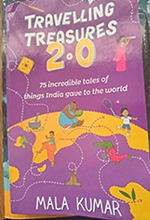
Mala Kumar’s Travelling Treasures 2.0 is a fascinating collection of 75 stories about things that originated in India and travelled far beyond its borders. What makes the book enjoyable is the range of its subjects. Instead of focusing only on famous historical achievements, Kumar explores everyday objects, foods, games, words, traditions and ideas that many of us use or recognize without knowing their Indian connections.
Shampoo, for example, is connected to the Hindi word chāmpo, while pyjamas have an Indian linguistic and cultural history. The book also looks at buttons, bindis, khaki and cardamom, showing that India’s influence was not limited to grand inventions. These familiar things become starting points for stories about trade, language and cultural exchange.
The sections on games and knowledge are equally engaging. Chess is traced to chaturanga, an ancient Indian game, while carrom and polo reveal different aspects of India’s sporting traditions. The book also discusses zero and mathematical ideas, as well as astronomy, Ayurveda and yoga.
What I found most appealing is that Kumar does not simply ask readers to memorize where something came from. She makes us follow its journey. A dish can leave India, encounter another culture, change its ingredients and eventually return in a completely different form. A word can cross languages and centuries. A game can evolve from an ancient battlefield simulation into one of the world’s most popular board games. In this sense, the book is really about how cultures meet and transform one another.
I particularly liked that the book encourages readers to question the origins of things they take for granted. Even mangoes, ghee, pepper and sugarcane become part of a much larger story about India’s connections with the rest of the world. The result is a book that makes history feel close to everyday life rather than something confined to textbooks.
Kumar’s writing is lively and accessible, which makes the book especially suitable for young readers. Overall, Travelling Treasures 2.0 succeeds because it combines history, geography, food, language, science and culture without becoming a conventional history lesson.