
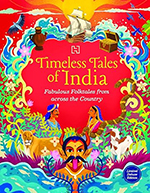
This deluxe collection of timeless and fabulous folktales of India is a creative tour de force with an impressive narrative range of the tales included in it, and the illustrations with which they are enriched and embellished. From the northernmost tip of Ladakh to the southernmost Andaman and Nicobar Islands; from the easternmost State of Arunachal Pradesh to the westernmost State of Gujarat, these stories map the cultural geography of India to document its rich heritage of eternal wisdom and the enduring joys of telling and listening to stories.
Since the intended readers of this book are children, the bright cover in primary colours with its illustrations redolent of the familiar tropes of mystery, adventure and romance, immediately invites one to delve into its pages and travel across all the thirty-six States and Union Territories, on a journey that is instructive and entertaining in equal measure. Each journey is steeped in local colours, costumes and cuisine, and the minute details of the topography with its botanical, avian and zoological richness. The imaginative teleporting makes the book an immersive experience from which one emerges with a feeling of having actually been there and lived among the characters. Each of the stories has been imaginatively and skillfully illustrated, ensuring that the images and the palette match the location as well as the plot. It is this attention to detail and the authenticity of cultural representation that make each of the stories an exquisite artefact with its textual and visual synergy. What also sets this anthology apart from other story collections is the one-page verbal snapshot of the geographical location that follows each story, giving some of the most important details of its history, unique cultural specificities like food and festivals, architecture and crafts, as well as introducing its present avatar as a place that invites a visit.
Stories written for children are conventionally didactic in intention and often tediously so, but not so the tales in this collection, which are written in accessible and evocative language with plenty of description and dialogue. They manage to foreground the plot, characters and action to focus on the showing rather than the telling of eternal verities of love and harmony, friendship and kindness, generosity and perseverance, courage and camaraderie. So, there are fables with anthropomorphic animals, birds and plants, origin and creation stories, and simple accounts of the daily lives of protagonists whose world the reader will have no trouble becoming a part of. Each of the writers guides us to a willing suspension of disbelief and creates a universe of possibility and excitement.
The opening story is from the Andaman and Nicobar Islands and tells us, ‘How the Night Came to the World’ and is accompanied by other origin myths like the story of ‘The Sun and the Moon’ from Jharkhand. There are cautionary tales like the one from Andhra Pradesh that tells us to ‘Watch What You Wish for’, and Assam in which ‘Petu Learns to Share’, a generous old woman is granted ‘The Promised Boon’ in her village in Bihar, and the adventures of ‘The Two Sisters’ from Chandigarh, which has more than a simplistic moral binary at its heart. In this fabular world inhabited by marvellous creatures, we read about ‘The Sacred Drum’ from Arunachal Pradesh, ‘The Lady of the Sea’ in Daman and Diu and Dadra and Nagar Haveli, ‘The Lady with the Lustrous Hair’ from Mizoram, ‘The Wily Jackal’ from Gujarat and ‘The Ghost Who Was Not Dead’ from Telangana. In the final story in this collection from West Bengal, we meet ‘Buddhu-Bhutam: Prince Monkey and Prince Owl’. As we traverse the mysterious and legendary Himalayas, it is fitting that we encounter ‘The Mountain Raksanik’ in Himachal Pradesh and are awarded with ‘The Unique Gift’ from Jammu and Kashmir. As we continue our journey across the country, we meet ‘Khaari’ in Meghalaya, encounter ‘Tapoi’ in Odisha and get to eat ‘The First Mangoes of Summer’ in Puducherry and learn ‘The Magic of Music’ in Uttar Pradesh. The tantalizing mention of these stories is meant to serve as an indication of the awesome range of this fabulous collection and also serve as an appetizer to the feast that its pages promise and deliver in generous measure.
It is AK Ramanujan in his Folktales from India who reminds us about the ability of folktales to travel across time and space and remain eternally relevant because after all, storytelling is the oldest and most enduring activity that binds us into a community. This collection of thirty-six fabulous folktales from across the length and breadth of India are like the songs that birds sing abidingly every morning at dawn and remind us, especially when heard with the trust and innocence of childhood, about the importance of a hedonic calculus like the ones in these stories, to help us negotiate the challenges of growing up.