
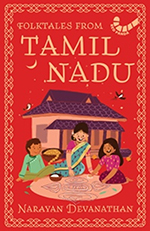
Why is it that folktales invoke grandmother/Paati or mother/Amma, little children, and a time locked in the past? The collection Folktales from Tamil Nadu, written by Narayan Devanathan is cast in the same framework, saying ‘I will talk to you as if you are a child’(p. viii). My own research shows that folktales are often parables for the adult reader to transfer the realities of violence, injustice and oppression to the imagined world of talking birds and beasts. Basically, a humanized cosmos endows folktales with the gravitas, ethics and morality that teach the young and old alike in the ways of their community. Once this autonomy and stature are granted to folk literature, one begins to look at Panchatantra, Vikram and Betal, Kathasaritsagar, Aesop’s Fables and Grimm’s Fairy Tales as a complex perspective on life’s challenges. This honour, I believe, should be granted to folktales.
Turning to the book of stories from Tamil Nadu, I could demonstrate this through a few themes and examples. The idea of talking animals and birds is so common that it builds certain stereotypes of the wicked crow, the diligent sparrow, the wily jackal, and such others. In the story ‘The Lazy Crow’ (p. 30), Kaka tricks the sparrow, Kurvi, and secretly gobbles up all the food that she had lovingly cooked for her children. In return, Kurvi decides to punish the crow in a smart but cruel way. She invites the crow to her home and offers her a nice warm bath before the meal. As the crow luxuriates in a tub, Kurvi pours buckets of scalding water on her. Is this justice or brutality? There’s another story about a crow stealing medu vada and being tricked into surrendering it. Without spoiling the fun of reading animal talk, can one also interpret such material as fables on moral choice?
Deriving from the medu vada episode, let me transit to the delectable tales on Tamilian food—payasam, kozhakattai, dosai, appalam and other mouth-watering dishes. Food is sustenance, reward, allure, temptation and other such signifiers in all cultures. In the folktales they are particularly attractive for centring the stories of mystification. ‘Kali and the Seventh Black Pepper’ (p. 17) enlarges the peppercorn into an influential object, ‘Athiripaacha’ (p. 55) tells of competing recipes. Food stories are also spiced up with rustic humour and age-old beliefs.
In a few stories, the boundaries dissolve between human and planetary beings—the moon being a favourite. The story ‘Nila, Nila, Odi Vaa’ (p. 101) revolves around the joyous songs of the ‘Moon Children’. When a King takes the Moon prisoner, the Sun refuses to set and the world is in danger of being scorched into destruction. Night has ceased, sleep has disappeared, water is evaporating, vegetables are wilting. Finally, the King realizes that the Moon has to be released and reunited with her Moon Children, so the diurnal order returns. That action completed, everyone ‘lives happily ever after’.
I question the traditional ending ‘lived happily ever after’, which is indeed so false that no child will believe it. When Amma or Paati is asked to tell another story, it will be about another crisis, another challenge. As the gap between the real and surreal disappears in the digital world, stories for children have to adjust to the young ones who have scrolled on phones before they could talk. Folktales adapt. They have survived the fragile oral origins, retellings, migrations, language wars, translations and interpretations. They are strong enough to survive the current devastations of environmental crisis. Today, a folktale is to be read as an exemplum for promoting human coexistence with nature. It belongs to a sophisticated genre of storytelling. Across languages, folk tales have left archival footprints of the community’s value systems. Periodically, anonymous storytellers have written down a few. Fortunately, folk narratives are now receiving honourable attention as serious literature.
Folktales from Tamil Nadu is a good example of how culture is preserved and passed on through stories. The book contains sparkling illustrations by Nirzara Verulkar, relating to the stories and also cultural knowledge. Examples are ‘Anjarai Petti’ or a ‘five-compartment box’ (p.152), or ‘Malli Poo’ (jasmine flower, p. 100), or ‘Kolam’ (rice flour decorations on the floor, p. 68). These visuals anticipate the day when such items become a part of museums because, sadly, globalization is flattening the minutiae of cultural difference.
Narayan Devanathan’s book is a part of a regional series on folktales published by Red Panda. My sincere plea is not to infantilize the reader because such tales heard in childhood build the ethical core of adults. Stories carry the responsibility of conserving the past and directing the future.