
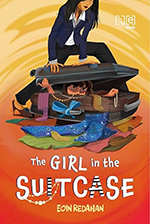
In the landscape of contemporary youth fiction, stories that navigate the delicate intersection of domestic turmoil and structural vulnerability often risk slipping into the depths of moralism and overt simplification. The Girl in the Suitcase deftly sidesteps these challenges by anchoring its high-stakes narrative in the psychological resilience of its eleven-year-old protagonist, Orla. Driven by familial duty, the narrative uses the motif of the suitcase to examine how childhood agency operates under acute distress. Redahan delivers a gripping, tautly written thriller that effectively keeps readers guessing.
The premise turns on a small, plausible act of loyalty. Orla’s older brother Declan has a scheme involving stolen manhole covers, and Orla, rather than reporting him or walking away, follows him out of familial loyalty. That choice brings both siblings into the orbit of Magda, a teenager who understands how to make children feel responsible for their own entrapment.
What follows is a tightening sequence of blackmail—Magda has secrets that can bring ruin to Orla’s family—prompting her to take on a high-risk journey involving a suitcase whose significance the reader anticipates well before Orla does.
The majority of the plot is centred on the suitcase, stumbling through various modes of transportation and the different aspirations and emotions the characters, especially Orla, experience throughout this haste with only one thing in mind—escape. The suitcase itself is never allowed to become a symbol the narrative pauses to interpret. It functions purely as object and obstacle—carried, hidden—and whatever it comes to represent about secrecy is left for the reader to construct rather than for the text to state. The device is handled with restraint precisely because it is not overworked.
Orla is not written as a heroine. She lies, panics, consistently makes wrong decisions, second-guesses herself, and continues anyway, only to save her family from shame. She becomes part of a complicated scheme of lies and deceit unwillingly, something that bothers her conscience throughout and makes her craving for escape grow more and more.
It is in Magda that the book reveals its deeper ambition. Calm, calculating and frightening, she is no typecast villain: a product of hardship herself, shaped by scarcity and by adults who saw her as useful rather than as a child, she now does to Orla and Declan exactly what was once done to her. Coercion is presented as inherited and passed downward, a chain in which today’s exploited child becomes tomorrow’s exploiter—and that Magda is only a teenager herself makes this bleakly effective.
Redahan’s most significant achievement is his refusal to render law-breaking as adventure, rendering it instead as a compulsion whose consequences accumulate. The novel is unusually clear-eyed about the mechanics of coercion: children are drawn into schemes not through recklessness but through obligation, guilt, and the reluctance to abandon someone.
Poverty, want, and the adult exploitation of children are an important underlying theme. Magda, Orla and Declan are not affluent children playing at danger; want and ambition characterize their lives. Gemma, Orla and Declan’s mother, is an overworked, affection-deprived single mother whose only goal is freedom from the shackles of abject poverty, representing adults who are overwhelmed rather than negligent. Magda’s father Cormac, by contrast, is shady and untrustworthy, considering children and adults alike only as a means to gain. It is, however, Redahan’s major concern that when adults are distracted, children absorb the shortfall, making decisions far beyond their years and carrying consequences they did not earn.
The book is divided into sixteen short chapters, all of which close on a note of intrigue, and certain comic instincts are present to relieve the tension without completely evaporating it. This economy of style has clear narrative advantages: it keeps the pace brisk and lends the prose a cinematic quality well suited to the book’s short, cliff-hanging chapters.
Mehnaaz Hussain’s illustrations work in close alignment with the text, marking pace and character rather than extending the narrative independently, and they function mostly at significant scenes that are often hard to picture through descriptive text alone.
However, the novel does have some drawbacks. The aftermath of the climax is wrapped up quickly, which does not match the premise that is set. The social conditions the book gestures towards remain largely in the background, and Magda’s history, once revealed, is not given room to complicate the ending as fully as it might. Readers looking for resolution of the circumstances that produced her will find the book more interested in escape than in repair.
The Girl in the Suitcase is witty, suspenseful and quietly substantial—a middle-grade thriller that takes seriously what children carry when the adults around them are negligent. The book excels at building suspense, even if the plot occasionally relies on familiar crime-fiction clichés that slightly weaken the depth of its characters.