
The scariest moment is always just before you start. — Stephen King
This was the first thought that came to my mind when I was reading Akela. We rarely come across books for children or young adults that talk about the difficulties of writing. A few may exist, but they are usually written like guidebooks. In Akela, Richa makes the difficulty of writing itself the subject of the story.
For children, it can be fascinating to know how the books they read come into being. What does the journey of writing look like? There are so many choices in life, and writing can be one of them too. People often say that writing and art need solitude. But too much solitude can cut you off from life and the world. Your writing cannot have the heartbeat of life if you are not living life yourself.
The main character, Akela, is a writer struggling to write. But his problem is not really writer’s block. It is the difficulty that comes just before beginning. Perhaps the story waiting to come out of his pen is simply not ready yet.
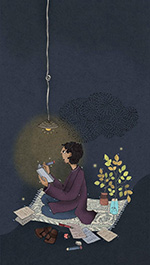
There is a pleasant little town with many lanes. Somewhere in these lanes lives Akela Lekhankoot, looking for something new to write. But he cannot write. He thinks the noise around him is the problem. So, he decides to move away from it.
With nails, a hammer, pliers and a spanner, he climbs up and builds himself a small rahanwari, a little shelter of his own.
Sitting there, he is happy. Surely, now he will write. But morning turns into evening, and he cannot write even a single line. He climbs higher and builds another rahanwari. A new hope appears. Perhaps now the writing will begin. But the paper, pencil and ruler remain untouched in a corner. Only a face appears in the story, along with its name, and then the story gets stuck there. Akela shouts, screams and stamps his feet, but if the story does not want to move, how can it?
So, he climbs higher and higher, carrying wires, ropes and bulbs, and builds another world. Perhaps here, the dry stream of imagination will begin to flow. But nothing happens. Disappointment surrounds him. Will he ever write again? Will these lifeless words ever fill with life?
And then something happens.
The cries of children reach his ears on the wind. He hears people fighting, women complaining, voices filled with pain and anger. Suddenly, it feels as if a door has opened.
This book is not only for children. It is for anyone who has ever tried—or even thought about trying—to create something. In a quiet and creative way, it tells us that we cannot create by running away from the world. We may need silence and solitude, but we also need life. Writing cannot breathe without life.
Ruchi Shah’s illustrations bring this idea beautifully to life. The cover, with its deep colours, shows Akela Lekhankoot and his tiny world. The illustrations are full of wonderful details—strings of bulbs, flowers, the night sky and children swinging on old tyres. Most beautiful is the way Ruchi Shah has imagined and brought Akela’s rahanwari to life.
Originally published in English, the book has been translated into Hindi by Shashi Sablok. The translation is simple and smooth, though a few extra words could have been avoided. Overall, Akela is a thoughtful and imaginative picture book, beautifully published by Eklavya Prakashan.
Having traded the classroom for the quill, Upasana is a versatile writer, crafting tales for young and old alike. With four books under her belt and three awards, including the coveted Bhartiya Jnanpith’s Navlekhan Award, she is a trained painter too.