
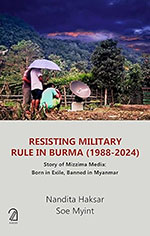
Soe Myint, one of the authors and a central figure in this book, is a Myanmar national who has devoted his life to the struggle for democracy and the creation of an independent media in his country. The thirty-six-year period covered by this remarkable volume traces his evolution from a student activist to a dramatic hijacker seeking to draw international attention to Myanmar’s plight, and later to a journalist driven by a clear mission. This journey culminated in the establishment of Mizzima, a media organization that would come to play an important role in documenting resistance to military rule.
Mizzima was initially set up in India, where Soe Myint lived in exile for twenty-two long years. The organization expanded significantly after Myanmar’s political transition allowed him to return home in 2012. That opening, however, proved short-lived. With the military’s return to power in February 2021, conditions deteriorated rapidly, and Mizzima was among the media outlets that were banned. Undeterred, Soe Myint relocated to ethnic rebel-controlled areas along the Thailand border, from where he continued leading his team in reporting on the grim developments unfolding inside the country.
The book’s co-author, Nandita Haksar, is a well-known Indian human rights lawyer who has represented many Myanmar nationals fleeing repression and seeking refuge across India’s long northeastern border. Her comradeship with Soe Myint—he affectionately addresses her as ‘Aunty Nandita’—is recounted at several points in the book and reflects a relationship built on deep mutual respect and solidarity. At the same time, Haksar candidly notes that they often differed in their political perspectives and worldview. She played a key role in mobilizing legal defence and public pressure that eventually led to the acquittal of Soe Myint from hijacking charges. Their collaboration, however, extended far beyond courtroom battles: they worked together on initiatives ranging from putting together television programmes to humanitarian medical assistance for Myanmar, all aimed at strengthening people-to-people ties between the two countries.
Haksar’s empathy for the Myanmar cause is also rooted in her earlier work. Along with her husband, Sebastian Hongray—a human rights activist from Nagaland—she had been long involved in addressing human rights abuses in India’s North East, a region whose communities share strong ethnic and social links with populations across the Myanmar border.
Structurally, the book adopts an unusual and effective format. After an introductory chapter that offers a concise overview of Myanmar’s military since 1962 for the benefit of unfamiliar readers, the volume consists of fifteen chapters presented as personal narratives by five different voices. In addition to the two authors, three Mizzima associates contribute their accounts. Together, these narratives interweave the evolution of Mizzima with contemporaneous political developments in Myanmar, creating a chronicle that is both compelling and, at times, deeply disturbing. The book vividly conveys the courage and resilience of the Mizzima team, as well as the personal challenges they faced, including Soe Myint’s own battle with cancer.
The additional voices enrich the narrative considerably. One is that of Sein Win, Soe Myint’s younger brother, an engineer-turned-journalist who partnered with him in expanding Mizzima’s operations. Sein Win reflects on how his years in India shaped his understanding of diversity and the centrality of minority rights in building a just society. Another contributor is an American journalist writing under the pseudonym Joseph Ball, who recounts Mizzima’s brief collaboration with the Myanmar Government when it served as an official media partner for the Southeast Asian Games hosted by the country in December 2013.
The third is James, an Assistant Manager at Mizzima, who was arrested by the military regime in April 2021 following the organization’s ban the previous month. His account offers a chilling glimpse into the interrogations and torture endured by political prisoners.
At its core, the book seeks to show how Mizzima consistently brought acts of popular resistance against military rule to a global audience, despite the challenges. As Soe Myint states at one point, ‘I have always thought of Mizzima as an integral part of the movement for democracy and federalism. Our interventions are all aimed at initiating conversations around issues most important for the future of our country.’
This review cannot do justice to the full range of experiences and evocative episodes captured in the book. These include, for instance, Haksar’s legal intervention in a poignant cross-border love story involving a Manipur Rifles soldier and a Burmese Muslim woman, as well as the fascinating detail that Soe Myint and some of his colleagues once operated out of outhouses at the official residence of then Indian Defence Minister George Fernandes during their exile in India.
Certain aspects of the book, however, merit specific attention, particularly its treatment of Daw Aung San Suu Kyi. While the volume is dedicated to her and acknowledges her deep love for her people and her commitment to a democratic and federal Myanmar, it does not shy away from criticism. It notes candidly that although the National League for Democracy (NLD) Government that took office in 2016 initially advanced media reforms, these efforts later slowed and were even reversed in some areas. A striking example is the arrest of two Reuters journalists for reporting on the killing of ten Rohingya men, an action defended by an NLD spokesperson who argued that peace, national unity, and economic development took precedence over media freedom.
Elsewhere, the critique becomes sharper. The book observes that the NLD failed to build durable democratic institutions and remained overly identified with a single leader rather than a coherent programme. Aung San Suu Kyi retained multiple ministerial portfolios, there were no women in her Cabinet, and the Party did not field a single Muslim candidate in the 2015 elections, despite Muslims comprising around four per cent of the population.
On the contentious Rohingya issue, Soe Myint speculates that Aung San Suu Kyi may have refrained from outright condemnation of military atrocities to avoid empowering Buddhist chauvinist forces. This reasoning, however, does not adequately explain the position, particularly in light of her decision to personally lead Myanmar’s defence at the International Court of Justice in December 2019.
Mizzima may be one of the few in Myanmar which stood out for its unequivocal reporting on the plight of what the book describes as the country’s ‘most oppressed minority’. And this despite the severe risks involved.
Looking ahead, what does the book suggest about Myanmar’s future following the military’s forcible return to power in February 2021? Soe Myint expresses cautious optimism, drawing strength from the unprecedented resistance mounted by a younger generation that had experienced a decade of relative openness and reform. Armed struggle between the military and resistance forces—including ethnic armed groups and the People’s Defence Forces aligned with the exiled National Unity Government—resulted in the latter gaining control over nearly half of the country’s territory by the end of 2024, although to some extent these have got reversed in 2025.
The book was completed before the military announced elections scheduled to be held in the very near future. With major parties such as the NLD and some prominent ethnic political groupings not in the poll fray, critical questions remain unanswered: Will the elections be conducted peacefully? Will they extend to areas beyond full military control? Will citizens turn out to vote in significant numbers?
These uncertainties remain unresolved. Soe Myint himself concedes that he cannot predict the outcome of Myanmar’s resistance. Yet, reaffirming his journalistic credo, he insists that whatever happens, Mizzima will continue to tell the world what is unfolding inside the country. It is this steadfast commitment that lends the book its moral force—and that may yet carry Soe Myint and Mizzima far into Myanmar’s uncertain future.
VS Seshadri is former Ambassador to Myanmar and presently a Senior Fellow at the Delhi Policy Group.