
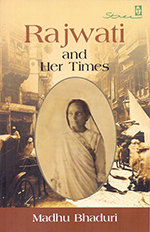
A retired IAS officer who has already written four novels in Hindi and published several collections of short stories decides to write her first book in English. What could be a better subject than writing the life story of her grandmother Rajwati who was born in 1896 and died in 1985, and whose interesting life covered the freedom struggle and the Partition of India? What triggered the writing was the accidental discovery of a tattered copy of a book found in a box containing papers in the cottage in the Sivananda Ashram where Rajwati had lived for the last two decades of her life. Published in 1906, the book, called The Seths of Biswan, was written by Rajwati’s father Kunj Behari Seth, and after one of her grandsons got it professionally restored from Paris along with several old photographs, the interest in writing her family history turned into reality.
Written through nine chapters, an epilogue, a family tree chart at the beginning, and interspersed with several black and white photographs throughout the text, the story of Rajwati Seth (initially called Rajjo and later mentioned as Bari Mummy by the author), begins in Lucknow or Awadh where her father, belonging to the Khatri clan, ventured out of the traditional money-lending business to work as an esteemed judge in the lower court and who greatly valued women’s education in particular. After a decent English education, Rajjo and her family faced an upheaval when bubonic plague struck the country, and she lost her mother to it. Later, after her father’s remarriage, family equations changed and by chance she met her future husband Shivraj, who was educated abroad, and who was from a Bhalla Khatri family from Punjab. Despite cultural and language differences, she got married to him in 1915 and moved on to her new home in far-off Lahore.
A brief life history of this remarkable lady must be narrated here to understand how without professing to be a radical feminist in her ideas, the protagonist was very open-minded even while functioning within the domestic parameters of her existence. For her, each of her granddaughters was a princess and she called them, including our author, by adding ‘Rani’ to their names. Despite being an ardent Hindu, she did not openly contradict the beliefs that her Arya Samaji in-laws’ family professed.
Rajjo’s exposure to different communities began when just after her marriage she moved with her husband to his workplace in a remote mining ore factory in Gurumahisani in Orissa, came back to Lahore for her first childbirth, and in due course moved to Calcutta where Shivraj was transferred and where her second son was born. This city added to her freedom where among other things she learnt driving. In 1922, the family moved back to Lahore and later moved on to stay in their own home at Chauburji, where Rajjo’s hospitality became famous. Some of her husband’s open-minded attitude towards religion must have rubbed off on Rajjo too. During the 1940s when strong political currents leading to the movement for Independence shook the country, the effect was felt by Rajjo’s extended family too. On the one hand, she took the role of the matriarch and lived a life of luxury till the point when the family decided to move out of Lahore. Believing in Hindu-Muslim amity, they continued to stay even after Lahore was set ablaze in June 1947. At the end of September, Rajwati and her husband left Lahore in the private aircraft belonging to Liaquat Ali Khan, the Prime Minister of Pakistan, who was Shivraj’s friend, and they were perhaps the last refugees to leave the city.
The next stage of Rajwati’s life was spent in a large house in Rajpur Road in Delhi which accommodated members and friends of their extended family. In due course of time, she started accompanying her friend Kailashwati to visit an ashram near Rishikesh founded by Swami Sivananda and soon found its environment compelling. Beginning with occasional visits there, in the last chapter, ‘A Room of Her Own’, we are told how Rajwati, used to living in a high level of comfort throughout her life, chose to live a very simple life in the ashram. She moved here and there according to her own will, and though her husband sometimes came to meet her in the ashram, she asked her granddaughter to look after him and keep him in Delhi till his death in 1975. With time she grew weaker till she was diagnosed with cancer, but she took her end with magnanimity, chanting the mantra which appeals for liberation by death, and passed away peacefully in her sleep.
Memoirs are often technically incorrect, especially because one must take recourse to narration by different people, and after a lapse of several years, faults do creep in. Nevertheless, one is really impressed by the way the author has managed to bring together the personal and the political in this text. In conclusion, one needs to mention a typographical error: Lansdowne Road in Calcutta is named after the British ruler and not Lansdown as mentioned in p. 39. In p. 31, the author mentions that ‘Balraj was given seven years of rigorous imprisonment in the most dreaded prison on the Andaman Islands in the Bay of Bengal, which was called “Kalapani”, translated into English as “Blackwater”’. The meaning remains a bit unclear here and needs to be reworded as the jail was known as the Cellular Jail and ‘Kalapani’ was the name given to the oceans that Indians had to cross to reach British territory, whether in England or elsewhere. Hope these minor errors will be rectified in the next edition when the margins on both sides of each page can also be kept at equal width. For a slim volume of merely 106 pages, the price of the book is rather steep, but it captures in a broad sweep the history of a family as well as that of the subcontinent throughout the twentieth century very well. This should lure readers into picking up the book.
Somdatta Mandal, critic and translator, is former Professor of English at Visva-Bharati, Santiniketan.