
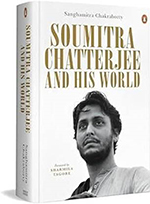
When I think of Soumitra Chatterjee (1935-2020), I get immersed in memories stored in my mind from my school-going days in the early sixties. I still remember how remarkably handsome he looked while shooting for Satyajit Ray’s Charulata (The Lonely Wife, 1964). We used to play cricket just opposite his residence in Kolkata. Almost fifty years later, I was mesmerized by his acceptance speech on receiving the Dada Saheb Phalke Award in 2012 at Delhi’s Vigyan Bhawan. During the six decades since his appearance in Ray’s Apur Sansar (The World of Apu, 1959, the third part of the celebrated Apu Trilogy), Soumitra scaled heights of artistic achievement that few in India could equal. This appears extraordinary if one thinks that, unlike his more popular compatriot Uttam Kumar, Soumitra had acted only in Bengali feature films. No wonder, his death was widely mourned in Bengal, and also in film circles abroad.
There is hardly any enigma in the life and professional career of Soumitra. A consummate actor, equally proficient in cinema and theatre, Soumitra knew the difference that these two art-forms demanded. He was also fortunate to have been mentored in his early years by Natyacharya Sisir Kumar Bhaduri who gave a new life to Bengali theatre, and later by Satyajit Ray.
Satyajit-Soumitra collaboration has been much discussed in discourses on cinema. Having played the lead role in fourteen of Ray’s twenty-eight Bengali feature films, and having evolved over the years, he remained an integral part of Ray’s creative oeuvre. But Soumitra was more than that, and his multi-faceted persona is what this book, the most comprehensive so far, seeks to explore.
In recent years, there has been serious academic work on film-actors and their contribution to cinema, both as an art form as also as a popular medium that stirs public imagination. And this is true for what is known as ‘regional’ cinema as well. In Bengal, scholarly works in English on popular heroes is rather a recent phenomenon. After Sayandeb Chowdhury’s Uttam Kumar: A Life in Cinema (Bloomsbury Academic, 2021), Sanghamitra Chakraborty’s recently published work on the other stalwart of post-Independence Bengali cinema is a milestone in this genre.
After an insightful foreword by Sharmila Tagore, one of Soumitra’s co-stars, the book starts with a six-page introduction, and is thereafter divided into ten well-defined sections, followed by a postscript, acknowledgements and notes.
As Sharmila Tagore recalls, ‘The morning-after scene in Apur Sansar where the young Apu finds Aparna’s hairclip on their bed, has remained one of the best-loved scenes from the film. It was beautiful how Manik da (Satyajit Ray) had left just a hint of the couple’s intimacy and said no more…’ This is quintessentially Ray, but it required a Soumitra Chatterjee to act out on screen such sequences with ‘emotional authenticity’, in film after film after film.
Soumitra was more than a film star. His talent ‘as a poet, essayist, editor, playwright, theatre actor and an artist’ manifested itself for about six decades and made him a cultural icon of the State. Uttam Kumar was more popular among the masses and also a great actor whom even Ray described as ‘unparalleled’. But Soumitra covered spaces that only he could do while remaining steadfastly dedicated to the cause of cinema (and to an extent, to theatre). This multi-dimensionality was beyond the call of his contemporaries in Bengal, and in the broader context of India.
Although he played the protagonist in over 200 full-length Bengali films, it is a pity that he had declined offers to work in Hindi cinema for films like Bees Saal Baad (played finally by Biswajit Chatterjee), Sangam (the role that went to Rajendra Kumar), Aadmi, Anand (for the part that made Amitabh Bachchan famous), Life in a Metro, Pink and Shyam Benegal’s Kaliyug (the role played by Shashi Kapoor). This shows the esteem in which Soumitra was held in Bollywood, but his consistent refusal had also deprived him of a wider, pan-India audience. In the process, both sides suffered. Much later, in 2017, he said, ‘If it were today, I wouldn’t have refused them…’ Arguably, as an actor, he belonged to the class of Amitabh Bachchan and was more accomplished and versatile than the likes of Biswajit, Rajendra Kumar and Shashi Kapoor.
The uniqueness of the book lies in its attempt to capture the complete persona of Soumitra, based on extensive research, where reliable anecdotes mingle with facts, known and unknown, quite seamlessly. His long association with Ray that is often likened, for instance, to Toshiro Mifune’s with Kurosawa, has been widely covered. But the author goes beyond the obvious, exploring Soumitra in all his dimensions.
Adoor Gopalakrishnan observed that Soumitra, on screen, ‘became the quintessential Bengali, intellectually inclined, of middle-class orientation, sensitive and likable.’ Soumitra not only turned down attractive offers from Bollywood, he did so for the enfant terrible of Bengali cinema, Ritwik Ghatak, who offered him a leading role in Komal Gandhar (1961). But the two belonged to different worlds. Ghatak, though an eminent filmmaker, was mercurial, often an alcoholic and provocative. Here is an instance recalled about a meeting, ‘At the meeting, we sat on the last bench, and I was close to Ritwik. He had some very cheap habits; he would manipulate and rib people. He kept on abusing Satyajit Ray. I did not get provoked since I did not hold a brief to defend Ray. Maybe he got frustrated at my nonchalance and he threw a swear word on me. I jumped at him, held him by his collar and planted a huge blow on him. One blow. I said I would bury him right there. That I was not Satyajit Ray and a bhaddorlok (respectable gentleman) like him…’ This shows the sterner side of the gentle Soumitra Chatterjee. It was a loss to cinema that Soumitra and Ritwik had never worked together.
Except that the book does not have an Index and a Filmography, it is a definitive work. To know about this great actor and a man of high sensibility, and of his indelible imprint on cinema, this masterly work would serve as a major source to cineastes and educated readers alike.
Amitabha Bhattacharya is a former IAS officer who has also served in the private sector and with the UNDP.