
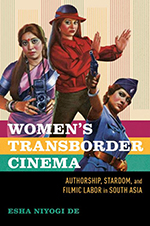
Esha Niyogi De’s remarkable and innovative book is a work of transregional feminist film history, examining women’s filmmaking and film production across South Asia. It shows how women working in South Asian films crossed many kinds of borders, including institutional and aesthetic ones, and how they played major roles in reshaping labour practices, stardom, and authorship. Niyogi De zooms in on women filmic authors such as Shamim Ara, Aparna Sen, Sai Paranjpaye and Gauri Shinde—figures who directed and shaped films in regional cinemas in India, Pakistan, and Bangladesh, while also engaging in roles such as acting, screenwriting, or producing. Such women worked in scales ranging from small studios to large, lavish productions. The book thus also traces how women’s interventions vary by scale, affecting aesthetics, marketing and stardom strategies.
The book adopts a transnational and transborder approach to film studies. From this framework, we get much analysis of co-productions, piracy networks, shared star practices and circulation of films and personnel across borders. Narratives of sutured national filmmaking are punctured. ‘Transborder’ as a term in this book is anchored in an understanding of production and distribution. But the book also addresses how national film identities, and regulation are negotiated. The author argues that women used strategies such as women’s companies, sisterly networks, entertainer-producers, and star personae to claim authority in contexts that are patriarchal and postcolonial.
The book is organized as a series of case studies and thematic chapters that move geographically and analytically across South Asia. Representative chapter foci include female stars producing in Kolkata; women’s companies and sororal production in Dhaka; entertainer-authors and small-scale Urdu cinema in Lahore studios; female film authors at Bollywood scale; and pirate modes, coproductions and transnational Bangla media. Niyogi De’s interdisciplinary approach is particularly innovative in bringing together studio records, archival records, the trade press, and, most importantly for this reviewer, attention to informal economies. The attention to female labour is welcome and yields important fruits.
If we look at some of the case-studies examined in the book, the contours of the argument become clearer. Lady Smuggler (1987) is an action heroine film produced by Shamim Ara Productions (headed by star Shamim Ara), co-produced with the Bangladeshi star Babita. Released in Pakistan (1987) and dubbed in Bengali for Bangladesh (1990), the film is a strong example of a pirate mode and cross-border co-production by women. The film takes popular action-hero tropes from Indian cinema, for example, but reworks them in ways highlighting female agency. Alternate circuits of film labour and spectatorship were built up by such cinema.
The case of Shamim Ara (Pakistan) as star, director, producer is riveting. Her company produced a series of action-heroine or travel and tourism-inflected films (Miss Hong Kong, 1979 and Miss Colombo, 1984, to take cases in point). She was a female star-author who carved out a space and found creative authority in a male-dominated industry. Her films often involve cross-border circuits of production and borrowing from global genres. She was both an artistic and economic entrepreneur.
Aparna Sen, established actress and director/producer, is analysed in two parts of the book. In the earlier part, her emergence as a film director in 36 Chowringhee Lane (1981) and her bold film Parama, which treats a mature married woman’s relationship with a younger man with sensitivity, are seen by Niyogi De as part of the larger story of decoupling maternity, creating maternal tropes that escape the focus on heterosexual coupledom, and creating symbolic languages of public maternity. Also riveting is Niyogi De’s detailed analysis of the earlier, pioneering Bengali star Kanan Devi’s negotiation of direction and production of films after having been an actress, and how she too created powerful tropes of unusual maternity in her films and persona. Later in the book, we have an analysis of Sen’s The Jewelry Box (2013), a horror-comedy film that innovates generically, and that leverages Sen’s celebrity identity, and fan expectations. Sen is a mainstream celebrity figure playing multiple roles, including having edited a popular women’s magazine. The multigenerational film under discussion treats Partition histories, possibilities of cross-religious love and desire, and the liberation movement of Bangladesh. Niyogi De’s close readings are deft and subtle, and The Jewelry Box is one of the best among them.
Another fascinating analysis is that of the Bangladeshi filmmaker Rubaiyat Hossain’s Meherjaan (2011), in the analysis of which war trauma, cross-border solidarities, and a subversive aunt figure, Salma Khala, produce, Niyogi De argues, an unusual feminist utopia set during the Bangladesh Liberation War. Niyogi De’s book examines the work of film companies in Dhaka led by women, often working with family or sister-network connections producing films across Bengali cinema circuits. In this analytical narrative, while earlier Bangladeshi star authors and filmmakers such as Babita worked with small-scale transnational infrastructures or local infrastructures, filmmakers such as Hossain are highly educated internationally, and work in an era of digital streaming and diasporic audiences. Though Meherjaan faced public outcry and a ban, after showing publicly for some days, perhaps due to its sympathetic depiction of a deserting Pakistani soldier and his ties with an East Pakistani young woman and her aunt, Hossain has gone on to make more films, such as Under Construction (2015) and Made in Bangladesh (2019).
That female star labour and women film directorial labour can fruitfully be analysed together is revelatory for many readers. Also impressive is how the book carefully interweaves empirical analysis and theoretical analysis: this is a work that uses interviews, biographies, memoirs, articles from the trade press, to name only some of the sources it deploys, while its analysis of culture, female agency, labour, and feminism is nuanced and brings vividly alive how much these South Asian women filmic authors were able to do and be, without losing sight of the constrictions they faced, and the constant negotiations with patriarchy and the state they engage(d) in. Obviously, by focusing on prominent women film authors, the book does not have the analytic space to examine minor filmic authors. But that would be to quibble. We get a richly layered feminist transregional cultural-theoretical history of South Asian women filmmakers, and the conditions of production within which they deployed their labour as makers of film.
Niyogi De in fact shows much continuity, and not primarily difference, between older female star-author practices and those of female filmmakers working in newer media constellations. Most of all, what this book reveals is that a transregional analytic approach can be excellent at uncovering local, regional, national, as well as transnational dynamics. The author travelled literally and metaphorically across borders and diasporic spaces, interviewed filmmakers and sometimes their family members, unearthed private, unofficial archives, and offers us a way of considering female filmic authorship and female filmic labour together. The book is steeped in recent scholarship on South Asian film, and is supple and agile in deploying cultural theory. It is also a book that an educated lay reader will enjoy. Niyogi De makes an important contribution to the cultural history of South Asian women’s filmic creativity and entrepreneurship through this book.
Barnita Bagchi is Chair and Professor of World Literatures: English at the University of Amsterdam.