
Schooling is a ubiquitous word but not a ubiquitous experience in our country. In this book writer Amman Madan elaborates upon social reasons for this differential schooling experience. The writer does not confine himself to attributing these differences to systemic, policy-based issues, but digs deeper into our social settings, which shape the schooling experiences or lack of it.
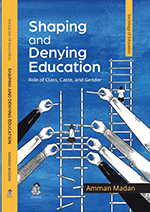
The cover of the book shows two ladders: one is a tall ladder, climbed comfortably by a child to reach high. The other, shorter ladder has missing steps, creating long gaps, numerous hands are mediating, adding and removing the steps making it a relatively difficult ladder to climb. And it is not difficult to guess who gets to climb which ladder.
In fluid, relatable, easy to understand language Madan explores the themes of caste, class and gender in the book. He begins by explaining how our society is stratified and explains varied aspects of social inequality and its impact on schooling experiences. Taking the reader along each chapter are figures, tables, graphs illustrated by Abira Bandhyopadhyay, the concepts explained in the text. Illustrations of layered sociological concepts add to the understanding of the text with simple, effective and contextual graphical representations. As the writer minutely dissects the intersectionality of caste, class and gender, keeping the text free from jargon, illustrations allow the reader to look, pause and make a deeper correlation with the text. The effort to keep the narration style flowing, easy and complemented by illustrative figures makes the book accessible to everyone interested in understanding how schooling is both a collective and an individual experience shaped by social inequalities.
Madan has integrated his extensive experience as a student, teacher and sociological researcher by giving relevant and relatable examples to bring out the nuances of inequalities which are otherwise easily missed even by seasoned educators.
The book also gives readers a hope, hope which comes from education which challenges, critically questions and demands an egalitarian system. It explains the transformative power of education and quotes examples from around the world where the existing social order has been resisted, challenged and changed. In an increasingly privatizing world, education can still be the tool which brings equity in a traditionally unequal society.