
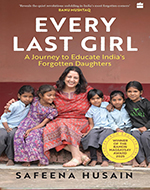
Safeena Husain’s book posits pertinent and relevant questions about access, opportunity and the continuation of education for millions of girls in India. Being educated is seen as an important process to improve an individual’s living conditions, bring about transformative changes in society, and challenge the patriarchal mindsets of people that render the health and education of daughters as less important than their sons. From the author’s own life experiences, she firmly believes that education is not only a source of ensuring better employability and acceptance from others, but it also allows us to live with dignity, awareness and pride. It also ensures that one is not in the state of being ‘illiterate’ and can make their day-to-day decisions with wisdom and rationality.
Husain recalls the role of her aunt and credits her for enabling her to dream big and continue her educational journey after a break of three years. While the rest of the family had written her off in terms of what she could achieve and aspire to do in this lifetime, the encouragement and support of one family member ensured that the author not only got herself educated but also made sure that many girls from marginalized backgrounds were educated as well. She insists that getting educated is the only way to break the cycle of poverty, abuse, violence and neglect and be able to bring about progressive changes in their lives. She reiterates that being educated can bring about a positive affirmation of an individual’s identity and how they see themselves and can empower them with situational awareness and informed decision-making. It also translates into being seen as an important and contributing/participating member of society and not a liability or a burden. While the idea and intent of inclusion of all girls, especially those who are scarred by poverty, caste discrimination and patriarchal prejudices and expectations are laudable, achieving it by navigating the ground realities is full of obstacles and challenges.
Husain and her team attempt to reach out to the girls of the most marginalized backgrounds in Rajasthan, Uttar Pradesh, Madhya Pradesh and Bihar. Their efforts aim to include every last girl (Antimbala) in the process of being educated and overcome their physical, economic and social marginalities. These marginalities, interspersed with stringent and staunch patriarchal ideas, often create strong reluctance and resistance against girls’ education. It means the preferential treatment for boys over girls is reflected in families choosing to send boys to school in case of economic crunch, girls being burdened with domestic chores, taking care of cattle, farm animals or even younger siblings. The act of sending girls to school is seen as a loss of ‘free labour’, and girls are often encouraged to adhere to their gendered socialization roles. The intersectionality of class, caste and gender adds to vulnerability and exclusion for girls, increases their chances of child marriage and child labour, and the continuation of intergenerational cycles of illiteracy and poverty.
In order to achieve the objectives of the Right to Education and Sustainable Development Goals, gendered disparities in the educational experiences need to be addressed. During the early phases of their campaign, they were met with suspicion and mistrust, with many people questioning their intent and interest in this matter. Their presence and efforts in some of the most remote and isolated areas of the country were full of challenges. The families of the girls were concerned about their safety while commuting to distant schools; the idea of viewing girls as ‘paraya dhan’ demonstrated a preference for sons.
Girls’ education was not prioritized or rendered as important and on par with the education of boys. It also led to a kind of ‘negative loop’ where families would not send their daughters to schools and hospitals as there were not many female teachers or female doctors. However, to ascertain that there is a significant number of female teachers and female doctors, girls need to be educated and supported in their educational pursuits.
This was done through awareness programmes, collaboration with government agencies and funding partners, securing the trust and support of influential local leaders, and conducting door-to-door surveys and documentation. It was also accompanied by powerful anecdotes and narratives from community members who shared the meaningful and purposeful changes that education brought to their lives. These stories evoked relatability, instilled inspiration, and aimed to encourage people to send their children to school and ensure regular participation. The attempts of Husain and her team demonstrated their grit, persistence and agency to bring about social transformation. They posed reflective questions about gendered socialization, challenged conventional patriarchal practices and presented powerful stories of role models from their communities. The book allows readers to contextualize/comprehend the ground realities of people on the margins and the possibilities of bringing about progressive and inclusive changes through education. It is a recommended read for research scholars, educators, social workers or anyone interested in researching social changes brought about by education in contemporary times.