
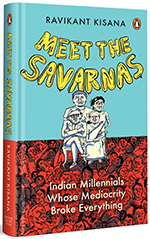
The structure of the Indian social system cannot be understood unless caste is studied as an institution which constitutes its building blocks and columns. Social scientists, including historians, political scientists or even sociologists, have all mostly invested in the study of caste as a raison d’etre of hierarchy, discrimination, exclusion or humiliation. The available literature on caste has scarcely touched upon the notion of caste as social capital of intergenerational advantage or privilege, barring a few. One is reminded of a book like Being Brahmin, Being Modern: Exploring the Lives of Caste Today (Bairy, 2013), or an article titled ‘Caste and Castelessness: Towards a Biography of the General Category’ (Deshpande, 2013) published in the Economic and Political Weekly that may serve such a purpose.
Ravikant Kisana underlines the literature gap relating to the subject of privileged castes whom he calls Savarna. He is convincing in his claim that there has been hardly any mainstream full-length cultural commentary on Savarna elites in India before this book. This social category literally owns everything, be it social, economic or cultural capital, he asserts. They run everything, including the publishing firm that published Kisana’s book. Kisana is both unambiguous and unapologetic in his assertion as he notes:
…I have attempted, foolhardily, to document and narrativize the pathologies of the hyper-visible yet perennial blind spot that is the world of elite ‘savarnas’, who critique everyone and everything but never themselves. No matter what method I use, this venture is doomed to fail in many savarna eyes. They will inevitably find clever and creative ways to dismantle its mediocrity in ways that I cannot imagine. This is because the savarnas, especially the educated elites, are used to being experts on everything…they are used to being pundit…the final word on a subject…they are not used to reading about themselves…. (p. 7)
Kisana is an academic; he has theorized his plot to situate and narrate his point of view. In doing so he has taken his cue from a feminist scholar, Marilyn Loden, who is credited to have coined the notion of a ‘glass-ceiling’. Kisana calls it a ‘glass-floor’. In the South Asian context, and more specifically India being a caste society, the author constructs an imaginary glass floor, below which lies the majority of Indians popularly and literally known as Bahujan (that constitutes Dalit/SC, Adivasi/ST and Shudra/OBC). These are mostly the have-not masses struggling, facing penury and hardship. And above this floor lies a relatively small group of people whom the author calls ‘Savarna’, who have historically been laced with intergenerational privileges of wealth, education and employment. This miniscule minority above this floor dons control over all the switches of electricity and water supply for those stuck in this basement below the glass-floor for more than a thousand years now.
The usage of the term ‘Savarna’ is somehow fraught with historical as well as sociological quandary. Dr Ambedkar too, had faced this conceptual dilemma. He agreed to a formulation that those who are born in (or with) a ‘varna’ are called ‘savarna’ and those born outside the four specified varnas mentioned in the religious scripture including the tenth Mandala of the Rig Veda. Kisana depicts one traditional varna representation of the four varnas in a triangular visual with Brahmins on the top followed by Kshatiyas, then Vaishyas and then the Shudras at the bottom. He contrasts it with another visual, what he calls a more accurate varna representation where the top three varnas are categorized as Dwijas; yet all four including the Shudras are marked to be falling in a broad category of the Savarna. The bottom of the pyramid is occupied by the Avarnas which constitute both ex-untouchables and tribals (p.19).
If one applies the mathematical principle of set theory, all ‘Dwijas’ are ‘Savarnas’ but all ‘savarnas’ are not ‘Dwijas’. Logically, it may look convincing. But the same visual further depicts that all ‘Shudras’ are ‘Savarnas’, which is slightly problematic. The author fittingly explains the ‘Dwija’ Savarna as a category in itself with a privilege to wear a sacred thread. But this privilege too is based on one’s janma (birth) and not on one’s karma (action). History tells us how the Yadav community in Bihar had braved violent onslaught in their conscious attempt at wearing the sacred thread to claim Kshatriya status in the early nineteenth century. But this never altered their varna status as it remained detrimental to the mandate of religious scriptures.
It is only when one applies the corresponding constitutional categories of General as unreserved and OBC, SC and ST as reserved that the two broad categories of Savarna and non-Savarna might look distinct from each other. For instance, there are a number of upper Shudra castes like Kammas, Reddys, Marathas, Patels, Jats, Lingayats and Vokaaligas who fall in the General category and have not been the beneficiary of reservation meant for the Other Backward Classes. But many of these caste groups have been mobilizing themselves to be included in the category of OBC. There are, however, both historical and contemporary reasons for their exclusion.
There are evident examples of how the Shudra status of Shivaji came as a hurdle during his coronation to become Chhatrapati in 1674. As recently as in 2017, the official residence of an outgoing Shudra-born Chief Minister of one of India’s largest States, Uttar Pradesh, was cleansed with Ganga-jal to purify and make way for a Kshatriya-born Chief Minister. Yes, the upper caste Shudras may have gained some economic capabilities but calling them ‘Shudra’ is both historically as well as sociologically validated. They are Savarna in a semantic sense. This offers a philosophical explanation for why the colonial administration called them ‘depressed’ and later the Indian Constitution called them Socially and Educationally Backward Classes. The best scientific representation, however, is depicted in an article, ‘Who are the Other Backward Classes? An Introduction to a Constitutional Puzzle’ (Gallanter, 1978, p. 1813).
Beyond this conceptual dichotomy, this book neatly constructs the narrative about how the politics of being Savarna and the inherent privileges operate in subtle body language. This book reminds us time and again how it is important to adopt lenses to gaze beyond the written and spoken language. On one hand, the author eloquently adopts the academic and lexical lingua-franca but on the other hand, he also utilizes subtle anecdotes and the popular medium of story telling. His reference to Lalu Prasad being referred to as corrupt, rustic or lacking refinement, and Mayawati as lacking beauty was a common story in average Savarna household conversation during the decades of 1990s and 2000s. But who dared to document this? Kisana’s hard-hitting lexicon can be discomforting, but he establishes through his logical arguments that the pathogens of caste superiority are not going away anytime soon.
The author’s own social location no way deters his articulation. He is aware that all the prejudice and ostracism does not come exclusively from Brahmanas and Savarnas. The nature of graded caste inequality means that even the marginalized do fall prey to such pathology (pp. 32-33). By telling us the stories of success of lot many mediocres in the last three decades is the real strength of this book.
Arvind Kumar is Assistant Professor, Centre for the Study of Social Inclusion, Jamia Millia Islamia, New Delhi.