
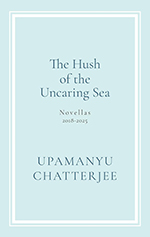
Upamanyu Chatterjee has a wondrous knack for creating unusual characters and developing them in meticulous detail till they become full-fledged protagonists from atypical segments of society. Add to this his sardonic humour and rare chronicling methods, and every book is a page turner. The Hush of the Uncaring Sea contains a bonanza of four novellas, markedly different from each other—but Chatterjee’s penchant for exposing power hierarchies binds them coherently.
The first story from which the book derives its title is about Abani, an adolescent who is accidentally left behind on a ship, completely unaware of his dangerous position as an ‘extra’. The ship’s captain, and the other officials don’t wish to jeopardize their immigration procedure in a foreign port with this unlisted sailor. A ruthless decision is taken to float Abani in a boat, with a few bottles of water and packets of biscuits and leave him to his fate, whether it is rescue by a passing vessel or death by starvation. Chatterjee’s so called ‘neutral’ prose describes the scenes without a comment, and what makes the situation even more poignant is that young Abani doesn’t protest; the underdog in the hierarchy has no voice. His simple faith: ‘When I was lone out there, it was the sea that took care of me’ (p. 102).
The second story ‘The Revenge of the Non-vegetarian’ portrays a different kind of non-entity, Basant Kumar, the exploited servant in a wealthy family who loves non-vegetarian food. Plenty of it graces the dining table with a delectable aroma. The men eat first and leave just enough for the women, who in their turn consume the remaining pieces of meat with the curry and rice. Finally, the container with the remnants is handed over to Basant Kumar for his ‘meal’. He is never given a single piece of meat and is expected to mix poor quality rotis with the remainders in the pot, add chilli and onion to this pathetic portion and satisfy his hunger. At other times he is expected to carry a pot of the rich aromatic dish from one home to another and all along the journey ‘its aroma had made him salivate, driven him mad…’ (p. 122). One time, he decides to slurp up some of the curry, knowing well that the recipient will notice. The oil drips on the side of the pot are a sure giveaway and the woman’s caustic comments are simply ignored by Basant Kumar. The deprivation and frustration turns an obedient servant into a murderer and he bludgeons the family. Imprisoned, tortured—for coveting a piece of meat. Again, silence from the underdog.
The third is a delightful story called ‘The Stink of Red Herring’ about young Prem Kumar, just returned from the USA, his status marked by a Delsey suitcase and State Express cigarettes.
He is expected to land a brilliant job but his snobbish Surgeon General father is appalled to hear that Prem wants to set up a Detective Agency! How preposterous, as the eldest son he must fulfil the dreams of his parents. A strange turn of events brings about the kidnapping of a child and a demand for ransom. Liberally sprinkled with references to old Hindi cinema, pretentious practices in the desi sahib’s home, and an easy banter about the ‘master sleuth’, the story leads to Prem’s ‘success’ in solving the case. This enables his setting up an ‘international detective agency’ in a tiny barsati room in a gali in Karol Bagh. ‘Entry from Back Side only’, declares the signboard (p. 236).
The last of the stories, ‘The Hapless Prince’, veers into history when the Indian nobility was trying to establish friendship with the British Resident in the hope of retaining their privileges. Yet another tale of social snobbery, ‘young royals’ were sent to British schools. The Prince, after many years, meets up with his English classmates and recalls the racism, condescension, and also a kind of perverse curiosity about palace lives. He confesses to the humiliation he accepted, ‘I demeaned myself, spoke the language like an Indian blockhead, left my brains behind in a jewel box with my retainers’ (p.
275). In India, it is his turn to show off the regal lifestyle that the foreigners are fascinated by: Polo in Jaipur, duck shoot at Bharatpur, ceremonial dinners at Rampur. The Prince has secret plans about dethroning the Resident and befriends a few English officers. One of them is completely besotted by the fragrance of the mutton korma and saffron rice, the finest of wines and expensive tobacco. His gluttony is his weakness and even the Matarani or Queen Mother indulges him. Upamanyu Chatterjee has no hesitation is using words such a ‘darkie’, ‘niggers’, ‘ink pots’ and ‘natives’ to illustrate the insulting attitude of the British towards Indians. The plot slides into a macabre comedy of irresistible Indian cuisine and a British ‘guest’ who refuses to leave!
From Prince to paupers, the protagonists in all the novellas are young people situated within social hierarchies that cannot change. Chatterjee’s earliest grand success English, August: An Indian Story had cast a pattern, in a way that structures and systems allow little freedom to the individual. As his novels have progressed, the focus has shifted to the individual’s small hope of cracking the code and attaining a sense of selfhood. Though often futile, even self-destructive, the ‘heroism’ of the underclass lies in dreaming up an escape and chipping away at little slivers of authority that might crumble. Portraits of the outcast, the outlier, the non-entity open into the fascinating tales in The Hush of the Uncaring Sea. Upamanyu Chatterjee knows that the stultifying systems will not change, they constitute a habituated understanding of the political and social chain, privileges of wealth, neglect of the poor, and the continuing supremacy of those in power. The ‘Hush’ is not so much in the sea as in people who accept, adhere to and propagate the ‘uncaring’ system.
Malashri Lal, writer and academic, with twenty-five books, retired as Professor, English Department, University of Delhi, Delhi. Publications include Tagore and the Feminine, and The Law of the Threshold: Women Writers in Indian English. Co-edited with Namita Gokhale is the ‘goddess trilogy’ with books on Sita, Radha and Lakshmi. Also co-authored is Betrayed by Hope: A Play on the Life of Michael Madhusudan Dutt which received the Kalinga Fiction Award.