
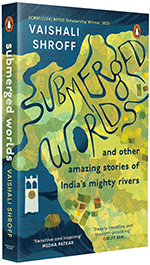
As rains lash across the country and we are inundated with news about floods and landslides nearly every day, this book comes as a stark reminder of what we are doing to Nature and how it is pushing back at our shortsightedness and greed. While we pay lip service to the holiness of our rivers, how we worship them and consider them as mothers, there is the only too different reality of what we actually do to these ‘mothers’. Allowing untreated effluents to pollute the flowing waters; rampant construction on the flood plains; blocking of natural water courses; irresponsible tourism; sand mining; cutting down of trees; building huge dams that submerge villages, cultures and ways of life–need one go on?
The foreword informs us that Submerged Worlds was inspired by the story of a displaced man who lost his home to a dam. As the author explores the mythological and cultural history that is so closely linked to our rivers, she does not ignore reports generated by both government and non-government agencies, combining them with interviews with experts, and impact assessment findings. And running through them all are the narratives of the people who live/lived in close kinship with rivers, whose lives are imbued with the flow of the waters that are not only a tangible part of their emotional make-up but also provide them with their means of livelihood. The modern development paradigm with all its socio-economic-political implications road-rollers its way into riverine areas without sufficient surveys on the manner in which these projects would impact local people and nature. As the river flows down from the mountains, it carries along with it the essence of life, and nourishes along its banks entire civilizations and peoples, something that seems to have been completely forgotten by urban planners and power czars.
While countries like New Zealand, Colombia and Bangladesh have secured legal rights for their rivers, India appears to march blithely on, ignoring environmental laws and the rights of not only the people who are sustained by the waters but the rights of the rivers themselves. The author speaks movingly of our beautiful rivers that are part of folklore, of the collective consciousness. She also tells us how, ironically, the terror of dacoits in the Chambal ravines actually helped to protect those areas and the habitat since people would not dare to venture there during the peak of the dacoit troubles. 
 As damaging as dams have been—to the locals as well as the environment—there are indeed exceptions as seen in the Jawai village of Rajasthan where a dam has actually promoted biodiversity and offered sanctuary to a wide array of wildlife and birds. The author also comments on the remarkable harmonious relationship that the villagers there share with the leopards that sometimes prey on their livestock, an occurrence that is stoically accepted as a part of life.
Shroff’s book is full of facts and stories about our rivers, linking them with the everyday lives of people in poignant ways.
A gripping debut novel, the narrative in The Ex Daughters of Tolstoy House carries readers across the threshold of a willing suspension of disbelief in this dark tale of a family in the ‘peaceful’ environs of Lutyens’s Delhi. It is a loving, educated, well-travelled, cultured family on the surface. But the dark secrets it harbours slowly unravel; the otherwise loving father and husband driven by a deep compulsion, aided and abetted by his wife who hungers for love and validation. The daughters are drawn into this chilling saga of blood, relationships, and betrayal as their mother initiates them into a bizarre ritual that changes their very soul.
Meera, the beautiful, perfect wife, her husband, Ambarish–a skilled surgeon—and their three daughters, Sujata, Kavita, and Naina, bask in the appreciation that the man of the family bestows upon them, going over and above the norms of duty and love in the process of pleasing him. To have Ambarish’s approval is paramount; one wonders at the perversity of the love and need that goads not only the women of his family, but another, his close friend, as well. How and why does a man inspire such blind devotion? Why do women allow themselves to be manipulated and controlled in ghastly ways in the name of love and family? And, in the ultimate analysis, do all civilized forms of behaviour fall by the wayside when confronted with the demands of an obsessive ‘love’?
All these questions, and more, raise their heads as the reader makes the journey with Meera and her daughters, through the by-lanes of memory as they record moments of joy, hope, and loss. There is a textured layering to the narrative that moves back and forth between characters, countries (through letters), and timelines, that has an almost cinematic feel to it. Tolstoy House, their home in an aristocratic area, conceals behind its impressive and enviable façade the darkness of bloodshed, abuse and domestic violence. Ambarish appears to have a hypnotic control over his family and his charming, sophisticated demeanour can quickly change to destroy all those who dare to cross him. That there are so few challenges to his evil in spite of the sure and cold knowledge of his depravity makes this novel a study in human psychology.
As the story moves between two voices, one of Meera’s and the other of Naina’s, there is no slackening of pace, no letting up of the tension. Gradually, the pieces of their life and experiences come together like a mosaic until they merge at the end seamlessly, leading up to a climax that is also cathartic. Just as the all-consuming passion of love, admiration, need on the one hand and the overpowering compulsion of evil on the other consume the characters, the annihilation that consumes the saga seems a befitting finale, driving home the point that evil will always rebound back onto itself. A riveting novel with mastery over language, plot and structure that heralds a new voice in fiction.
Hidden Treasure packs within its pages various shades of human experience. There is Chintamoni who is married to a man she detests; there are her daughters, one of whom, Urmila is married into a wealthy family and the other, Sharbari quietly takes on familial duties when compelled to by circumstances; the enigmatic ‘spiritual’ tenant on the terrace who reads palms and soon reveals his true self; Manmatha the hapless husband of Chintamoni who wages a losing battle with life. Sexual desire, greed, adultery, fear, thievery, the keeping of secrets which robs one of one’s sanity, despair, are all evoked across these pages. And the supreme irony of keeping a treasure hidden under a coal pile while languishing in penury brings home to us, as perhaps nothing else does, the utter futility of material gains. The story moves at a fast clip; the provocative titillation that Chintamoni indulges in with Kalishankar is graphically described as the undertones of her loveless, lust-less existence sound out sharply. There is also the gullibility of the owner of the house, Rajeshwari, a deeply religious, domineering widow who believes strictly in caste and adheres to all the customs required of her according to her position in the hierarchy. The narrative etches the stark reality of the status of women, their self-imposed chains of domesticity and society, their passivity, and ineffectual attempts to break through societal norms and barriers.
The other story in the book, ‘The Household’, traces the role of women in a family and their reluctance to relinquish control over domestic affairs. There is a tangled web of relationships, each exerting their right over the daughter-in-law, Anamitra, amid her attempts to retain a semblance of normalcy and practicality. When compelled to hand over the reins of the household to Anamitra, the mother-in-law, Asha lapses into a state of depression and lassitude, losing interest in life altogether. In a world where the only power that women seem to have is in the running of the household, deciding who could visit, what to serve them during meals, what to gift people during festivals etc., the key to the larder is a symbol of their authority. It is difficult to let go of this ‘power’, and the inevitable tug of war between generations of women takes its toll on both.
This is an impeccably translated book and opens up a world of culture and customs which, inspite of its unfamiliarity in certain aspects, is sadly recognizable for the sub-text of patriarchy that it holds.
Malati Mathuris former Professor of English, Director, School of Humanities and Director, School of Foreign Languages, IGNOU, New Delhi. She is a creative writer and award-winning translator who translates from and between Tamil, Hindi and English, and a former Fellow at the Indian Institute of Advanced Study, Shimla.