
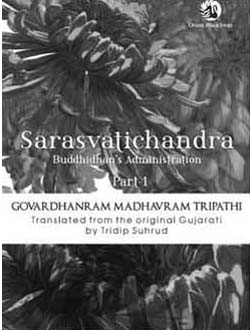
By Govardhanram Madhavram Tripathi . Translated from the original Gujarati by Tridip Suhrud
2015
Hailed as a landmark literary work, a milestone in the literary history of Gujarat, Sarasvatichandra, Govardhanram Tripathi’s magnum opus is now available in English translation (coincidentally, all the four parts of the novel have been translated into Hindi at this juncture), after 128 years of its publication in Gujarati. It is but natural for the discerning reader to wonder why it was not translated for these many years.

By Santhosh Kumar . Translated by P.N. Venugopal
Reading Island of Lost Shadows takes one compulsively back to Joseph Conrad’s Heart of Darkness. A century and a half after the publication of Conrad’s masterpiece, here is another novel, set in Kerala, a continent away from Conrad’s Africa, that probes the ability of power to corrode the human soul. A boat journey across a river, a headless trunk of a pig washed down the stream, the mysterious figure of Karadi Papa (more a myth than a man), the impaled head on the gates of the Meledathu tharavadu, the tribal Paniyas with their chants, songs, and rituals—all bring to mind a Conradian world of darkness, mystery and, more than anything else, horror.
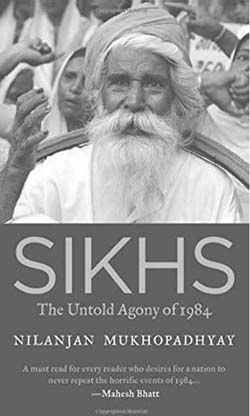
Nilanjan Mukhopadhyay
The wounds may have healed to an extent but the suffering is relived and borne again and again by the affected families and through them, by their younger generations. The Sikhs who faced the terror and shame of the 1984 riots have found a voice in this book which Nilanjan Mukhopadhyay, a well-known journalist and political commentator, has written almost three decades after the horrifying event. This is no fiction! Even the people whose stories he narrates have not been given any fictional names.
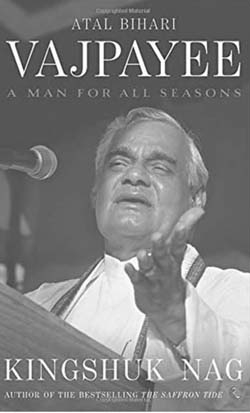
Kingshuk Nag
In the year 1996 during an election rally in Lucknow when Atal Bihari Vajpayee stepped on the stage the excited crowd chanted, ‘Hamara PM kaisa ho, Atal Bihari Jaisa ho’. Vajpayee retorted in his characteristic style, ‘Arre PM chodo, pahle MP to banao’. What followed was another round of applause and cheers. Such rallies became Vajpayee’s trademark where he used wit and humour to strike a chord with his listeners instead of empty promises.In his sixties, Vajpayee had a huge following of youngsters who had been brought up in Uttar Pradesh and other States of the Hindi heartland of 1990s and had grown up listening to his poems and anecdotes.
Neerja Singh
Since the days of her research under the late Professor Bipan Chandra in the 1980s to the publication of Patel, Prasad and Rajaji: Myth of the Indian Right, Delhi University historian Neerja Singh has been engaging with the ‘right-wing politics in the Congress’. Critiquing the ‘Left’ historiography for clubbing Sardar Patel, Rajendra Prasad and Rajagopalachari under the Right Wing fold of the Congress, she offers the argument that these three key leaders of the Congress.
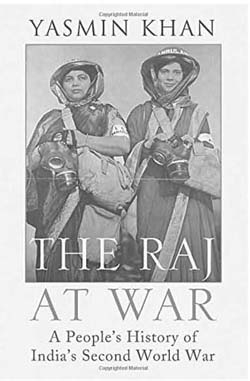
Yasmin Khan
The Raj at War: People’s History of India’s Second World War by Yasmin Khan, an Associate Professor of history at the University of Oxford and a winner of the Royal Historical Society’s Gladstone Prize, 2007, indeed justifies the prestigious award by being another magnum opus after The Great Partition. History from below was the project of subaltern historians during the 1980s, which was a paradigm shift in the study of history itself, by giving due attention to the excluded and marginalized voices and recognizing their important contribution in our society. The Raj at War does not claim to be one such text but it is written on similar lines.
By Sachidananda Mohanty
Odisha and Odiya language faced a crisis in the second half of the nineteenth century. Institutions and dispositions introduced by colonial modernity had produced a crisis of survival and autonomy before the Odiya speaking gentry. The new system of education, style of governance, use of technology, maritime trade, new revenue regulations, modern science and healthcare practices, and even food and other articles of consumption and new forms of entertainment, had unsettled a traditional social order. The Odiya literati responded to this crisis in several ways.
Satish Chandra
There are certain books that never lose their charm and value despite the passage of time. It is mainly because of the intellectual stimulation their contents give us and the variety of academic debates they initiate. One of such works is Essays in Medieval Indian Economic History edited by Satish Chandra. This volume being a collection of representative articles taken out of the Proceedings of the Indian History Congress (1935–1986) and originally published in 1987 as a part of the Golden Jubilee Celebrations of the Indian History Congress,
Meenakshi Thapan
The volume under review is a compilation of much that has been published as research papers on Indian education since 2000. They have a very contemporary location in terms of the importance of ideas being discussed, and also the academic relevance of what has been included. Although put together as a reading in the disciplines of Sociology and Social Anthropology, much of the discussion in the introduction as well as in a variety of papers transcends disciplinary boundaries, and poses therefore the challenge of what the integrating framework should be like.
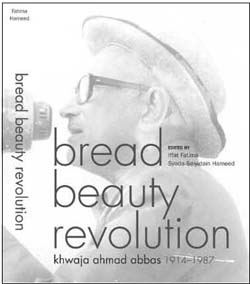
by Iffat Fatima and Syeda Saidain Hameed
Khwaja Ahmed Abbas donned many hats in his lifetime which includes writing poetry, short stories, novels and making films. For the uninitiated, K.A. Abbas was an active member of PWA and one of the founding members of IPTA. With the corpus of 74 books, 40 films, 89 short stories and 3,000 or so from his column writings, Abbas Sahab’s writings constitute a treasure-trove of information on the evolution of the idea of India. At the time of writing one of his last columns for the Blitz, Abbas Sahab makes an important observation about the then budding journalist P. Sainath—the proof of his astute reading of the media in general and politics in particular.
By Shafey Kidwai
Shafey Kidwai’s book is true to its title and it delivers what it promises. The chapters in this book may have been written over a long period of time but probably the book was waiting for a time when the distinction between literature and nonliterature (read journalism) is not so sharp. A different context would make earlier journalistic writings appear as literature. How do we read the essays of Addison, Matthew Arnold or Sir Syed Ahmad Khan today if not as literature? The two components of the book, literature and journalism, are defined by their textuality, a major point of debate in critical theory today.
Rajen Harshe
The Gypsy in the World of Ideas by Rajen Harshe is a successful attempt at addressing the issues of Indian society, politics, intellectual history and institutions through the perspective that developed consequent upon Harshe’s longstanding experiences as an academician and institution builder. We can find here idea and praxis mixed together creating thoughtful reading for the readers. Breaking the conventional formats it ardently depends on the use of metaphors and poetic symbols.
By Rajib Dasgupta
Let me introduce the book to the readers with an anecdote concerning the subject matter of the book. I joined as a medical undergraduate student at the Delhi’s University College of Medical Sciences (UCMS) in 1986, which by that time had shifted just adjacent to Shahdara in eastern Delhi, within the newly constructed campus of Guru Teg Bahadur Hospital (GTB). Having passed through the humdrum of Shahdara or other crowded and maddeningly chaotic localities of East Delhi to reach the GTB campus, its spacious locale and high rise buildings of the campus were bound to make an impression on any visitor.
Amartya Sen
This is a recent offering by Amartya Sen, who currently teaches economics and philosophy at Harvard University. He was earlier Master of Trinity College, Cambridge and is a Nobel prize winner.The book contains 13 essays, selected and organized by the editors of The Little Magazine, (TLM) who have resisted the urge to make them ‘contemporary’. They are presented in a chronological manner, covering the broad fields of culture, society and policy. An intimately warm, yet gently provocative, foreword by Gopalkrishna
By Bianca Brijnath
Unforgotten is the product of Bianca Brijnath’s doctoral research at Monash University. It can be considered as a significant contribution to anthropological literature on ageing, dementia and its care in India. Though her research is limited to urban middle class (which she acknowledges as a limitation), it is truly revealing in terms of the confined participants and their lived experience with dementia and sevâ. Sevâ a concept which Brijnath explores in all its forms and layers as care work is shaped in everyday family life centred on cooking, feeding and eating; in doctor shopping and looking for an ilâj or cure; and bearing the attended expenses.
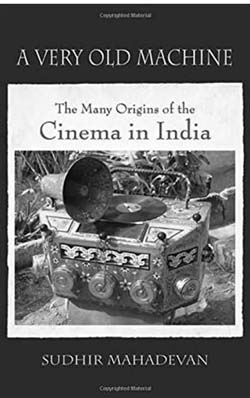
by Sudhir Mahadevan
The picture on the cover of Sudhir Mahadevan’s book is a Bioscope; a techno-material ‘assemblage’ that he will argue is emblematic of film cultures in India. Writes Mahedevan: The Bioscope is the combination of the past and the present. It represents the key symbol of early cinema brushing against new and not so new media. It is the refashioning of an ‘optical device’ of still pictures predating the cinema in the 19th Century, into a source of moving images with the help of home viewing technology and digital formats.
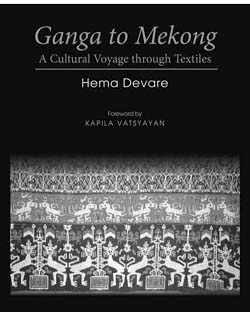
By Hema Devare
As stated by Kapila Vatsyayan, Chairperson, IIC Asia Project in her Foreword, the book is the author’s ‘personal voyage or certainly a journey of exploring and identifying the many levels of communications between India and countries of South East Asia over a long period of history.’ The journey has been lucidly captured in the text that illustrates the large number of colour visuals in the book. Many of these have been sourced from museums in countries of South East Asia during the author’s long sojourns in the region.
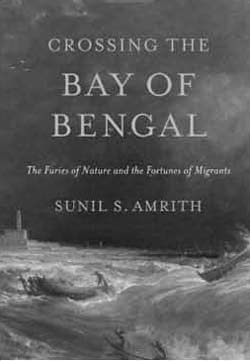
By Sunil S. Amrith
This is a book by arguably one of the best historians of migration of today. It definitely lives up to the fact that it won the American Historical Association’s John F. Richards Prize in South Asian History. The work is of a high scholarly nature, yet it makes you want to read it like a novel reminding one of the narrative genius of the likes of Amitav Ghosh. It is a solid history of migrations around the Bay of Bengal but can be of interest to scholars of environment, geographers and cartographers, not to say to those who are interested in the region itself.
By Meera Nanda
Meera Nanda’s new book continues with her mission to critically examine the interface of science, religion and Right Wing politics in India, which is a highly significant theme today with the growing trend of saffronization of knowledge production. While in her previous works such as Breaking the Spell of Dharma and Other Essays (2002), and Prophets Facing Backward: Postmodern Critiques of Science and Hindu Nationalism (2004), she explored the theme for largely an academic readership, the book addresses the general reader.
By Mohammad Habib . Edited and with an Introduction by Irfan Habib
The work under review is a collection of essays written by one of the well known historians of the Delhi Sultanate, Mohammad Habib. There are eight essays in this collection that deal with the social and cultural transformations in the Sultanate period. Some of these essays have turned out to be quite controversial, and have generated exciting controversies among historians. The essays ‘Sultan Mahmud of Ghaznin’ and ‘Chishti Mystic Records of the Sultanate Period’ have, for instance, been endlessly debated among historians, and we have still not heard the last word on the controversies that surround them.