
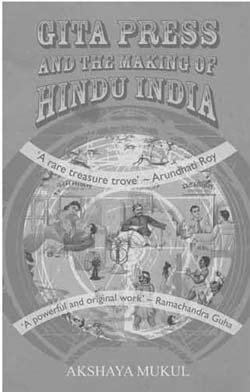
Akshaya Mukul
In 1987, Doordarshan, the state-controlled television network, began to air Ramanand Sagar’s popular show based on the epic Ramayana. Its broadcast was a remarkable departure for a government institution like Doordarshan from the Nehruvian mandate to uphold a secular and modern character and eschew tradition, especially when invoked in the context of religion. The televisual retelling of the epic achieved unprecedented popularity.
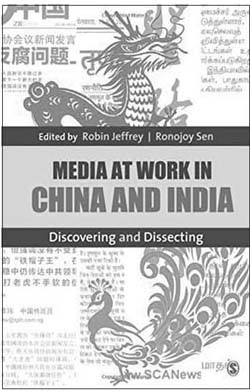
Robin Jeffrey and Ronojoy Sen
This volume offers a comparative perspective of media in two very different countries, and the ways in which they are changing. Eighteen writers—mostly scholars and journalists—bring their experience and differing perspectives to it, and pick a range of subjects to look at, through twin perspectives. The editors devise a structure in which chapters on China and India alternate through four sections which explore structure, reporters, practices and comparative case studies in two areas—social media, and disaster reporting.

Anjum Katyal . Translated by A.N.D. Haksar after Malla
Along with Mohan Rakesh, Vijay Tendulkar and Girish Karnad, Badal Sircar was a preeminent playwright who shaped our modern theatre. Ebong Indrajeet (Evam Indrajeet, ‘And Indrajeet’, 1963) and Pagla Ghoda (‘Mad Horse’, 1967) are undisputed classics of the modern Indian stage, translated into several languages and performed across the country. They blazed a trail, and opened new vistas. Badal Sircar was a playwright of great power and technical sophistication.
Patrick Olivelle
The nature and purport of this book is clearly explained by its title. It is a dictionary in English of technical terms, legal, political and administrative, used in the Sanskrit language.Such works on Sanskrit already exist for grammar and priestly rituals. The most recent are Abhyankar and Shukla’s A Dictionary of Grammar, 1986, and Sen’s A Dictionary of Vedic Rituals, 1978. The need for one on law, statecraft and political science prompted the present compilation, it being felt that technical terms on these subjects were not available sufficiently in standard Sanskrit-English dictionaries.
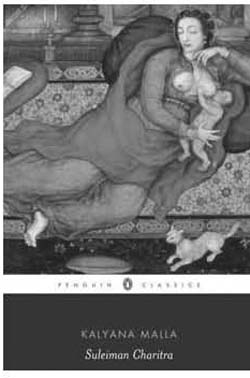
Kalyana Malla . Translated by AND Haksar
2015
Suleiman Charitra is a truly amazing little book. A short work in Sanskrit from the 16th century, it’s title should be enough of a clue to even the casual reader about its hybrid nature. It is a perfectly synthetic work that, on the surface, tells a story from the Semitic tradition in the form of a classical Sanskrit narrative—the Charitra, i.e., the acts of a great man who might be a king, a hero, or even a god. But below the surface, there are currents and eddies, perhaps even whirlpools, that sweep us off our feet and away into an unexpected story land
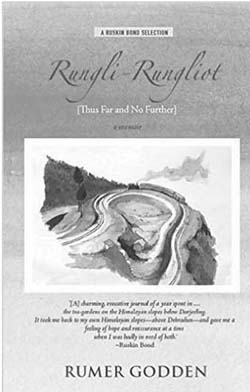
Rumer Godden . Illustrations by Ashis Panday
In Chinglam, most of what I plan comes true and that has seldom happened to me in any other place. The days were stolen before they had begun; I think I never saw a day. When I was a child I remember days that stretched into infinity with the certainty of other infinite days; certain, unhurried and brimmingly full.For the reader, the beauty of life in a solitary mountainous retreat in the North East is evoked in this very image of time hanging so heavy; the author’s day-to-day journal describes small and unrelated acts of quotidian life, human exchanges, and communion with nature, children and animals minutely one after the other as she reminisces about her life as a recluse for a year.
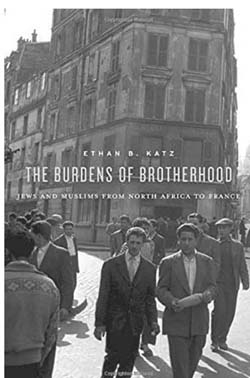
Ethan B. Katz
This study is a broad history of Muslims and Jews in France from World War I to the present times. With half a million Jews and 4 to 6 million Muslims, France is home to the largest Jewish and Muslim populations in Western Europe. It tries to look at how the lives of Jews and Muslims had been entwined on both sides of the French Mediterranean. Historically what we call Jewish-Muslim relations in France were neither inescapably ethno-religious nor necessarily oppositional, rather they interacted on a wide range of terms.
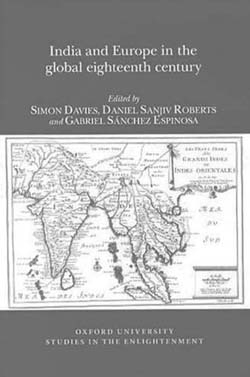
Simon Davies , Daniel Sanjiv Roberts and Gabriel Sanchez Espinosa
The long eighteenth century was a period of major transformation of the relations between India and Europe, with the advent of imperialism. The English justified colonialism by claiming that oriental despotism was replaced by moral and enlightened government. This claim has long been countered by critiques of imperialism. Some of the earliest of these criticisms emerged as early as the eighteenth century, from what may be termed the peripheries of empire, from Irish statesmen and journalists such as Edmund Burke and William Duane, or from the mythologizing of French imperial figures like Dupleix as purveyors of a superior French system of colonialism.
Vidhu Verma
Reading Unequal Worlds by Vidhu Verma is like reading an epistemological ‘post-mortem’ of the societal context which prompted Rohith Vemula to commit suicide. The book unfolds a number of factors which put Dalits and minorities (read Muslims) to ‘social death’ in their everyday life. Discrimination has been direct, indirect, institutional or structural. It can be seen in institutional biases, social closure to maximize rewards by restricting access to resources and opportunities to a limited circle of the eligible (p. 26); through ‘unruly practices’ (gaps between rules and their implementation).
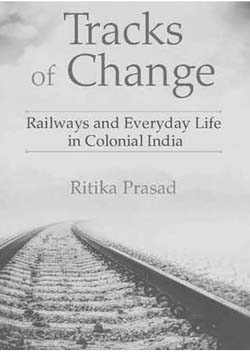
Ritika Prasad
The history of technology in India, and more specifically that of technological transfer from the metropole to colony, has been narrated from a number of perspectives, ranging from critical (technology as disruption) to laudatory (technology as redemption). In the context of the history of the railways in India, Ian Kerr with his Building the Railways of the Raj (1995) and Engines of Change (2007) has extensively mapped the processes by which the railways were planted, and thrived, in colonial India.
Hannah Werner
Development and nationalism were two themes highlighted in March 2016 with two major stories in the national media: the Union Budget Announcements 2016-17 and the uproar over sedition (anti-nationalist) charges on a few students of Jawaharlal Nehru University. Hannah Werner’s book The Politics of Dams also deliberates over the same themes. The author keeps the big dams at the centre of the stage and attempts to analyse developmental aims and objectives of the Indian state post Independence, comparing them with the development aims of the colonial state.
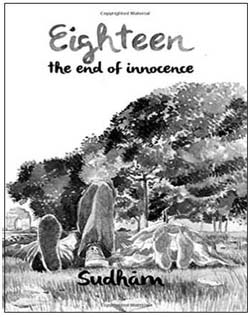
By Sudham . Cover illustration and typography by Arijit Gupta
Eighteen: The End of Innocence is a book dedicated to coming of age. Those sensitive teenage years which oscillate between childhood and adulthood are often beset with physical, mental and social worries. Books dealing with this time of life could be both a guide and friend. Yet there has been a regrettable gap in our literature for the young adult. This vacuum is recently being filled with novels on adolescent years and college life by a host of upcoming young authors.
By Asad R. Rahmani , Zafar-ul Islam, Raju Kasambe, Jayant Wadatka
The three books under review here, all belonging to the Environment and Nature category, cover India’s many protected areas. India has designated its protected wildlife areas as National Parks, Wildlife Sanctuaries, Bird Sanctuaries and Tiger Reserves. Besides this, there are areas that are designated as Important Bird Areas. Similarly, the country’s Western Ghats and the North East are declared global biodiversity hotspots.
By R.K. Biswas
Book reviews often depend on the affinity of the reviewer. The complex text of Indian femininity and feminism is not an easy phenomenon to be codified by any language of art and the art of the written word is no exception. R.K. Biswas’s Breasts and Other Afflictions of Women is a sensational draw for sure. Will it be Indian English’s answer to Eva Ensler’s Vagina Monologues? was the first question to come to my mind.
The eponymous story in this collection—a minor galaxy, to further the metaphor the title introduces—traces an encounter with the last speaker of a language, an elderly ailing woman in an unnamed location. All we can glean is that she is remote—geographically, culturally, and, of course, linguistically—from the team of young researchers who appear with their machines to record that which is inherently impossible—‘speech’ in a language of which she is the last remaining speaker.
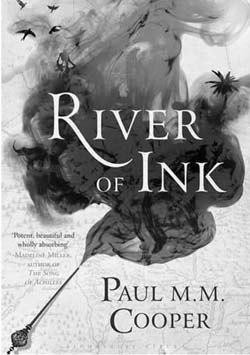
By Paul M.M. Cooper
2016
Paul Cooper is audacious in not only situating his debut novel in as unlikely a setting as medieval Sri Lanka but in constructing it around an ancient Sanskrit poem. His daring choice of context, however, adds to the lustre of the book. River of Ink is a work of abundant creative ability: an adroitly-crafted love story, a morality tale about poetry’s triumph over oppression.
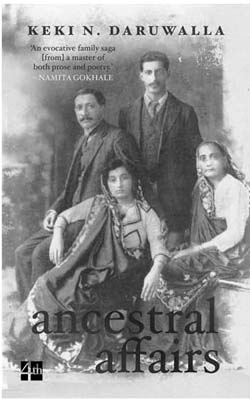
By Keki N. Daruwalla
If I recall right, Keki Daruwalla, a noted poet and writer of short stories, first ventured into the jungle of novels relatively late in life, in 2009, with an intriguing book titled For Pepper and Christ. I am not sure if the book did well in sales. I rather think it did not, although it had much to commend it. The problem was with the way it had been structured. His second novel, Ancestral Affairs, should do better.
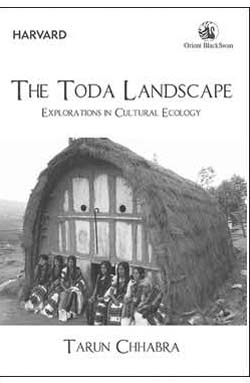
Tarun Chhabra
This monograph is the product of two decades of research by an amateur ethnographer who, based in the Nilgiri Hills, has devoted time both to the study and support of the Toda community. Chhabra’s work with the Todas crosses the spheres of research, advocacy and friendship. In 1992, he established the Toda Nalvazhvu Sangam (the Toda Welfare Society) to mediate between the local government and the community. Much of the monograph has been published elsewhere and the chapters remain relatively discrete but exceptionally rich explorations of particular facets of the Toda community’s cultural and religious life set carefully within the landscape, flora and fauna of the Nilgiri hills.
by Paul Melo e Castro
Lengthening Shadows, an anthology of short stories in the Portuguese-language from Goa, a former Portuguese colony, which covers a period of more than a century, from 1860 to 1980, was edited and translated into the English language by Paul Melo e Castro, an English scholar on Goan literature based at Leeds University. With the exception of ‘The Africa Boat’ by Laxmanrao Sardessai, the stories in this collection were painstakingly compiled by Melo e Castro from Goan newspapers, the Bulletin from the Institute Menezes Bragança (IMB), and private libraries. Therefore, while they are a novelty for the lay reader, they are a real treasure for literary scholars.
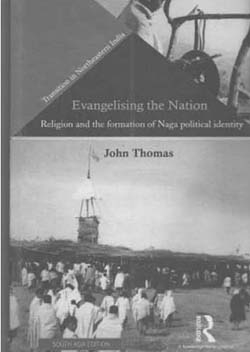
John Thomas
Evangelising the Nation by John Thomas is an important study on the making of the Naga nation, and especially its relation with the (Baptist) Church. There are few works which have critically engaged with this relationship. The book covers the period from the late nineteenth century to the last decades of the twentieth century in five chapters. Broadly, there are two inter-related processes which the book deals with. What is equally notable, as the book shows, is that the two processes emerged almost around the same time.