

By Vinita Bhargava
Probably the first of longitudinal research with adoptive families, the chapter highlights that most adoptees achieve emotional stability, become fully functioning adults, and form stable relationships. Children who struggled in rigid school systems found themselves in creative fields.

By Ananya Vajpeyi
We carry awhile the burden of our Karma like stones; we rise from ashes like jewelled birds; we fly away into the blue, on extended wings’ (p. 5) The extended passage exemplifies Vajpeyi’s mode of writing, in which metaphor and abstraction are mobilized to render ethical crises and human emotional geographies legible.

Edited by Alka Behari
Islamic societies to reiterate that education has always been reduced to social hierarchies, norms and structures. Her revisiting and reconstruction of the apprentice teacher model, and the emergence of normal schools map not only the genesis of the programmes but also the shift in epistemological assumptions such as what counts as knowledge, who is authorized to teach, what capacities a teacher must embody,

By Uma Das Gupta
His approach to nationalism was differently textured, particularly in his two novels, Gora (1910) and Ghare Baire (1916). There, nationalism was neither entirely rejected nor hailed, but it cemented a bond among those fighting for India’s emancipation from the British yoke.

By Hari Kunzru
2024
Centred here, the story moves backwards and forwards to London and New York, and to a few places in Europe and India. It is the time of the pandemic.
Other than those who dominate the writer’s visual canvas, there are characters in the background and the foreground. Each is drawn with a master’s spare, sure touch. But those who rule the canvas are rendered with a magical mix of lucidity and inscrutability. We never know anyone enough,

By Arundhati Roy
What follows is neither a saintly portrait nor a sentimental tribute, but a steady, unsparing account of a woman too forceful to be idealized. At the same time, the memoir reads unambiguously as a record of what Roy has made of her life—of the success, security, and meaning she has accumulated along the way. She animates a private archive she has long mined in fiction, now approached with the directness and vulnerability of memoir

By Inez Baranay
2025
India are used by the author to periodically punctuate the text and convey Halide’s impressions in her own words. In fact, the title itself borrows from Halide’s description of her feelings for India. On the other hand are the three girls: Zoya, making her way from doodling to creating ‘national’ art, Nuran, scholarly and contemplating marriage, and Aisha, who sees herself as a ‘modern’ woman aiming to become a lawyer.

By Paul Waters
While Sister Agatha is a forceful, pragmatic personality, whose ‘outsider’ tag becomes useful, especially in getting access to certain spaces, where her ‘foreigner’ tag and skin colour open doors that may be closed to ordinary Indians. Avtar is the essential counterpoint to Agatha. He is rooted in the history and complexity of Old Delhi, and his own personal experience with displacement allows him to empathize with the missing Pakistani pilgrim. Together this unlikely duo of detective and assistant get caught up in non-stop adventure, starting with a robbery they witness just outside the hotel,

By Abha Iyengar
Iyengar’s women, in particular, stand out. They refuse to remain confined by the roles assigned to them; they are flawed, capable, contradictory, vulnerable, and intensely alive. Though their lives are shaped by limits and pressure, their choices—often brave,

By Salil Desai
The why of the crime becomes more important. However, these sections often err on the side of over-articulation. Motivations are explained and justified at length. In seeking to make the psychology legible, the narrative occasionally flattens it. The repetition of grievance, resentment and self-pity risks turning complexity into monotony.

By Bhavika Govil
her 14-year-old brother who has just entered the ‘Pew Burty Club’, has a bigger share of questions without answers than her even though he is older. Their Ma is a far cry from a typical mother; she tells her children that she picked them from a shop when she was in the mood and had to keep them as the shop didn’t have a return policy. She forgets basic household chores on many days,

By Khalid Jawed. Translated from the original Urdu by A Naseeb Khan
Creating an absurdist world, it is not love but rather hatred and lust that are the clearer emotions in the novel. ‘The lines of love perpetually spiral into a whirlpool. Hatred and lust are better for they never fall prey to misunderstanding and doubt. Their manoeuvres, principles and rules are transparent…. It is love alone that remains trapped in doubt and suspicion, perpetually soaked in fear.’ The narrator celebrates lust.

By Sannapureddy Venkatarami Reddy. Translated from the original Telugu by Narasimha Kumar
it becomes his own creation. The first chapter in the source text raises some fundamental questions the novel raises, of the following of the traditional occupation of tending sheep versus taking up modern jobs and the priorities of people of different generations in the same family. The translator chooses to begin with chapter two in the source text. Unlike the source text that makes the entry of the tiger surreptitiously, even the word tiger is not directly used by the novelist until the fifth chapter and he prefers to use instead the word pedda nakka, the big fox;

By Tho Mu Si Ragunathan. Translated from the Tamil original by Peer Mohamed Azees
Also, the translator Peer Mohamed Azees, might have done well to have given the meaning of those words that require an explanation the very first time they occur, especially the names of the various literary magazines that Pudumaipithan worked for. Also, it isn’t till page 30 that we are informed that Pudumaipithan means ‘the one crazy about the modern’. Equally inexplicably, a glossary is missing;

By Satish Alekar
In substance, the government dominated over society in all the spheres of activities during the pandemic. Alekar further suggests that constitutionalism that respects the division of powers between the legislative, executive and judicial organs of the state and operates through mechanisms of checks and balances has been gradually on the wane in India since 2014.

By Raj Gauthaman. Translated from the original Tamil by S. Theodore Baskaran
The essay on religion from Dalit perspective underscores the significance of religion for Dalits. Moving away from the atheistic and rationalistic critique of Brahminical Hinduism, Gauthaman asserts the significance of folk deities (non-Brahminic) in strengthening Dalit struggle against Brahminism and caste.

By M. V. Venkatram. Translated from the Tamil original by Sumi Kailasapathy
Thus, it was that the Parsis found a home in Gujarat and Jewish traders in Kochi. Within India itself, communities migrated for economic and religious reasons. The weavers of Saurashtra fled their native land after Ghazni destroyed the Somnath temple.

By Santosh Desai
the simple pleasures of the good old khichhadi, the stall for South Indian food with an old but sturdy way of doing business, and the changing design of the kitchens, among others. The essays around work were particularly fascinating for me. Today the job market not only offers different kinds of jobs and modes of work/bussiness but also a more fundamental change in our very attitude towards work. A work-life balance is unfolding.

By Ranjith Radhakrishnan
In the author’s note at the end of the second book, Ranjith highlights his approach to writing about Parashurama after the feedback he received on the first book. At the outset he clarifies that he wanted to avoid writing Parashurama as a mere mortal who later came to be considered as an avatara. Taking creative liberties, which he is upfront in calling out,
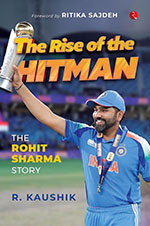
By R. Kaushik
The book is also one of the first to highlight his temperament and captaincy style in detail. It brings out both his meticulous preparation: spending hours in video analysis and attending team meetings with the bowling and batting units even when he wasn’t mandatorily needed, and his people-first management that balances his blunt honesty with backing for his players.