
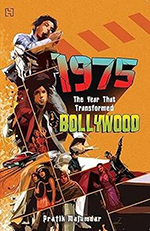
This is an eminently readable book not just for the Bollywood buffs but also the general public. It is timely as this is the ‘Golden Jubilee’ year. The author, a former advertising executive, now running a homeopathy business, describes himself as ‘passionate cinephile’ which comes through in the treatment of the material in the book. In 38 chapters, he gives a thematic bird’s eye view of overtwo dozen films released; the list of all films—released and unreleased—that year; his take on the leading male and female stars, film makers, music composers.
The reviews are brief, sketch the main points of the story, performances, memorable songs and other highlights. They are generally positive, bringing out the context, social relevance of the storyline and distinctive features.
The author devotes a four-page chapter to the impact of the Emergency that lasted twenty months (1975-77) on Bollywood and film making. He reminds us that during the Emergency, film makers and stars faced censorship, demands for conformity and even bans. The original prints of the film Kissa Kursi Ka were destroyed by the officialdom; Gulzar’s Aandhi which had been running for 23 weeks in theatres before the imposition of the Emergency was banned and re-released only after the Emergency was lifted; IS Johar’s Nasbandi was another casualty and banned; Kishore Kumar songs were banned on AIR. Disgusted, thespian Dev Anand founded the short-lived National Party of India.
Despite the restraints, limitations and control, the year saw several blockbusters. The themes were diverse. 1975, the author notes, epitomized the savagery of Sholay as well as the sacred in Jai Santoshi Ma. There were romantic films which led to the emergence of a new generation of romantic stars. The music in the films that year became classics and lives on half-a-century later.
1975 marked the rise and decline of leading stars and ‘super’ stars. The ‘anti-hero’, ‘rebel’ image caught the imagination of the audiences, in particular the youth. The characterization and portrayal of heroines underwent a significant change from the stereotypical signifying the changing, modernizing influences affecting the till-then conservative society. They could be shown as having a distinct personality; smoke, drink and have a live-in relationship. The trend won gradual societal acceptance. A new crop of film directors emerged showcasing creativity, nuance and sensitivity in their storytelling on screen. They read the pulse of the audience well enough to deliver commercial successes and keep the Bollywood story alive. A new generation of music composers with willingness to experiment with compositions and instrumentation created new trends in film music that attracted youthful audiences and compelled them to stay tuned in. A new generation of playback singers took over offering a wider range to composers and audiences.
Each chapter carries ‘Trivia’ about the film. The reader gets to know that in some blockbuster movies they enjoyed, the first choice of leading men and women did not materialize; in some the lead actors forced their way in; how producers used one movie they were producing to publicize another of their productions; how foreign musicians based a song on an Indian composition; songs were recorded but not used in the film for lack of a suitable situation. He recalls that for the iconic role of Gabbar Singh in Sholay, the original choice of director Ramesh Sippy was someone else; it was the established actor’s unavailability that gave a break to a then-unknown actor.
Entertaining in its telling and detail, the book is an enjoyable read.
TCA Rangachari is former diplomat and former Director of the Academy of International Studies, Jamia Millia Islamia, New Delhi.