
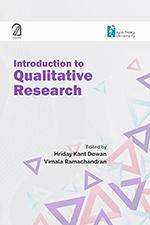
Introduction to Qualitative Research is meant for novice researchers in India. Organized into eight chapters, the volume covers ground from the purpose of research to process tracing.
The first chapter, ‘What is research?’, asks researchers to interrogate their perspectives and assumptions about doing research. The chapter examines both progressive and regressive pedagogical beliefs, critiquing much-used terms like ‘joyful learning’ and ‘teachers as facilitators’ as poorly defined. It is followed by ‘Tracing the path: from a research idea to conducting the research’ which demonstrates research processes through four multi-State studies.
The chapter on ethics in research traces how ethics emerged from biomedical violations and argues that research in the social sciences in India still lacks codified professional ethics. It delineates ethical protocols for social science research, particularly with children from disadvantaged communities. The claim that professional associations and universities have not shown ‘any key interest in developing rules and standards for ethical conduct’ for social science research (p. 73) requires qualification. The chapter on qualitative research methods takes readers through document analysis, interviews, focus group discussions, observations and case studies from Sarva Shiksha Abhiyan research. It positions children as active participants who know, rather than as objects of inquiry.
The chapter titled ‘Ethnographic Research’ engages with the challenges that researchers face in the field. It situates the ethnographic method within Indian contexts, including navigating rural access and caste markers in field sites. The chapter on grounded theory makes a convincing case for the method, presenting its iterative logic through coding and memo writing to theory building. The chapter on randomized controlled trials acknowledges that RCTs are not appropriate for inclusion in a qualitative research volume and subjects the dominant discourse of evidence-based policy to critical inquiry. It questions whether the demand for ‘scientific’ proof of interventions emerges from fiscal centralization rather than epistemological rigour, laying bare the politics of research. The chapter titled ‘Process Tracing’ situates the method within the realist tradition of social inquiry, working through case studies of literacy change in Karnataka and community mobilization in Rajasthan. The narrative shows how causal explanation and storytelling work together.
Reading and reflecting on the volume as a whole raise larger questions for a basic text on qualitative research. We discuss these issues here as a continuation of the dialogue from the volume and a set of suggestions for potential volumes. We take up three axes: epistemic, methodological and political.
What is qualitative inquiry for? The book opens with questions about research that no dataset can answer: ‘Why have certain professions become feminized while girls’ secondary education remains stagnant in certain regions?’ (p. 8). These questions provoke us to think beyond what assessment data measure, and they ask what experience looks like from the inside. Qualitative inquiry is about the quality of experience that cannot be accessed or explained by datasets. The book examines how inequality is not just measured but experienced.
Accessing experience is not a neutral act. It involves power dynamics between researcher and participant, and between the categories through which experience is named. Alongside reflexivity, a qualitative research book in the social sciences needs to engage with the questions of intersubjectivity in knowledge production. A novice researcher must not only examine her assumptions but also reflect on how her presence in the field, her position and her institutional location shape what she can access or know.
This is important because ‘qual’ and ‘quant’ are not a dichotomy. Tools from qualitative inquiry are cultural windows of ‘acceptable possibilities’ (Tateo, 2024). What falls outside that window is not merely absent; it is actively made invisible. For instance, caste may appear to be ‘absent’ in everyday life but can suddenly erupt during crises and events. These epistemological commitments raise methodological concerns about what it means to pursue research with rigour. There is no consensus on what constitutes ‘quality’ in qualitative research. Trustworthiness criteria (Lincoln & Guba, 1985) and markers of excellence (Tracy, 2010) represent one side of the debate. Others argue that any fixed criteria impose a false standardization on qualitative inquiry (Bochner, 2001; Denzin et al., 2023). While the book does not enter this debate upfront, it addresses it implicitly. In refraining from directly stating quality criteria, the volume presents validity as a continuous, recursive practice, one that requires the researcher to articulate their concerns, safeguards, and contradictions throughout the inquiry.
A book on qualitative research needs to scaffold novices in navigating the journey from the field to findings. The book rightly acknowledges that formulating research questions is ‘difficult’ (p. 115). Yet the format for ‘breaking down broad research ideas into specific research questions’ (pp. 49-51) may lead first-time researchers into treating a listing of factors as equivalent to framing a research question. Seeing how research questions, methods, and tools mutually shape each other, how the choice of tools loops back to methods, which in turn refine the questions, would steer this journey more clearly for researchers new to the field. While the first chapter addresses this relationship, subsequent chapters could have drawn on this, with a range of examples. A discussion of the complexities of drawing inferences from observations, interviews or focus group discussions would help novice researchers avoid linear linkages between data and interpretations.
Finally, we turn to the question of politics. Research does not happen outside politics. Wimmer and Schiller (2002) term this tendency to adopt the state’s own categories and priorities as methodological nationalism. Patel (2017) extends the argument to India. When research in education takes ASER data or the National Education Policy as its frame, it operates within value-laden categories and needs to acknowledge the political economy and cultural history embedded in them.
The state also circumscribes research through funding priorities, university guidelines, and defining what counts as a community, learner, or school.
The book illustrates that qualitative inquiry is not as fuzzy and complex as it has been portrayed. It will remain a critical reference for future books on qualitative research methodology in the Indian context.
References
Bochner, A. P. (2001). Narrative’s virtues. Qualitative Inquiry, 7(2), 131-157.
Denzin, N. K., Lincoln, Y. S., Giardina, M. D., & Cannella, G. S. (Eds.). (2023). The Sage Handbook of Qualitative Research (6th ed.). Thousand Oaks, CA: Sage.
Lincoln, Y. S., & Guba, E. G. (1985). Naturalistic Inquiry. Thousand Oaks, CA: Sage.
Patel, S. (2017). Colonial modernity and methodological nationalism: The structuring of sociological traditions of India. Sociological Bulletin. 66(2), 125-144.
Tateo, L. (2024). Fundamentals of Cultural Psychology. London: Routledge.
Tracy, S. J. (2010). Qualitative quality: Eight “big-tent” criteria for excellent qualitative research. Qualitative Inquiry, 16(10), 837-851.
Wimmer, A., & Glick Schiller, N. (2002). Methodological nationalism and beyond: Nation-state building, migration and the social sciences. Global Networks, 2(4), 301-334.