
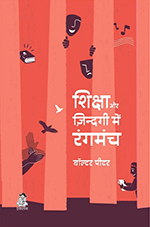
‘Theatre plays a key role in the holistic development of children.’ For some, the statement is well known and for some it is a new idea. Irrespective of your relationship with the statement, if you are looking for ways for children to reflect and understand themselves better, create a safe space for them which helps them express freely, interact with their surroundings and society in a thoughtful and meaningful manner, then this book will interest you.
Shiksha Aur Zindagi Mein Rangmanch is a collection of activities put together for one year’s worth of classes. Walter Peter, the writer of the book, has more than 30 years of experience working in rural and urban areas, in schools, colleges, and in jails, with students and with teachers. He uses the medium of theatre in education for his sessions. The book describes the activities for conducting experiments in theatre.
The initial text in the book, before the description of activities, describes in what way theatre and role-play help in learning, what environment is suitable, dimensions of a room in case of an indoor activity, group size, and even what qualities help the theatre facilitator work well.
The activities mentioned in the book will be useful for not just theatre facilitators, but language teachers, social science teachers and counsellors. Circle time facilitators will also find the activity list valuable. The collection of detailed activities is neatly tucked under four themes that progress from self to society.
Theme 1: I and Us–Us as a group: This theme deals with reflecting and expressing oneself, and in the process, getting to know others present to form an understanding of ‘Us’ as a group. It is to enable appreciation of individual differences and unity of a group.
Theme 2: Our family–World is our home: Various kinds of families, relationships, traditions, practices, and festivals of different areas and backgrounds are explored through this theme in the module.
Theme 3: Knowledge is Base–Learning is World: Learning is not limited to the four walls inside a school, the continuous process of learning happens from various surrounding interactions, and by stepping into various roles.
Theme 4: What constitutes a society: Exploration of the various roles that are there in the society. The activities support reflecting and interacting with roles and labels, to find oneself as an active and thoughtful contributor to the society.
The tremendous work in the book is a detailed logistical guideline for a facilitator who is looking for a guiding path.
However, for me there is still something missing. In spite of the writer’s experience, evident in the detailing of the structure and activities, lived anecdotes with these activities, the writer’s opinions, and facilitator reflections are missing in the book. The responses to the activities would have also helped the facilitators to connect with the idea of why theatre in education is important. Nevertheless, engaging and making use of the activities mentioned in the book hold the possibility of making them one’s own in the classes.