
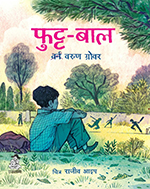
Varun Grover has given us a heartwarming and fun story, accessible and relatable to students of all ages. The brilliant illustrations by Rajiv Eipe add hilarity, joy, and nuance to the book. I would highly recommend this book to all readers, whether children, parents, teachers, or anyone else. It is appropriate for fluent Hindi readers of grade 3/4 and above and can be enjoyed as a read-aloud book for even younger children. I’ll quickly get my one minor gripe with this book out of the way before going into all that I enjoyed about it and that is with the publishers. The font choice in the book is a curiously stylised Devanagari which, while unique, makes the story sometimes difficult to read, especially for younger readers. It is particularly ironic in a story about language and the subtle but crucial differences in how words are said that the readers may sometimes struggle with how those words are read.
That out of the way, this book is a lovely glimpse into a very real set of experiences familiar to school-going children everywhere, and especially to ‘Hindi’ speakers in north India. The Hindi (and English for that matter) that is expected of us in schools is a particular form of the language, but not necessarily one that all speakers of the language use in their homes. This is particularly evident in some interactions we see with the familiar kinds of language teachers who unknowingly make some students’ lives quite miserable. Varun Grover captures all of this wonderfully (and hilariously) in his description of his attempt to shed his Punjabi pronunciation of Hindi words after moving to Lucknow as a child, while also asking a question I find myself asking often: if I am understood, then how does it matter how I pronounce a particular word?
After narrating a classroom experience, there is a page-long ‘digression’ on how Punjabi speakers know the very subtle difference between ‘kada’ (a steel bangle on the wrist) and ‘Kada’ (which is how Punjabi speakers would also pronounce the word Ghada, meaning a clay pot). This digression is in fact a short but loving ode to the Punjabi language: educational, very funny, and beautifully written. The line ‘मान लो िक घ वहीँ है और उसके नीचे तुमने क को घ का हल्का-सा लेप लगा िदया।’ is one of my favourites, so evocative and visual, while also giving us a sense of the nuance of the language. (The line means, roughly speaking, ‘assume that the “gh” sound is right there, and below that you have given the “k” sound the lightest coating of “gh”.’)
Along with this, it is also a story that authentically captures how students interact and engage in classrooms: the quick mocking, the attempts to fit in by allowing oneself to be the butt of the joke, the gradual adaptation to a new style of speaking as the author adjusts to life in Lucknow. And as we see how sometimes those who are bullied can become the loudest bullies themselves, we also see an easy model of empathy, without hitting us over the head with a moral lesson.
A particular highlight is the anecdote of the English class where the author learns Coleridge’s famous poem ‘The Rime of the Ancient Mariner’. The poem becomes a metaphor for the author’s own journey with learning these new languages and registers, and the whole scene is wonderfully illustrated by Rajiv Eipe. In fact, the illustrations are phenomenal throughout, beautifully depicting the many aspects and nuances of the narrative, all while adding small elements to give the reader even more moments of joy. For instance, as the story progresses, we also see the characters grow up and experience the awkwardnesses and joys of adolescence, relationships between boys and girls in the classroom evolve, all unwritten but fully depicted through the illustrations. There are a couple of pages of illustrated ‘dialogue’ where the author is coming to grips with the titular word ‘Football’ that are quite frankly genius. I defy anyone to look at those pages without giggling.
A truly wonderful story that all readers can relate to, one which can also raise important questions for us regarding what we think of as the ‘right’ way to speak a language.