
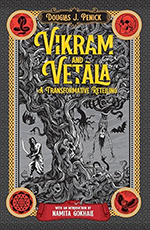
Even though this book has no illustrations, its cover (by Saurav Das and Mohit Suneja) conveys its sombre mood by bearing the corpse hanging upside down from a twisted tree, the hero King Vikram with his open scimitar, the face of the tantric who is the villain of the piece, a yantra, a skull, an owl, a snake, a crow and a pair of measuring scales. True to their commitment, HarperCollins Publishers have here presented one of the finest and oldest works from the subcontinent. By and large, most Indians, young and old, have some idea of the stories. In various languages, in various circles, they have gripped our minds over the centuries. Ishwar Chandra Vidyasagar himself had written an abridged Bengali version of them in 1847 (as an additional textbook requested by the Principal of Fort William College, Calcutta).
Douglas J Penick, though published widely, has done well to provide a Prologue where he speaks about his mother’s ‘legacy’ as well as his being ‘ensnared’ with the twenty-five Vetala tales (p. xviii).
The Introduction by Namita Gokhale rightly emphasizes its narrative structure of ‘frame stories’ and its intriguing quality of ‘ambiguity’ with respect to the ‘conundrums’ ethical, moral, legal, human, and even of the spirit-world (pp. xiii-xiv). There is no one particular solution to the quiz that the Vetala poses to Vikram and perhaps that is why even now it fascinates us. As Namita Gokhale says, Penick’s rendition is a ‘multilayered retelling as it addresses the riddles of life and death and the worlds beyond’ (p. xvi).
In the book, King Vikram got pledged to the ascetic or yogi Ksantisila to fetch him a corpse that was hanging upside down in the forest adjacent to a cremation ground. Vikram discovered the corpse to have been occupied by a spirit, the Vetala. It refused to go along with Vikram without making him listen to stories that it had to tell. At the end of each story, Vikram had to answer the query that formed its tailpiece. He had to exercise his judgment and answer the query right, else the consequences would be terrible. He did not have the right to have the correct answer and yet keep quiet—else the consequences would again be disastrous. This kshurasya dhara or Razor’s Edge was the path he had had to tread in his misty journeys through the forest while the Vetala sighed, hissed and whispered on his back.
Penick has retold the stories competently, adding his own dark colours to the rendition, until at the end of the twenty-fifth story he comes to the query to which Vikram genuinely had no answer. Penick has then taken Vikram and his spectral companion to the macabre yet clever denouement of the whole narrative. His rendition is correct as per available texts but perhaps he could have pointed out the link with the Truth that is there in the narrative, which is why, though fictitious, King Vikramaditya became so important to the Indian psyche. The stories in themselves are very well known and yet retain their quizzical element. But there is more to the series as a whole in terms of its dedication to good governance, courage and rectitude.
Vikram and his wispy grey burden have inspired contemporary forms such as graphic literature and films. Penick’s English retelling has certainly added to it. It has broadened the access of children to their world heritage beyond international boundaries of land and language.
However, publishers, parents and librarians must present such books to children with a note of caution. The yogi or tantric Ksantisila is the real diabolical spirit in this book—not the Vetala who is a benign spirit, friendly to humans and supportive of Truth. Look at the number of crimes that take place in present-day India for special powers that godmen say they possess and delude the gullible even into making human sacrifice. Perhaps some sort of a statutory warning should be a part of books that refresh ideas of such practices.