
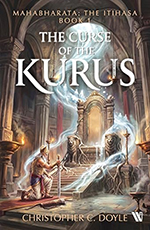
In this first book of a series, Christopher C Doyle takes a fresh look at the Mahabharata, the epic that in the recent past has been receiving enormous attention. He focuses on how a curse that Sage Vashisht put on the eight Vasus or demigods changed the course of the Kuru vamsha leading to the explosive Kurukshetra War. Two decades of research and study (Acknowledgements, p. 426) have resulted in this book and others like The Mahabharata Quest and The Pataala Prophecy. Doyle’s training in management at IIM Calcutta, I feel, has helped in restructuring the age-old available material, which is a collection of the rambling tales of bards, even charioteers, narrated on the occasion of long yajna ceremonies, and not systematically arranged. As the author points out, the story of the birth of the Pandavas is narrated in the Adi Parva whereas that of their elder Karna is brought up only in the Vana Parva. Again, Amba is introduced in the Adi Parva but her rebirth as Shikhandi is dealt with in the Udyoga Parva (p. ix). This happened to be India’s own way of storytelling, but a chronological rearrangement is certainly of value.
The Prologue (pp. 1-6), as dated by Doyle at 4000 BCE and placed at Mount Meru, deals with the pronouncement of the Curse. Doyle starts his first chapter (pp. 7-10) in 3305 BCE, in the Hastinapur forest, traces of which still remain near Meerut. Here King Shantanu of Hastinapur meets Goddess Ganga, and the inheritance of the Kuru kingdom passes from Prince Devavrat who eventually becomes Bhishma Pitamaha.
Doyle ends Chapter One Hundred and Two (pp. 395- 398) in 3188 BCE with King Pandu being cremated at the gates of Hastinapur and the widowed Kunti entering the palace with five orphaned sons born of gods rather than of Pandu. Pandu’s elder brother Dhritarashtra has a hundred sons already, entirely human, with the eldest Duryodhana older than Yudhishthira, the eldest of Kunti’s five sons. The Epilogue of Doyle’s book (pp. 399-405) ends with Dhritarashtra and Kunti both worrying about the future of Hastinapur.
It is still a long way off the eventual end of the Mahabharata that we are used to, which constitutes the beginning of the epic, with bards narrating it to those attending the yajna ceremonies of Janmejaya.
Sequels from Doyle are clearly due to follow.
The text, a little copious, is written in simple and readable language. The Author’s Note (pp. 406-411) and The Glossary (pp. 412-424) help young readers who lack the background to the Mahabharata. A few illustrations could have helped. Apart from chronological rearrangement, Doyle has provided innovation of content without transgression.
Right at the start, Doyle has said, ‘I have chosen to stay faithful to the original plot and text of the epic. I have used fiction to fill in the gaps in the life histories (biographies) of some of the characters and I have written dialogues that are not there in the epic, but everything is based on what the Sanskrit shlokas actually tell us. In doing so, if I have demolished some of the myths and incorrect perceptions about the stories of the Mahabharata, it would give me great satisfaction’ (p. x). But how can he lay claim to being a myth-buster if he admits to taking ‘creative liberties’ (p. 406), as done by others in other retellings? Such liberties are fine, as long as readable and credible. But for authenticity we must go by The Critical Edition of the Mahabharata by the Bhandarkar Oriental Research Institute (BORI) alone.
The Mahabharata is ours to re-read, re-imagine and re-write. From Bhasa’s plays Urubhanga and Karnabhara, Rabindranath Tagore’s poems Karna-Kunti-Samvad and Gandharir Avedan, to Lila Majumdar’s hilarious Baka-vadha-pala, Tripti Mitra’s emotion-charged Nathavati Anathavat or even Shashi Tharoor’s The Great Indian Novel, all qualify as Mahabharata literature as a conglomerate. Why limit ourselves to ‘critical editions’? Improvisations, adaptations and re-interpretations have every right to supplement it. But then why use the word ‘Itihasa’ (Iti-ha-asa, ‘This indeed is what it was.’) as part of the title of this series?