
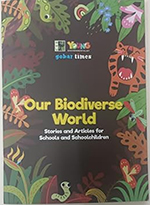
In an era when environmental education oscillates between alarmist rhetoric and dry scientific facts, the Centre for Science and Environment’s Our Biodiverse World: Stories and Articles for Schools and Schoolchildren attempts a more nuanced approach. This compilation draws from nearly a decade of Gobar Times publications (2016-2025), seeks to bridge the gap between academic ecology and lived experience, positioning biodiversity not as an abstract concept but as an integral part of human existence.
The volume’s greatest strength lies in its deliberate choice to centre narratives over statistics. Rather than overwhelming young readers with species counts or extinction rates, the book presents biodiversity through the eyes of indigenous communities, grassroots conservationists, and ordinary people whose lives are intimately connected to the natural world. This narrative framework acknowledges an important pedagogical truth: environmental stewardship begins not with fear but with wonder and connection.
The decision to curate content from Gobar Times, a magazine with an established reputation for accessible environmental journalism, is strategic. The articles carry the magazine’s characteristic blend of scientific accuracy with a flair for storytelling. Spanning nine years of publication, the collection also creates a temporal dimension, allowing readers to trace the evolution of environmental discourse in India over nearly a decade. This chronological breadth, though not explicitly emphasized in the book’s structure, adds depth to discussions around conservation challenges that have both persisted and transformed.
CSE’s emphasis on traditional ecological knowledge deserves particular attention. In a field often dominated by Western scientific frameworks, the book’s integration of indigenous wisdom offers a refreshing and necessary counterbalance. The stories of communities who have maintained sustainable relationships with their ecosystems for generations serve as powerful reminders that biodiversity conservation is not a modern invention but an ancient practice that contemporary society has largely forgotten. This approach also implicitly critiques the colonial erasure of indigenous knowledge, though one wishes the book had made this critique more explicit.
However, the publication’s pedagogical ambitions reveal certain tensions. While designed as an educational resource for schools, the book straddles an uncomfortable line between being a teaching aid and a standalone reader. Teachers seeking structured lesson plans or assessment frameworks will find themselves needing to supplement the material considerably. The book provides excellent raw material for classroom discussions but stops short of offering the scaffolding that would make it immediately usable in diverse educational contexts. This is particularly problematic given India’s vast disparities in teacher training and resource availability across different school systems.
The illustrations, described as rich and accessible, appear to serve a dual purpose: they make the content visually appealing while also functioning as educational tools in their own right. Visual literacy in environmental education cannot be understated, especially when communicating with students who may have limited direct exposure to the ecosystems being discussed. Yet without access to the physical book, one cannot fully assess whether the illustrations genuinely enhance understanding or merely decorate the text.
One of the book’s implicit arguments is the democratization of environmental knowledge. By targeting school-age readers, the organization acknowledges that environmental literacy must begin early and cannot remain the purview of specialists. The accessible language and engaging narratives lower barriers to entry, potentially reaching students who might otherwise find environmental science intimidating or irrelevant to their lives. This democratizing impulse is commendable, though it raises questions about depth versus breadth. In making biodiversity accessible, has the book oversimplified complex ecological relationships?
The timing of this publication is significant. Released in 2025, the book enters a world where biodiversity loss has accelerated to crisis levels, where climate change has made ecological unpredictability the norm, and where young people worldwide are increasingly vocal about environmental justice. The book’s attempt to inspire ‘critical thinking, ecological sensitivity, and a sense of responsibility’ responds to this moment, but one wonders whether inspiring responsibility without providing clear pathways to action might leave young readers feeling overwhelmed rather than empowered.
A notable absence in the text is any discussion of urban biodiversity or the relationship between urbanization and ecosystem health. Given that India’s urban population is rapidly expanding, and that many students using this book will be city dwellers, this seems a significant oversight. The focus on ‘indigenous communities and grassroots conservationists’ is valuable but risks reinforcing the false dichotomy between nature and civilization, as if biodiversity exists only in distant forests rather than in the cities where most students live.
The book’s value ultimately depends on how it is used. In the hands of a skilled educator who can contextualize the stories, facilitate critical discussions, and help students make connections to their own lives, it could be transformative. Used in isolation, without that pedagogical scaffolding, it risks becoming just another well-intentioned but underutilized resource gathering dust on school library shelves.
Our Biodiverse World represents CSE’s continued commitment to environmental education and its recognition that the next generation holds the key to conservation success. While the book could benefit from more explicit pedagogical structure and a broader conception of where and how biodiversity matters, its fundamental approach which moves along the axis of privileging stories over statistics, traditional knowledge alongside scientific understanding, and connection over fear points toward a more humane and potentially more effective environmental education. Its success will depend not just on what’s printed on its pages, but on the conversations that these pages will inspire in classrooms across India.