
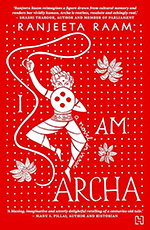
I am Archa is Ranjeeta Raam’s inspiring, crisp and delightful retelling of a centuries-old tale, the ballad of medieval Kerala’s warrior heroine, Unniarcha, the daughter of a highly renowned Kalaripayattu teacher. Set in Kadathanadu (North Kerala), Ranjeeta shows how Kalaripayattu is not just a martial art here but a vital element of the socio-cultural fabric, a way of life. And for 12-year-old Unniarcha, Kalaripayattu is her lifeblood. She wants to be a brave, fearless and invincible warrior whose name and reputation, like her father’s, will evoke fear and admiration. While her strict but loving and encouraging father, Kannappa Chekavar, realizes her potential and supports her in her ambition, her polite but firm mother doesn’t fail to remind her of the reality about marriage, household chores and familial duties. The boys who train under her father taunt her saying girls aren’t sent to fight duels and belong in the kitchen. Almost everyone except her father, her elder brother Aaromal and her paternal cousin Chandu (her father’s two favourite students) drives home the point that not lunges, jumps and squats, but giggles and gossip are better suited for girls. Torn between dreams and reality, with a myriad ‘whys’ buzzing in her head, Archa wonders what her future has in store for her when a cruel twist of fate opens up a path to realize her dream. Lies, deceit and betrayal push the cheerful and prosperous Kannappa Chekavar’s Puthooram House into darkness. And the responsibility of bringing light back into their lives, avenging the wrong done and resurrecting the lost glory rests with young Archa. How she fearlessly tackles every challenge head-on and moves one day at a time makes for an engaging read.
The book celebrates valour, resilience and undying passion to achieve one’s goals and dreams. The prose in verse style bundles elegance with economy. In sections titled ‘Chandu’s Effect’, ‘Trapped and Whirlpool of Delicious Brown’, the verses are packed intelligently to reveal underlying emotions. Sharanya Kunnath’s illustrations complement the text well. Be it the description of chuvaddukal, vadivukkal (stances and basic steps of Kalaripayattu), of weapons used or of Ayyappa festival, the author draws a fine and authentic portrait of life in the region. The end notes reveal what inspired the author to imagine and write Archa’s life the way she did and how her work is backed by thorough research. Beginning with a heartwarming dedication and a glossary of terms coming handy at its end, I Am Archa is guzzle-worthy from start to finish, an uplifting tale about living life on one’s own terms.