
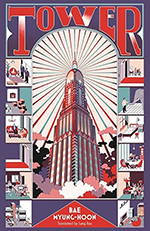
Award-winning writer Bae Myung-Hoon’s novel, Tower, is a work of speculative science fiction that draws strong political and social connections with the real world. The ‘Tower’ is a 674-storey high skyscraper called Beanstalk that functions as a sovereign nation with a population of approximately 500,000. The book comprises six stories set within Beanstalk. Each of these interconnected stories explores themes of bureaucracy, authoritarianism, and isolation in modern societies.
The first story, ‘Three Wise Recruits’, studies political relationships within Beanstalk through GPS-tagged wine bottles that are gifted among the elite in the tower. The researchers attempt to map power networks and centres of concentrated power within Beanstalk by tracking the bottles. The story addresses ideas of manipulation, commodification of relationships and surveillance within the tower.
In the second story, ‘In Praise of Nature’, the reader is introduced to terraphobia, a fear of the ground that stems from living in a colossal high-rise. Citizens of the nation rarely step outside the tower, leading to alienation from nature. Dependence on an artificial environment arises from living in a hyper-modern society. A similar theme is also covered in ‘The Buddha on the Square’, where an elephant is brought to Beanstalk. Most people have never seen an elephant in real life and are amazed by the size and space it occupies in the building corridors. The story is written completely as an exchange of letters between a security guard in Beanstalk and his sister-in-law. It also explores the themes of family estrangement and isolation. Almost all stories in the book explore absurdity in governance, drawing parallels with existing government functioning.
Alongside misplaced priorities and bureaucratic inefficiency, ‘Taklamakan Misdelivery’ presents a story of a pilot who crashes in a desert. A privately set up website, satellite imagery, and a collaborative effort by citizens around the world help locate him. The story highlights the vulnerability of human life and how people come together when governments fail to protect their citizens.
‘The Elevator Manoeuver Exercise’ presents an interesting tale of a civil servant in Beanstalk. His role is to monitor strategically and design movement within the tower, including in crisis situations. The story presents the ideological conflict between two groups: ‘horizontalists’ and ‘verticalists’, each defending their view of social life in the tower. In contemporary times, this seems to closely resemble the real world.
Critiquing authoritarian conformity, ‘Fully Compliant’ talks about regimentation and control within Beanstalk. Citizens are pressured to agree with the government, and compliance is seen as essential to survival. The story also brings to the fore international relations and diplomacy as the nation grows financially.
While each story is independent, they share the same context of Beanstalk as a nation. They also share the common satirical sharpness towards absurdity in contemporary governance. Contextualized in Korean socio-political realities, the stories also show how larger geopolitical issues impact the everyday lives of ordinary citizens. To fully appreciate the book, readers would benefit from an understanding of Korean history and everyday life. For readers in late adolescence, this book will serve as a good read that blends science fiction with social realities.