
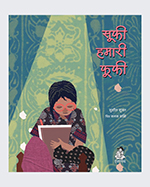
The hand-drawn collage work, with its folk-inspired aesthetic, draws you straight into a warm Indian household wrapped in traditional handcrafted textiles like ajrakh, ikat, and kantha prints. The vibrant paper cutouts add a layered texture and depth that make the reading experience even richer.
The story follows a woman writer and her young niece, who watches her aunt with quiet admiration, praising both her writing and her spirit. Written in Hindustani, the story is dotted with delicately chosen Urdu words that lend it a charm and tenderness. It also breaks a familiar stereotype—portraying a husband who supports his wife’s ambitions as a writer and treats her with genuine respect.
At its heart, this is a story about a young girl looking up to her aunt—a woman who follows her passion, is unapologetically ambitious, and carries within her stories from around the world. What struck me most was its central theme: a woman from a minority community becoming a source of inspiration for a young girl to dream freely and follow her heart, in a world that doesn’t always make space for people from minority communities to do so.
This makes the story an important addition to children’s literature—offering young readers, especially young girls from minority communities, a window into being themselves, and the courage to dream, create, and pursue what they love with freedom and confidence. It quietly challenges the patriarchal mindset that so often stands in the way of these dreams.
Simple yet powerful, written in a poetic Hindustani style, this is a story you’ll want to read again and again. It’s short, lyrical, and carries a strong social message—one that isn’t stated outright, but unfolds gently through the voice of a young, aspiring girl. The affection the girl holds for her aunt gives young readers an easy point of connection, since children so often look up to and follow their role models.
A Muslim woman living life on her own terms—with freedom, choice, and the courage to pursue what she loves, while quietly becoming someone’s role model—this is the subtle message that settles, almost unnoticed, into a young reader’s mind.