
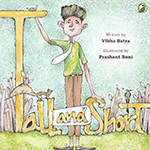
Few pressures weigh on a child more heavily than the desire to fit in, and few things expose that pressure as plainly as looking different from everyone else. Author Vibha Batra and illustrator Prashant Soni address this sensitive reality in their picture book about Kabir, a boy conspicuously taller than his classmates. His height becomes a hurdle as he struggles to fit comfortably at his desk, stands apart from his classmates in the class photograph, and is routinely sent to the back of the line.
The story opens with Kabir’s reluctance to attend school: ‘No, no, no! I don’t want to go.’ His anxieties seem justified as his classmates tease him with towering monikers such as ‘Qutub Minar!’ and ‘Bamboo!’ Across these moments, his recurring refrain, ‘Why am I so tall?’, captures his self-consciousness.
The book’s premise is neatly encapsulated on its back cover: When faced with a problem ‘as tall as the Kanchenjunga’, how can a boy stand tall? Since his height cannot be changed, the question becomes not how to alter the problem, but how Kabir might respond to it.
A turning point occurs when another teacher places Kabir in the front row, and he discovers the advantages of his height as he easily reaches the top of the blackboard and is given the opportunity to lead his classmates. His anxiety quickly dissolves, and he runs home declaring, ‘Run, run, run! School is fun!’
Vibha Batra’s simple, repetitive text, with phrases such as ‘Sit, sit, sit’ and ‘Send, send, send’, creates a rhythm well suited to young readers and also reinforces Kabir’s frustration. Prashant Soni employs a whimsical, caricature-like style to convey the boy’s physical distinctiveness and emotional isolation. His exaggerated, elongated limbs are comically out of scale, visually depicting his sense of being out of place. The illustrations also give the teasing scenes a lively energy without losing sight of Kabir’s discomfort.
The book’s primary shortcoming is the swift resolution, with Kabir moving from distress to delight once his height proves useful, without much inner reckoning or an answer to the teasing. The back-cover question promises a deeper case for self-acceptance than the story provides. Still, this is a minor reservation in an otherwise well-conceived and visually engaging book.
The final page offers a wry twist when Kabir, surrounded by taller people, wonders, ‘Why am I so short?’, suggesting that insecurities can shift with perspective. In that sense, Tall and Short offers an easy conversation starter about appearance, peer teasing, and self-image while encouraging children to see perceived shortcomings as strengths. It would be a welcome addition to primary school libraries and early-childhood reading lists.