
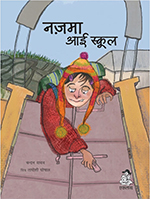
Najma Aayi School, a story set on a very cold winter morning, shows a girl named Najma who has a strong love for school and studies and is deeply committed to her education. Chandan Yadav’s language is very close to the world of children. He uses simple words and words from the Bundelkhandi language, such as chaddi-baniyan, thithur, naga, nasaini, and basta. These words connect the story with children’s everyday experiences and surroundings and make the story easy and comfortable to read.
The illustrations by Taposhi Ghoshal make the setting of the story, cold weather, fog, and early morning atmosphere, all come alive. I especially liked the picture in which Masterji reaches the school and marks his attendance by climbing the nasaini (ladder).
A school is not only a place for studying and learning but also a place for children to socialize, build connections, and develop trust between teachers and students. The children come to school with so much excitement, but the teacher’s attitude in the story is discouraging. As a facilitator, there are a few things that need to be kept in mind while taking this book to children or using it in a workshop. It is important to listen to children’s experiences. Before discussing the story, the pictures can be used to help children read and understand the story. Children should be given enough opportunities to express their thoughts. It is also important to create an environment where every child feels comfortable talking openly about school, teachers, their fears, and their excitement.
Najma’s home and school are located in a forest area. When Najma comes to school, she does not come only as a student. She also brings the influence of her village and surroundings with her. Her presence brings changes to the old ways of the school and society. It raises new questions and brings changes in people’s thinking about girls’ education.
The story gives a message about gender equality. It shows that girls can overcome the restrictions and difficulties that come in the way of their education and create new paths towards their dreams.
This book is also important because adults sometimes fail to understand why a child cries when asked to go to school, feels afraid, or wants to stay away from studies. This story gives adults an opportunity to understand children’s mental stress, emotions, and perspectives more closely. Perhaps this is what makes the story so beautiful. While reading Najma’s story, we do not only see her experiences; we also begin to remember our own childhood and school experiences. This connection makes the book meaningful not only for children but also for adults.